AMSTERDAM — In an era dominated by hyper-accelerated digital culture, flat algorithmic imagery, and a pervasive societal detachment from the physical world, Dutch contemporary artist Sandra Keja Planken is carving out a radical space for friction, feeling, and form. Operating across the boundaries of textile, glass, and immersive installation, Planken creates works that defy easy categorization. They sit uneasily—yet captivatingly—somewhere between organism and object. Her woven structures pulse like living tissue, while her glass sculptures possess a fluid, malleable quality that suggests they might yield to the touch at any moment.
Planken’s artistic practice is anchored by a single, urgent preoccupation: investigating how sensory experience, tactility, and material presence can restore emotional connection within an increasingly mechanized and digitized world. Far from producing passive objects for silent contemplation, Planken engineers breathing, shifting environments that demand physical engagement, psychological surrender, and an acute return to wonder.
Main Facts: The Anatomy of a Living Practice
At its core, Sandra Keja Planken’s work is defined by a deep synthesis of traditional craft techniques and avant-garde ecological science. Based in the Netherlands, her portfolio spans monumental woven tapestries, fragile glass sculptures, and sprawling, room-sized environments that blur the lines between dreamscape, memory, and ecological body.
Media and Materials: Planken works primarily with recycled and donated textiles, mixed fibers, custom-blown glass, and industrial ropes. Her materials are frequently sourced from discarded wardrobes and forgotten factory stocks, imbuing every thread with a pre-existing history.
Core Philosophy: The artist posits that contemporary art must serve as an emotional and cultural counterweight to societal speed and sameness. By prioritizing tactility and material vulnerability, she seeks to slow viewers down and reawaken their sensory intelligence.
Signature Project: Her acclaimed installation, Weaves of Saltwater Dreams—showcased at BIG ART Amsterdam in collaboration with ValorosaViva—serves as a primary touchstone of her career. The piece merges submarine cartography with textile sculpture, functioning simultaneously as high art and active ecological intervention.
Real-World Impact: Through her ongoing conceptual universe, Nature’s Visual Sound, Planken collaborates with scientific institutions like the University of Wageningen and the Branch Foundation. Together, they utilize her glass and textile structures as experimental, temporary habitats designed to foster the growth of heat-resilient algae and corals on the seabed. Ten percent of proceeds from every artwork acquisition are funneled directly into this underwater reef restoration initiative.
Chronology: The Evolution of a Sensorial Vision
To understand Planken’s unique material vocabulary is to trace a cross-cultural upbringing and a deliberate, decades-long evolution through various mediums.
Roots in Contrast: Formative Years
Planken’s artistic sensitivities were forged in early childhood, growing up caught between the emotional warmth and cultural openness of Spain and the quiet, structured restraint of Northern Europe. This bicultural upbringing instilled in her a profound hyper-awareness of spatial psychology—an early recognition that certain environments vibrate with life while others feel hollow and absent. This foundational intuition laid the groundwork for her lifelong inquiry into how humans relate emotionally and physically to spaces, materials, and one another.
The Turn to Textile
Initially, Planken gravitated toward textiles due to their inherent tactility and emotional resonance. Threads, knots, and woven structures offered an almost biological familiarity, mimicking the vulnerability of skin and muscle. What began as traditional woven objects gradually expanded into sculptural forms, and from sculpture into room-spanning installations capable of entirely enveloping the viewer’s field of vision.
The Introduction of Glass and the Ecological Shift
As her practice matured, Planken sought a material counterpart that could introduce tension, reflection, and the illusion of suspended light. She turned to glass. This sparked a rich, material dialogue: the juxtaposition of soft, yielding textiles against hard, fragile glass. Through intensive experimentation, these disparate elements began to dissolve into one another, creating hybrid forms that behaved less like static sculptures and more like living organisms.
Simultaneously, the natural world—particularly vulnerable coral ecosystems and complex marine ecologies—emerged as a central muse. Planken’s work shifted from merely representing nature to actively participating in processes of ecological care, regeneration, and emotional repair.
Supporting Data and the Creative Process
Planken’s creative methodology is deliberately intuitive, standing in stark contrast to the rigid blueprints of industrial design or commercial manufacturing.
Observation and Intuition
The genesis of a Planken installation almost always begins with raw, uncurated observation. She collects fleeting atmospheric fragments from the world around her: the refraction of light through water, the undulating movements of underwater flora, the textures of seaweed and fallen blossoms, or the subtle emotional tensions hidden within physical architecture. Rather than working toward a fixed, predetermined outcome, she allows the materials themselves to dictate the evolution of the piece.
Tactility is the cornerstone of Planken’s methodology. Textiles invite physical closeness, lowering the viewer’s defensive barriers and encouraging a sense of vulnerability. Glass introduces intellectual and visual complexity through transparency, fragility, and the manipulation of light. Planken deliberately engineers moments of material contradiction—instances where rigid glass appears to soften, or where woven fabrics take on architectural or biological weight.
Works are constructed layer by layer through patient accumulation and continuous material dialogue. Light acts as the ultimate, unpredictable collaborator; as day turns to night, or as different viewers navigate the space, the atmosphere of the installation shifts continuously, ensuring no two experiences of the work are ever identical.
Official Perspectives: In the Artist’s Own Words
In an era where artists are frequently pressured to produce consumable content at breakneck speeds, Sandra Keja Planken remains an outspoken advocate for slowness, invisible labor, and deep sensitivity. In a recent statement reflecting on her career, the artist shared deep insights into the ethics of contemporary creation:
"I wish more people understood that being an artist is not only about creating objects, but about learning how to remain deeply sensitive within a world that constantly pushes towards speed, distraction, and sameness."
Planken emphasizes that the final aesthetic object is merely the tip of the iceberg, masking years of rigorous experimentation, self-doubt, patient observation, and unseen physical labor.
"Most artworks are built through years of experimentation, doubt, observation, and invisible labor. The final piece often carries countless emotional and material decisions that are never immediately visible on the surface. I also believe artists help create emotional and cultural space within society. Art can slow people down, reconnect them to wonder, and allow them to experience the world differently for a moment."
Addressing the digital saturation of modern life, Planken issues a clarion call for the preservation of imagination:
"In a time where so much becomes flattened into fast images and algorithms, I think sensitivity and imagination become increasingly important."
Case Study: Weaves of Saltwater Dreams
The pinnacle of Planken’s philosophy is forcefully embodied in Weaves of Saltwater Dreams, an ambitious coral art installation presented at BIG ART Amsterdam in partnership with ValorosaViva.
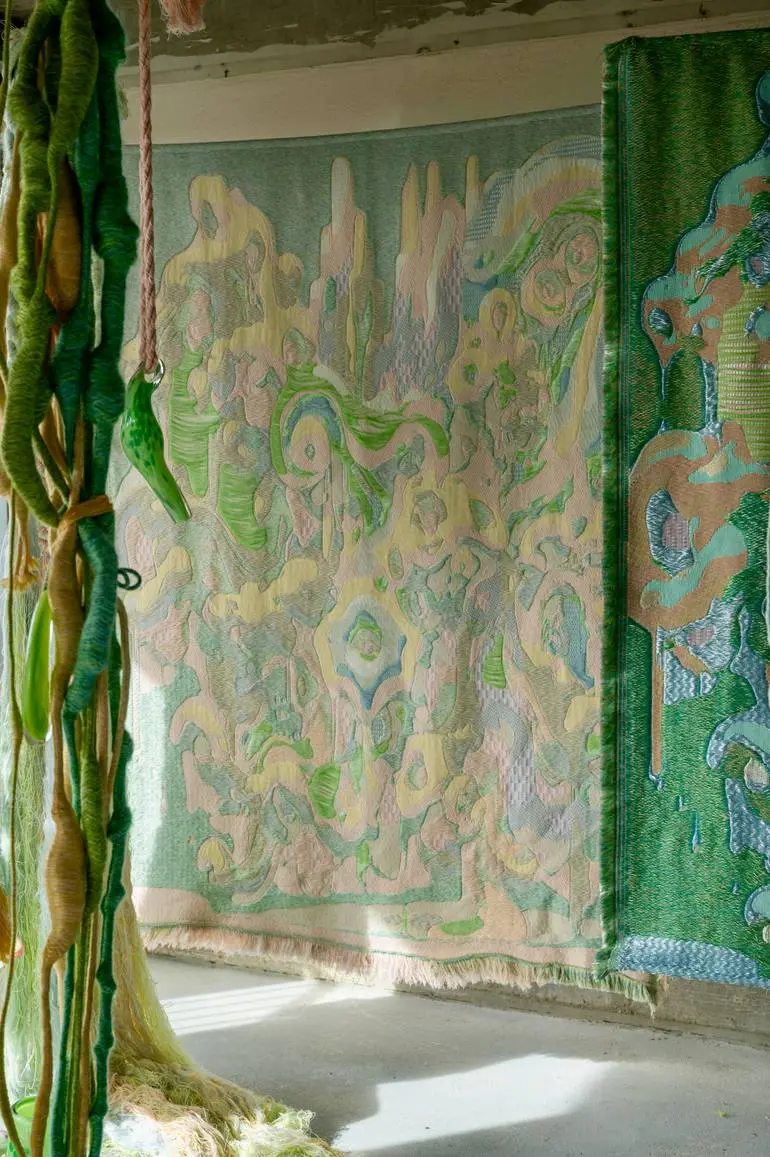
The installation defies simple classification. At its center unfurls a monumental woven tapestry rendered in deep oceanic hues of seafoam green, soft cream, rich copper, and vibrant teal. It reads like an ancient or alien submarine cartography—part living coral reef, part vivid hallucination. Thick, tactile ropes cascade alongside the main textile body, elongating into organic, sea-creature-like appendages that seem to pulse with hidden vitality. These textiles do not merely illustrate the ocean floor; they enact a visceral, poetic rehearsal of our return to it.
Crucially, the materiality of the work is deeply tied to sustainability. Every single yarn utilized in the tapestry is recycled or donated—salvaged from discarded wardrobes and forgotten industrial stock—and reborn as a complex, tactile topography.
This sustainability is not merely symbolic. Through her ongoing project, Nature’s Visual Sound, Planken has partnered with the Branch Foundation and the University of Wageningen to deploy specially engineered glass and textile structures onto the seabed. These installations are designed to act as temporary, life-supporting marine habitats that encourage the cultivation of heat-resilient algae and corals.
By tying commercial acquisition directly to ecological action—donating ten percent of every sale to underwater reef art projects—Planken bridges the gap between aesthetic appreciation and planetary stewardship. The work refuses to lecture the viewer; instead, it bypasses cynicism by making them feel deeply first, allowing intellectual concern and environmental responsibility to follow naturally behind.
Implications: The Future of Sensory Art and Ecological Integration
Sandra Keja Planken’s practice offers profound implications for the future trajectories of contemporary art, interior architecture, and environmentalism.
Re-enchanting the Built Environment: As contemporary architecture increasingly leans toward minimalist sterile spaces and digital screens, Planken’s immersive installations demonstrate a surging demand for organic textures, emotional warmth, and tactile engagement in public and private interiors.
Art as Active Ecological Infrastructure: By moving beyond traditional land art or passive awareness campaigns, Planken’s collaboration with marine biologists redefines the artist’s role. Art is no longer just an object to be preserved in a climate-controlled museum; it is deployed as an active agent of ecological regeneration.
Resisting Algorithmic Homogenization: In an art market increasingly driven by viral digital aesthetics and speculative flipping, Planken champions the slow, laborious, and deeply human process of material mastery. Her work serves as a blueprint for how contemporary creators can maintain artistic integrity and profound emotional resonance in a fast-paced world.
Ultimately, Sandra Keja Planken reminds us that art’s highest calling is not to replicate the world as it is, but to restore our capacity to feel it. Through her woven reefs and living glass, she invites us to step out of the digital stream and plunge back into the tactile, breathing depths of human experience.