









By the Staff Desk
Main Facts: The Phenomenon of Monetary Dreams
Few nocturnal visions evoke as powerful a blend of anticipation, anxiety, and curiosity as the act of counting money. Whether one is sifting through crisp paper bills, gathering heavy metallic coins, or staring at an endless digital ledger, dreams involving currency are remarkably common across diverse demographics. While popular culture often reduces these dreams to literal auguries of upcoming lottery wins or financial ruin, modern psychological research suggests a far more intricate reality.
At its core, dreaming of counting money is rarely about physical currency. Instead, it serves as a profound psychological mirror reflecting an individual’s internal relationship with abundance, self-worth, control, and personal security. Analysts and behavioral researchers note that these nocturnal episodes function as symbolic processing units. They help the sleeping mind parse through waking-life pressures regarding stability, power dynamics, and the psychological trap of conflating net worth with human value.
Chronology & Evolution: From Ancient Omens to Modern Psychoanalysis
The human fascination with interpreting nocturnal visions dates back thousands of years, evolving through distinct historical phases:
- Ancient Interpretations (Pre-20th Century): In ancient civilizations, such as those of Egypt and Mesopotamia, dreams were treated primarily as prophetic messages from the divine. Wealth or currency appearing in dreams was frequently interpreted literally—either as a harbinger of imminent prosperity or as a warning of impending poverty and divine displeasure.
- The Freudian and Jungian Revolution (Early-to-Mid 20th Century): The advent of psychoanalysis shifted the paradigm from external prophecy to internal revelation. Sigmund Freud categorized dreams as the "royal road to the unconscious," where symbols often masked repressed desires or anxieties. Carl Jung expanded this by introducing archetypes—universal, archaic patterns and images that derive from the collective unconscious, transforming money from mere paper into a symbol of psychic energy and value.
- Contemporary Psychological Research (Late 20th Century to Present): Modern behavioral science, supported by empirical studies from academic institutions like the University at Buffalo, has begun mapping the exact neurological and psychological intersections between financial pursuits and self-esteem. Today, sleep researchers analyze monetary dreams not as mystical portents, but as emotional regulatory mechanisms that help individuals navigate modern socio-economic pressures.
Supporting Data & Psychological Insights: The Intersection of Wealth and Self-Esteem
To understand why money permeates our dreamscapes, one must examine how society conditions human self-perception. Contemporary psychological literature emphasizes that modern culture heavily links financial status with personal identity, creating fertile ground for subconscious anxieties to manifest during rapid eye movement (REM) sleep.
The Danger of Conflating Wealth with Worth
Dr. Lora Park, an associate professor of psychology known for her research on motivation and self-identity, cautions against the societal tendency to tie personal value to financial achievements.
"People don’t often think of the possible downsides of wrapping their identity and self-worth around financial pursuits because our society values wealth as a model of how one should be in the world," Park observes.
When this societal pressure penetrates the subconscious mind, it often manifests as the repetitive, meticulous counting of cash in dreams—a subconscious attempt to quantify one’s worth when waking-life metrics feel overwhelming.
Empirical Evidence on Money and the Ego
Adding empirical weight to these observations, psychology researcher Liqing Zhang has published extensively on the psychological mechanics of currency. Zhang notes:
"Empirical evidence has shown that the meaning of money, situational need for money, self-esteem boost, and ego threat influence the exchange between money and self-esteem."
This dynamic explains why counting money can simultaneously trigger feelings of immense power or deep-seated anxiety. When an individual feels threatened, inadequate, or creatively blocked in their waking life, the brain utilizes the universal symbol of money to stage an internal evaluation of resources, energy, and coping mechanisms.
Official Responses & Expert Perspectives: Decoding the Subconscious
Mental health professionals, dream analysts, and behavioral economists generally agree that monetary dreams act as emotional barometers. Rather than providing actionable financial advice, these dreams provide critical feedback regarding an individual’s psychological state.
- The Need for Emotional Balance: Experts stress that counting money in a sleep state is an invitation to evaluate non-monetary riches. Are your relationships, creative pursuits, and spiritual practices yielding abundance, or are you bankrupting your mental health in pursuit of external validation?
- The Stress-Response Loop: Clinical observations indicate that individuals undergoing chronic financial stress—such as mounting debt or job insecurity—frequently report endless loops of counting scarce resources in their sleep. This is identified as a cognitive processing loop, where the sleeping brain attempts to problem-solve an issue that has no immediate physical resolution.
- The Reclamation of Personal Power: Conversely, mental health practitioners point out that dreams of holding vast, secure amounts of wealth often coincide with periods of personal breakthrough, professional confidence, or successful boundary-setting in relationships.
Implications: Archetypal Energies and Practical Interpretations
To fully comprehend the depth of a money dream, analysts often look toward Jungian archetypes. These universal patterns give context to how the money is being experienced in the dream world.
The Merchant Archetype
The Merchant archetype governs the principles of exchange, fairness, and value. When a dream involves counting money in a transactional context—such as a bank, a marketplace, or a cash register—it prompts the dreamer to evaluate fairness in their waking life. Are you receiving as much emotional, professional, or creative energy as you are expending?
The Ruler or King Archetype
Symbolizing authority, control, and governance, the Ruler archetype surfaces when an individual counts massive sums of wealth. This scenario highlights a deep-seated desire to command one’s environment, establish stability, and assert personal influence over chaotic life circumstances.
The Magician Archetype
Moving from static control to dynamic creation, the Magician represents transformation. Dreaming of turning effort into wealth mirrors an internal awakening—a realization that the dreamer possesses the ingenuity, creativity, and inner resources required to manifest real-world change.
Practical Guide: Common Dream Scenarios and Their Meanings
For those seeking to decode their own nocturnal experiences, examining specific dream scenarios provides a clear roadmap to self-awareness.
1. Counting a Large Sum of Money
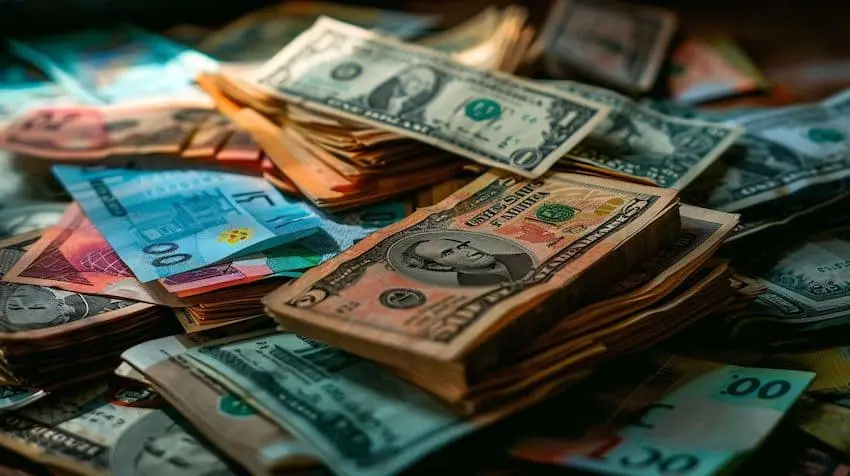
- The Experience: You find yourself surrounded by stacks of cash, calmly and successfully counting a massive fortune.
- The Implication: This vision rarely portends a sudden windfall. Instead, it signifies a growing sense of personal freedom, confidence, and emotional security. You are recognizing your own internal assets, talents, and readiness to tackle upcoming life chapters.
2. Encountering Fake or Counterfeit Money
- The Experience: You are counting bills, only to realize halfway through that the currency is entirely fake, counterfeit, or printed on cheap paper.
- The Implication: This is a classic warning sign from the subconscious. It often points to feelings of being deceived—either by others or by your own choices. It asks you to examine where in your career, relationships, or goals you might be pursuing unfulfilling, superficial, or dishonest paths.
3. Handling Paper Bills
- The Experience: Your focus is entirely on paper currency, noting denominations, folding notes, or settling accounts.
- The Implication: Paper money symbolizes conscious value, responsibilities, and accountability. This dream often surfaces when you are grappling with important waking-life decisions, debts, or unmet promises, highlighting a need for better resource management.
4. Accumulating Coins
- The Experience: You are gathering, sorting, or counting heavy metallic coins.
- The Implication: Coins represent incremental, foundational growth. They remind the dreamer that grand achievements are built through small, consistent, and often unnoticed daily efforts. Every minor victory counts toward your ultimate personal and spiritual evolution.
Conclusion: Harnessing Dream Insights for Personal Growth
Transforming ordinary nights into opportunities for deep self-awareness requires deliberate practice. Experts recommend maintaining a dedicated dream journal, noting every detail immediately upon waking—from the type of currency to the accompanying emotional state.
By analyzing these symbols over time, individuals can untangle the complex web of desires, fears, and societal pressures that shape their waking lives. Ultimately, whether your dreams show you counting mountains of gold or struggling with empty pockets, the message remains clear: true abundance is not merely measured in currency, but in the peace, resilience, and self-worth cultivated within the human spirit.