





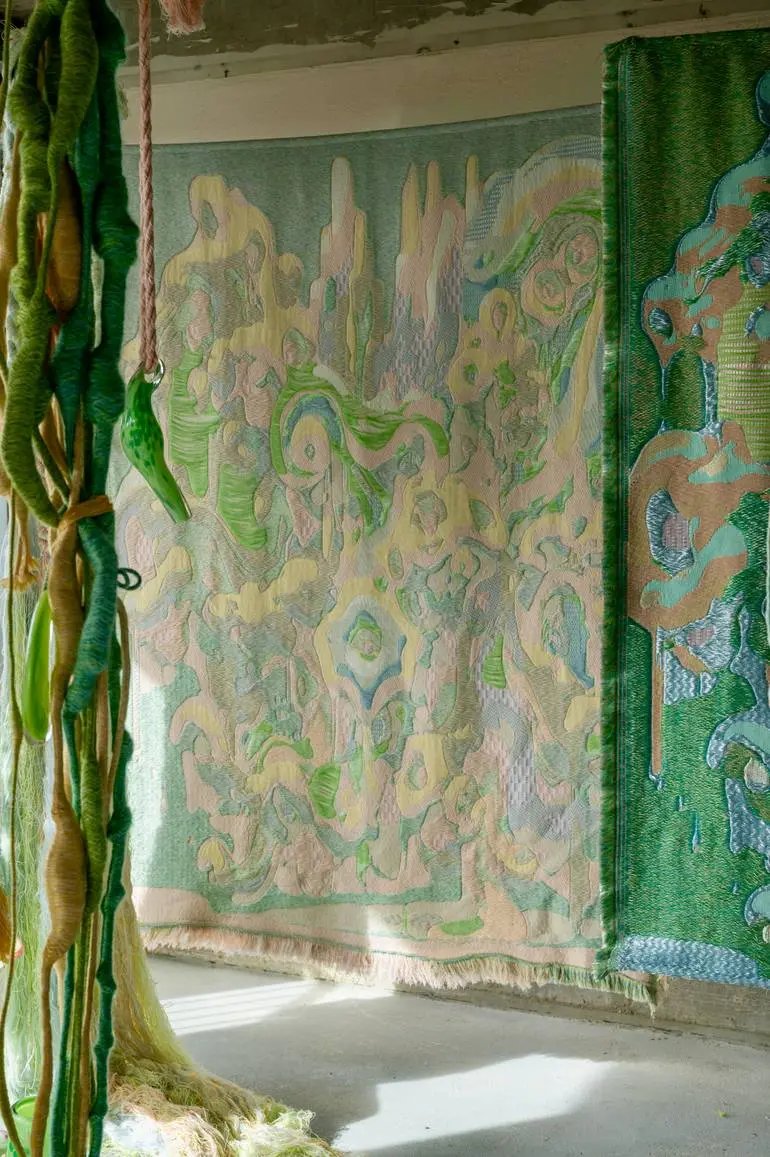
AMSTERDAM — In an era dominated by flat digital screens, algorithmic feeds, and the relentless velocity of modern visual culture, Dutch contemporary artist Sandra Keja Planken is carving out a profound counter-narrative. Operating at the ambiguous intersection of sculpture, ecology, and immersive architecture, Planken creates works that defy easy categorization. Her pieces—woven structures that pulse like living tissue, and glass that appears startlingly malleable—hover gracefully between organism and object.
At the core of Planken’s practice lies a singular, urgent preoccupation: how sensory experience, tactile engagement, and material presence can restore emotional and psychological connection within an increasingly detached society. Through her elaborate textiles, refractive glasswork, and large-scale immersive environments, Planken does not merely ask viewers to look at art; she invites them to inhabit it, feel it, and remember what it means to be physically present in a physical world.
Main Facts: The Intersection of Art, Ecology, and Material Alchemy
Sandra Keja Planken is a multidisciplinary Dutch contemporary artist whose work spans textile art, glass sculpture, and expansive spatial installations. Rather than adhering to the traditional boundaries of fine art, her practice merges material experimentation with ecological activism.
Her signature approach leverages the emotional weight of materials. By combining soft, tactile yarns—often sourced from recycled or discarded textiles—with hard, light-refracting glass, Planken creates a deliberate material contradiction. Her installations evoke coral reefs, submarine cartographies, and dreamscapes, acting as living ecosystems that respond to light, space, and human interaction.
Key pillars of her contemporary practice include:
- Material Duality: Exploring the tension between softness and hardness, where textiles take on architectural forms and glass mimics the fluidity of organic tissue.
- Ecological Integration: Bridging the gap between fine art and environmental science, notably through her ongoing initiative, Nature’s Visual Sound.
- Immersive Scale: Shifting from isolated objects to room-sized, multisensory environments that envelop the viewer completely.
- Philanthropic Commitment: Directing 10 percent of proceeds from every artwork acquisition directly toward marine conservation and underwater reef art projects.
Chronology: The Evolution of an Intuitive Practice
Planken’s artistic trajectory has been shaped by a lifelong sensitivity to spatial atmospheres and environmental energy, tracing a path from an culturally rich upbringing to the cutting edge of ecological art.
Formative Years: Cultural Duality and Spatial Sensitivity
Growing up between the vibrant, emotional openness of Spanish culture and the structured restraint of Northern Europe, Planken developed an acute early awareness of how physical spaces affect human emotion. She noticed that certain environments felt alive, warm, and resonant, while others felt strangely sterile and absent. This foundational sensitivity never left her; instead, it became the driving question of her artistic life: How can spaces and materials be made to feel alive?

The Turn to Textile
Planken initially gravitated toward textiles because of their profound tactility and innate emotional presence. Threads, knots, and woven structures carried a historical and human resonance that metal or stone often lacked. In her hands, yarn became a vocabulary of connection. Over time, her work expanded organically—evolving from flat objects into three-dimensional sculptures, and eventually into room-sized installations that surrounded the viewer entirely.
The Introduction of Glass and Ecological Shifts
As her practice matured, Planken introduced glass as a counterpoint to textile. Fascinated by its capacity to hold fragility, reflection, and suspended light, she began experimenting with the friction between soft threads and hard panes. This experimentation coincided with a deepening fascination with nature, specifically coral ecosystems and ecological transformation. The work slowly transitioned from abstract sculpture into immersive environments that actively participate in processes of care, regeneration, and environmental storytelling.
Supporting Data & Methodology: The Alchemical Process
Planken’s creative process is deeply intuitive, moving away from rigid blueprints and toward a dynamic dialogue with the materials themselves.
Observation and Material Gathering
Every project begins with careful observation of the world: atmospheric light shifts, underwater movements, blooming flora, seaweed structures, and the invisible emotional tensions within built environments. Rather than imposing a fixed outcome, Planken allows forms to evolve organically, moving fluidly between drawing, weaving, glassblowing, and sculptural experimentation.
The Language of Tactility
Tactility is the primary language of Planken’s work. Textiles invite physical closeness, vulnerability, and touch, while glass introduces an ethereal dimension of light, reflection, and perceived fragility. The magic of her installations often occurs at the exact moment materials contradict themselves: when rigid glass appears soft to the eye, or when woven fabrics begin to behave like living organisms or architectural pillars.
The Role of Light as a Collaborator
Light acts as the final, unpredictable collaborator in Planken’s installations. As daylight shifts, or as viewers move through the space, the atmosphere of the work continuously transforms. No two encounters with her installations are ever identical.
Official Responses & Artist Philosophy
In an industry often obsessed with speed, marketability, and viral digital imagery, Planken has been vocal about the invisible labor and philosophical grounding required to sustain a meaningful contemporary art practice.

Reflecting on her career and the role of the artist in the 21st century, Planken shares:
"I wish more people understood that being an artist is not only about creating objects, but about learning how to remain deeply sensitive within a world that constantly pushes towards speed, distraction, and sameness. Most artworks are built through years of experimentation, doubt, observation, and invisible labor. The final piece often carries countless emotional and material decisions that are never immediately visible on the surface."
She further emphasizes the societal necessity of artistic spaces:
"I also believe artists help create emotional and cultural space within society. Art can slow people down, reconnect them to wonder, and allow them to experience the world differently for a moment. In a time where so much becomes flattened into fast images and algorithms, I think sensitivity and imagination become increasingly important."
Implications: Weaves of Saltwater Dreams and Environmental Action
Planken’s philosophy finds its most compelling expression in Weaves of Saltwater Dreams, a striking coral art installation presented at BIG ART Amsterdam in collaboration with ValorosaViva.
Defying Categorization: A Submarine Cartography
Weaves of Saltwater Dreams refuses easy categorization. A massive woven tapestry—pulsing in shades of green, cream, copper, and teal—unfurls across the space like an otherworldly submarine map. It is part living reef, part dreamscape hallucination. Thick ropes hang alongside the weaving, elongating into organic, sea-creature-like forms. The textiles shimmer and seem to ooze with life; they do not merely depict the ocean floor—they rehearse a visceral return to it.
Upcycling as Ecological Metaphor
Significantly, every single yarn utilized in the installation is recycled or donated, sourced from discarded wardrobes and forgotten industrial stock, reborn through Planken’s hands into intricate coral topography. This commitment to sustainability is far from superficial.

Through her ongoing creative universe, Nature’s Visual Sound, Planken is actively collaborating with the Branch Foundation and the University of Wageningen. Together, they are growing heat-resilient algae and corals on specialized glass and textile structures designed to function as temporary, regenerative habitats on the seabed.
The Art of Feeling First
Planken’s approach to ecological art avoids heavy-handed didacticism. Her work does not lecture the viewer or demand environmental concern through guilt. Instead, it operates through sensory seduction: it makes the audience feel the awe, fragility, and beauty of natural systems first, allowing genuine care and ecological stewardship to follow naturally.
In keeping with this mission, 10 percent of every acquisition of Planken’s work goes directly toward funding these critical underwater reef art and marine restoration projects.
Featured Work & Acquisition Details
For collectors and institutions looking to engage directly with Planken’s tactile universe, key signature pieces remain available through select exhibitions:
- Medium: Sculpture, Weaving of Wool, Mixed Fibres
- Materials: Recycled and donated yarn, woven textile, structural mixed media.
- Dimensions: 55" W x 40" H x 2" D (Dimensions variable depending on installation context).
- Conservation Impact: 10% of every acquisition directly supports marine habitat restoration via Planken’s ongoing scientific and artistic reef partnerships.
As contemporary art continues to grapple with the digital age, Sandra Keja Planken stands out as an artist who insists on the power of the physical, the emotional, and the deeply alive. Through thread, glass, and light, she builds bridges back to the natural world—reminding us that sensitivity is not a weakness, but our most vital ecological instrument.