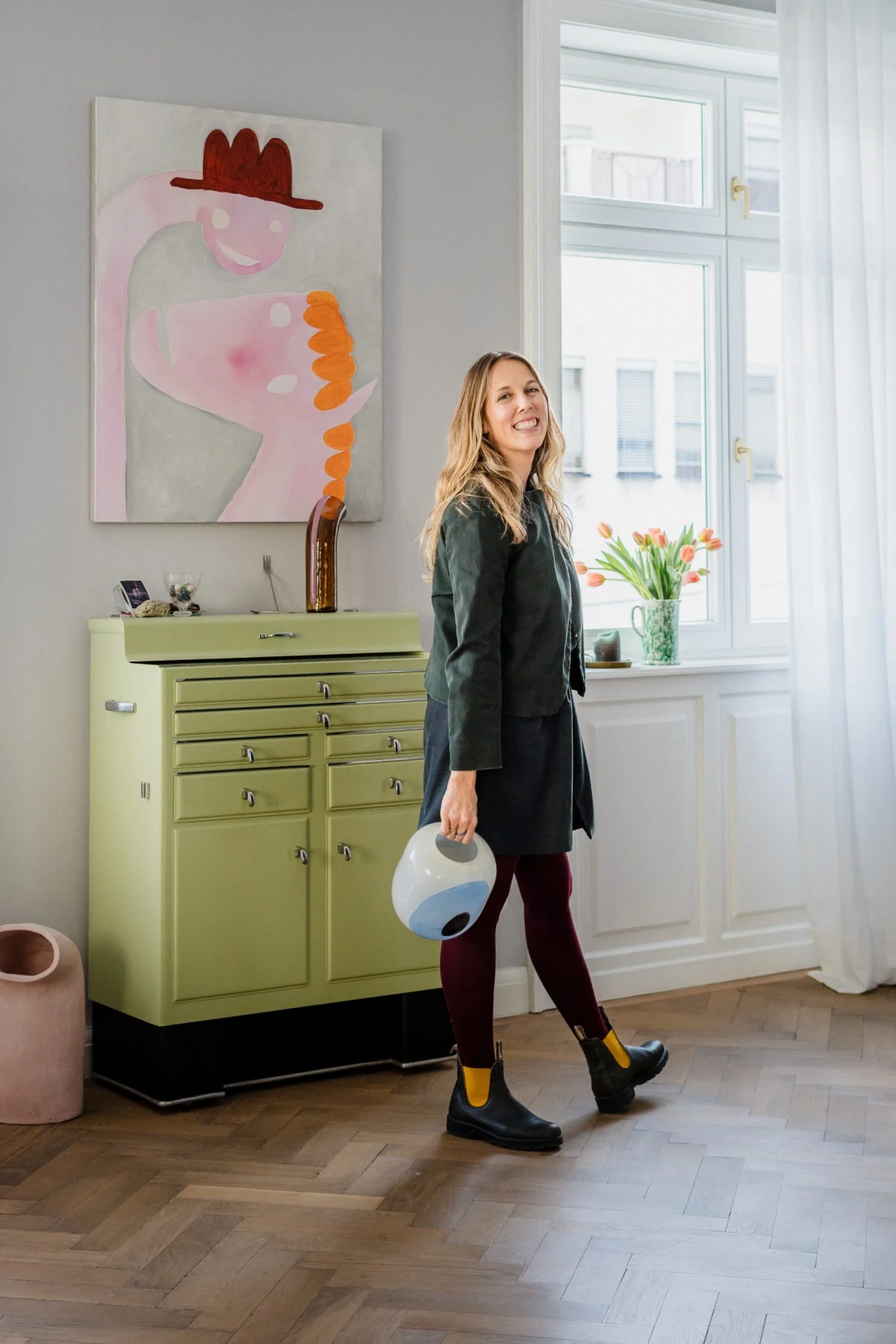
Main Facts
In the quiet, deliberate studios of Vienna and the fiery furnaces of Bohemia, a quiet revolution in contemporary glassware is taking shape. Ursula Futura, the unbridled creative alter ego of designer Kathrin Schaden, has emerged as a refreshing antidote to the hyper-sanitized, mass-produced aesthetics dominating modern interior design. Eschewing the cold perfection of industrial manufacturing, Ursula Futura specializes in mouth-blown, handcrafted glass objects that celebrate asymmetry, tactile emotion, and the unpredictable nature of molten material.
At the heart of the studio’s portfolio is a striking lineup of sculptural design pieces—including the lumbering, organic forms of NESSIE, the haunting silhouettes of PHANTOM, and the rhythmic, celestial geometries of PULSAR. The latter has recently captured the design world’s attention with the launch of the Pulsar Table Lamp, a piece of functional art fashioned from opaque colored glass that shifts character depending on the angle of observation and whether it is illuminated.
Key facts surrounding the Ursula Futura phenomenon include:
- Production Method: Strictly mouth-blown and handcrafted, bypassing automated casting or pouring.
- Geographical Footprint: Conceived and designed in Vienna, Austria, with production rooted in the historic glassmaking furnaces of Bohemia.
- Design Philosophy: Embracing "material arguments"—retaining intentional imperfections like trapped air bubbles and subtle waves to honor the human hand behind the craft.
- Current & Future Offerings: The flagship Pulsar Table Lamp is currently available, with matching pendants and wall lamps actively in development.
Chronology: The Evolution of Ursula Futura
To understand the visceral impact of Ursula Futura, one must trace the trajectory of its creator, Kathrin Schaden. For years navigating traditional commercial design spheres, Schaden frequently found herself on the receiving end of a familiar, stifling critique: she was "too much." Her vibrant enthusiasm for intense color gradients, exaggerated shapes, and the way light interacts with refractive surfaces often clashed with the minimalist restraint demanded by conventional markets.
Rather than muting her creative voice, Schaden chose a radical path of self-preservation and expression. She established Ursula Futura—not merely as a commercial enterprise, but as a deliberate alter ego. Ursula Futura became the space where self-editing was strictly forbidden, a sanctuary for ideas that demanded to be realized simply because their creator could not stop thinking about them.

The timeline of this artistic awakening manifests in physical form through the studio’s output:
- The Phase of Introspection: Years spent absorbing critiques of over-expressiveness, leading to a pent-up reservoir of uninhibited design concepts focused on movement, light, and transparency.
- The Birth of the Alter Ego: The formal inception of Ursula Futura as a conceptual umbrella for unfiltered creativity.
- Exploration of Matter (Bohemia & Vienna): Establishing partnerships with master glassblowers in Bohemia, marrying Vienna’s contemporary design sensibility with centuries-old Central European glass-forming traditions.
- The Naming of Forms: The introduction of foundational pieces—NESSIE, PHANTOM, and PULSAR—each christened with titles that evoke movement, mass, and cosmic phenomena.
- The Pulsar Debut: The refinement of the Pulsar Table Lamp, marking a transition into functional lighting that translates rhythmic waves into solid, luminous matter.
Supporting Data & The Craftsmanship Process
The allure of Ursula Futura lies deeply within the physical science and poetic reality of glass. In modern manufacturing, glass is often treated as a static, rigid medium. Schaden and her collaborators treat it for what it truly is: a liquid pretending to be a solid.
When glass is subjected to extreme furnace heat, it undergoes a metaphorical awakening; it "remembers" its liquid state, becoming pliant, responsive, and temperamental. The production process involves a master artisan blowing air through a pipe into a glowing mass of molten silica. This dynamic interaction between human breath and elemental heat produces a shape that can never be precisely replicated.
Material Realities and Imperfections
- Thermal Memory: Every piece cools at a slightly different rate, locking in a unique molecular tension.
- The "Argument": Tiny air bubbles trapped within the walls of the glass are often viewed by industrial standards as flaws to be eliminated. Ursula Futura intentionally preserves them as evidence of the material "arguing back" during creation.
- The Wave Motif: The foundational geometry of the Pulsar series relies on softly stepped, conical waves. These contours are deliberately kept imperfect to maintain a tactile softness.
Data regarding glass behavior confirms that cooling rates directly affect optical dispersion and color saturation. By utilizing opaque colored glass, Ursula Futura ensures that its pieces possess a dual identity: by day, they act as solid, sculptural blocks of chromatic depth; by night, internal illumination transforms them into glowing beacons of layered light and shadow.
Official Responses and Creator Insights
The philosophy behind Ursula Futura is perhaps best understood through the words of its founder. For Schaden, the creative process is deeply meditative, drawing parallels to fundamental biological and natural rhythms.

Reflecting on her fascination with wave patterns, Schaden explains:
"I keep coming back to the wave because it never really stops moving, even when it’s frozen in glass. The repetition in the form feels meditative to me. Like breathing, or tides."
This perspective has resonated deeply within the broader architecture and interior design community. Curators and critics have lauded the brand for reintroducing emotional resonance into domestic spaces. Instead of offering objects that quietly blend into the background, Ursula Futura’s creations demand a moment of pause.
Design critics have noted that encountering a piece of Ursula Futura glass—such as light striking a tinted vessel to cast an unexpected rainbow across a sterile room—triggers an instinctive, physiological response. It is a moment of unscripted wonder that stops viewers in their tracks, forcing them to feel something that resists easy explanation.
Implications for the Future of Contemporary Design
The rise of Ursula Futura points to a broader, highly significant shift in consumer psychology and interior architecture. For over a decade, the design world was dominated by uniform minimalism—often referred to pejoratively as "millennial grey" or sterile corporate modernism—where efficiency and seamless perfection reigned supreme.

However, a cultural fatigue has set in. Consumers and interior designers are increasingly searching for an antidote to algorithmic predictability. They want homes and commercial spaces that reflect individual human quirkiness, emotional depth, and historical continuity.
Ursula Futura capitalizes on this cultural pivot in several profound ways:
- The Revival of Slow Craft: By relying on mouth-blowing techniques in historic regions like Bohemia, the studio champions endangered artisanal skills, ensuring that generational knowledge is passed down and valued.
- The Triumph of Imperfection: In an era where 3D printing and digital rendering promise flawless symmetry, Ursula Futura proves that emotional resonance lives exclusively in the "hand-touched"—the subtle wobble, the trapped bubble, and the uneven wave.
- Lighting as Kinetic Art: With the Pulsar Table Lamp—and upcoming expansions into pendant and wall lighting formats—functional objects are no longer expected to merely illuminate a room. They are expected to alter the emotional climate of a space through shifting shadows and tactile color densities.
Ultimately, Ursula Futura serves as a reminder that design does not need to apologize for being emotive, bold, or "too much." By capturing fleeting natural phenomena—a wave in motion, light refracting through liquid silica, a rainbow appearing from nowhere—Kathrin Schaden has carved out a vital space where human emotion and raw material collide, forever altering how we experience our living environments.