Main Facts
As society grows increasingly digitized, a counter-movement is quietly taking root on the walls and refrigerators of homes, observatories, and classrooms worldwide: the physical, scientifically rigorous moon calendar. Celestial Products, a premier publisher in astronomical stationery, has officially released its highly anticipated lineup for the upcoming year, featuring the flagship MoonLight 2026 and MoonMaggy 2026 editions.
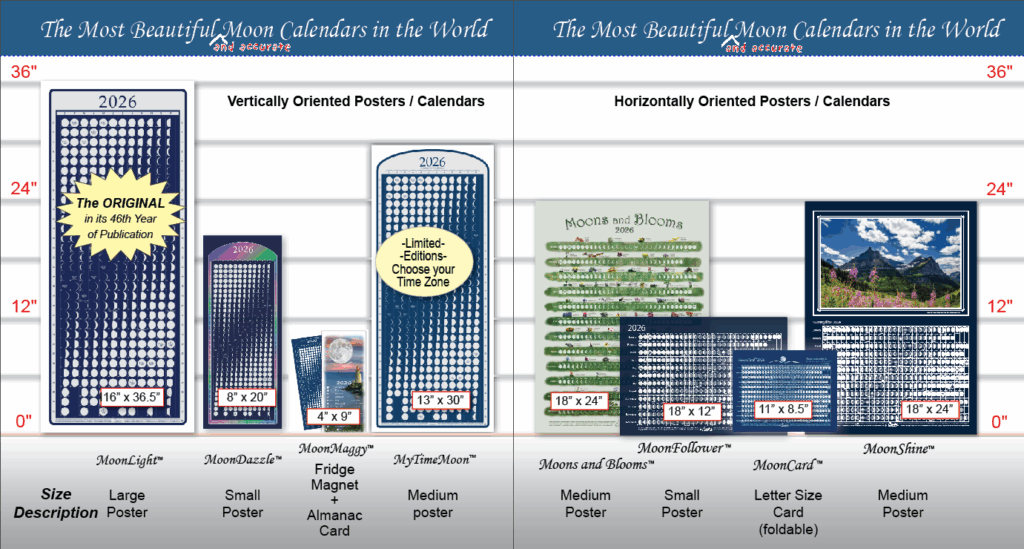
Designed to bridge the gap between hard astronomical science and fine art, these calendars offer meticulous accuracy regarding lunar phases, perigee and apogee, eclipses, and orbital tracking. Yet, their appeal transcends pure astronomy. Crafted to satisfy both the mathematically minded stargazer and the visually driven artist, the collection spans a remarkably diverse array of formats. Consumers can choose from pocket-friendly fridge magnets and thoughtful greeting cards to small, medium, and large-format wall posters that serve as striking visual centerpieces.
The launch comes at a time when consumer interest in natural rhythms, lunar gardening, tidal tracking, and night-sky photography is experiencing a steady resurgence. By providing a tangible, beautifully rendered map of Earth’s constant cosmic companion, Celestial Products continues to anchor modern audiences in age-old celestial cycles.

Chronology
To understand the enduring success of these lunar publications, it helps to trace the timeline of how astronomical tracking evolved from survival necessity to modern consumer art:
- Ancient Beginnings: Millennia ago, humanity relied entirely on the moon’s predictable 29.5-day synodic cycle to track the passage of time, schedule agricultural planting, and navigate oceans. Early lunar calendars were etched into bone, stone, and parchment.
- The Scientific Revolution: As telescopes advanced and celestial mechanics were mapped by astronomers like Johannes Kepler and Isaac Newton, lunar tracking shifted from observational mysticism to precise mathematical science.
- The Birth of Celestial Products: Recognizing a niche for products that honored both the scientific precision of orbital mechanics and the aesthetic beauty of the cosmos, specialized publishers began curating printed moon phase calendars for the public.
- Recent Years: With the advent of digital screens, demand for tactile, analog goods experienced a unique renaissance. Consumers began seeking out offline, mindful ways to connect with nature, driving record sales for physical wall calendars and specialty celestial charts.
- Present Day (2025–2026 Cycle): Celestial Products officially unveils its comprehensive 2026 catalog. Featuring updated formats, expanded distribution via online storefronts like Amazon, and digital catalog integrations via Adobe platforms, the 2026 collection represents the modern evolution of traditional star-charting.
Supporting Data
The appeal of the 2026 collection lies in its meticulous attention to detail, diverse sizing options, and multi-platform accessibility. Market analysis of the astronomical merchandise sector reveals key insights into consumer preferences heading into 2026:
- Format Versatility: The 2026 lineup caters to various spatial and functional needs. The product ecosystem ranges from micro-formats (fridge magnets and greeting cards) to macro-formats (comprehensive wall posters in small, medium, and large dimensions).
- Digital Integration meets Analog Tradition: While the calendars are proudly physical, the purchasing journey has modernized. The complete 2026 catalog is hosted interactively via Adobe digital publishing tools, allowing prospective buyers to browse layouts seamlessly online before placing orders.
- Direct-to-Consumer and E-Commerce Reach: In addition to direct purchasing avenues through the publisher, major titles such as MoonLight 2026 and MoonMaggy 2026 are distributed globally via dedicated Amazon storefronts, ensuring rapid fulfillment for retail customers.
- Scientific Precision: Every calendar is calculated using precise astronomical data, ensuring that moon phases, waxing and waning transitions, supermoons, and lunar eclipses align precisely with the observer’s perspective on Earth.
Official Responses
Representatives and creators behind Celestial Products have emphasized the philosophy guiding the 2026 catalog rollout. While speaking on the synthesis of art and science, publishers highlighted the unique emotional resonance that the moon holds for humanity.

"The moon is our closest celestial neighbor, yet it remains endlessly captivating," notes a spokesperson for Celestial Products. "When designing a calendar like MoonLight 2026, our primary challenge—and our greatest joy—is honoring the exactitude of orbital science without losing the innate poetry of the night sky. Whether someone is an amateur astronomer tracking perigee or an artist seeking inspiration from the phases of illumination, our goal is to create an object of enduring value."
Regarding the expansion of digital catalogs and e-commerce availability, management stressed the importance of accessibility. "We live in a fast-paced digital era where people spend hours staring at screens. Bringing our catalog to platforms like Adobe and expanding our Amazon presence isn’t just about modernizing sales; it’s about making it as effortless as possible for people to bring a piece of the cosmos into their physical living spaces."
Implications
The sustained popularity of physical moon calendars carries several broader implications for contemporary culture, education, and lifestyle trends:
1. The Analogue Renaissance and Mindfulness
In an age dominated by smartphone notifications and digital calendar apps, the physical wall calendar serves as a quiet sanctuary. Glancing up at a beautifully illustrated poster of the lunar cycle encourages a mindful, unhurried relationship with time. It prompts individuals to look out their windows at night, reconnecting with natural light cycles that have guided human biology for eons.
2. STEM Education and Public Science Engagement
Products that sit at the intersection of art and science play a vital, understated role in public education. By presenting complex astronomical phenomena—such as the moon’s libration, phase progression, and orbital tilt—in a visually digestible format, these calendars demystify astronomy. They spark curiosity in younger generations, turning casual observers into active learners of space science.
3. Niche Markets in the Modern Economy
The success of specialized publishers like Celestial Products demonstrates the viability of niche, high-quality craft goods in a globalized marketplace. By combining rigorous academic accuracy with premium artistic design, independent creators can carve out resilient market segments that mass-market corporate publishers often overlook.

As we look toward 2026 and beyond, tools like the MoonLight and MoonMaggy series prove that humanity’s fascination with the night sky is as potent as ever. Whether viewed as an indispensable scientific tool, an artistic statement, or a daily anchor to the rhythms of nature, the printed moon calendar remains a timeless fixture of modern life.