






AMSTERDAM — In an era dominated by hyper-accelerated digital culture, flat algorithmic imagery, and a pervasive societal detachment from the physical world, Dutch contemporary artist Sandra Keja Planken is carving out a profound counter-narrative. Operating at the ambiguous intersection of sculpture, installation, textile, and biological systems, Planken creates works that defy easy categorization. Her pieces—woven structures that pulse like living tissue, and glass elements that seem startlingly malleable—exist somewhere between organism and object.
Far from static gallery pieces, Planken’s immersive environments function as sensory ecosystems. They are designed with a singular, urgent preoccupation: to utilize tactility, material presence, and deep sensory engagement to restore emotional and ecological connection within a visually oversaturated world.
Main Facts: The Anatomy of a Living Practice
At its core, Sandra Keja Planken’s artistic practice bridges the gap between high-concept contemporary sculpture and environmental activism. Based in the Netherlands, her work spans intricate fiber arts, glassblowing and manipulation, and large-scale spatial installations.
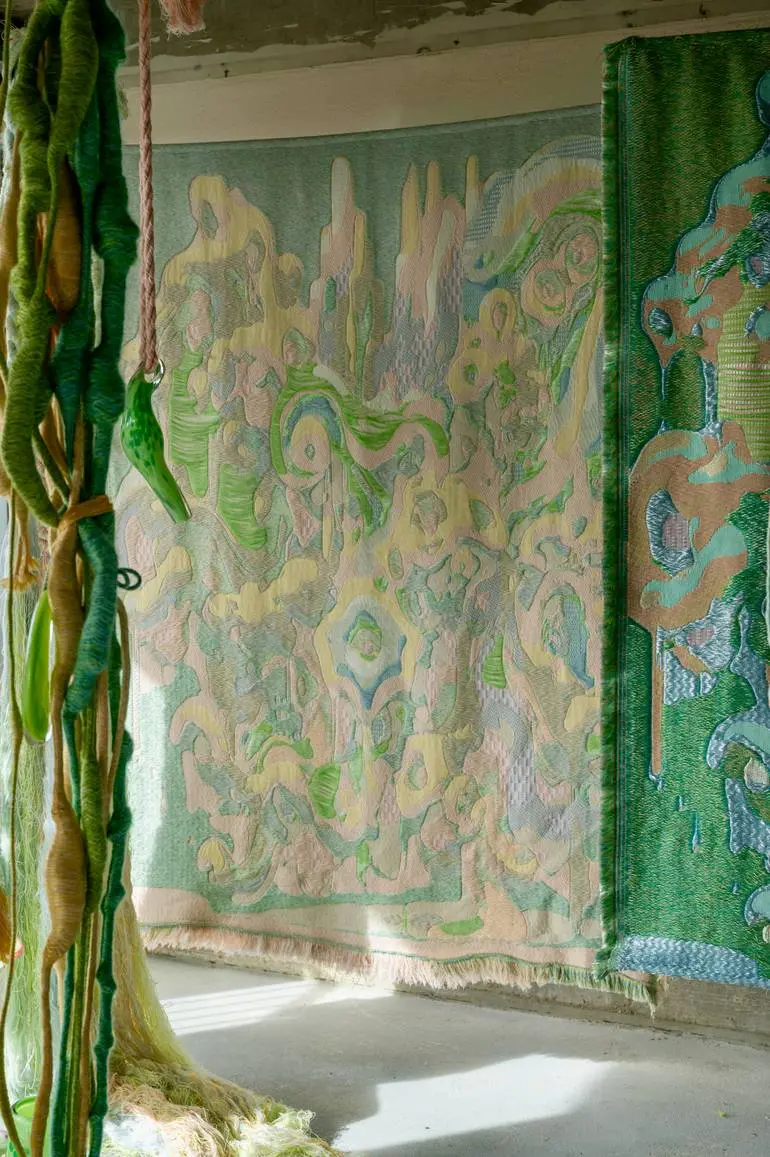
Her standout masterpiece, Weaves of Saltwater Dreams—showcased prominently at BIG ART Amsterdam in collaboration with ValorosaViva—exemplifies her methodology. Measuring an impressive 55 inches wide by 40 inches high (with variable dimensions depending on the iteration), the installation features a sprawling, multi-hued tapestry woven in tones of oceanic green, cream, copper, and teal. It unfurls like a submarine cartography, equal parts living coral reef and surrealist dreamscape. Suspended ropes cascade alongside the textile, elongating into organic, sea-creature-like forms that shimmer and seemingly breathe under calculated lighting.
Crucially, Planken’s work is deeply sustainable. The materials are not merely aesthetic; they are purposeful. Every strand of yarn utilized in Weaves of Saltwater Dreams is entirely recycled or donated—sourced from discarded wardrobes, textile waste, and forgotten industrial stock.
Moreover, her engagement with the natural world extends far beyond metaphor. Through her ongoing conceptual and scientific universe, Nature’s Visual Sound, Planken is actively collaborating with the Branch Foundation and Wageningen University. Together, they are cultivating heat-resilient algae and artificial corals directly onto glass and textile structures engineered to serve as temporary marine habitats on the seabed. To seal this commitment to ecological regeneration, 10% of the proceeds from every acquisition of her work goes directly toward funding these underwater reef art initiatives.
Chronology: The Evolution of a Sensorial Vision
To understand the complexity of Planken’s current work, one must trace the geographic and material trajectory that shaped her artistic identity.

Childhood Sensitivities and Cultural Dualities
Planken’s artistic sensibility was forged early in life, rooted in a keen awareness of spatial atmospheres. Growing up straddling two distinct cultural worlds—the emotional openness and warmth of Spanish culture and the structured restraint of Northern Europe—she developed an acute sensitivity to her surroundings. She noticed early on that certain physical environments felt palpably alive, vibrating with energy, while others felt strangely sterile and absent. This foundational awareness never left her; instead, it transformed into a lifelong inquiry that she continues to explore through material form.
The Textural Genesis
Initially, Planken was drawn to textiles because of their inherent tactility and deep emotional resonance. To her, threads, knots, and woven structures felt almost human—possessing a vulnerability and warmth lacking in traditional hard-edged mediums. What began as traditional textile work gradually expanded: flat objects evolved into volumetric sculptures, sculptures grew into room-sized installations, and installations eventually transformed into fully immersive environments that envelop the viewer.
The Introduction of Glass and the Dissolution of Boundaries
Glass entered Planken’s practice at a later stage, introduced as a counterpoint to the softness of fiber. She sought out glass for its capacity to hold fragility, reflection, and light. This led to a fascinating material tension within her studio: the exploration of how softness and hardness could begin to dissolve into one another. Through rigorous experimentation, her sculptures began to blur the lines between rigid inorganic material and pulsating biological tissue.
The Ecological Turn
In recent years, nature, coral ecosystems, and ecological transformation have emerged as the defining pillars of her work. Moving beyond mere representation, Planken’s practice now actively participates in processes of environmental care, material regeneration, and psychological reconnection, cementing her status as a pioneer of ecological art.
Supporting Data & The Creative Process
Planken’s creative methodology is fundamentally intuitive, relying heavily on observation, material dialogue, and rigorous invisible labor.
Observation as a Starting Point
The genesis of a piece usually begins with passive, deep-world observation. Light reflections dancing on a ceiling, micro-movements witnessed underwater, the ephemeral architecture of flowers and seaweed, forgotten industrial remnants, or the latent emotional tensions within specific architectural spaces serve as raw starting points. Rather than forcing a preconceived outcome, Planken allows the materials themselves to guide the evolution of the work.
Material Alchemy
Her studio practice is a fluid dance between disciplines:

- Textiles: Used to invite physical closeness, psychological safety, and vulnerability.
- Glass: Harnessed to capture reflection, structural fragility, and the illusion of suspended, trapped light.
- Mixed Media: The combination of recycled fibers, industrial yarns, and blown glass creates a jarring yet harmonious emotional contradiction—where hard glass visually softens, and woven textiles take on architectural or organic properties.
The Role of Light
Light acts as the final, indispensable collaborator in Planken’s installations. Because her works are rich in texture, reflectivity, and depth, the atmosphere of an installation continuously shifts depending on the viewer’s position, the ambient environment, and the changing time of day. The work is never truly static; it breathes in tandem with its surroundings.
Official Responses and Artist Statement
In an intimate reflection on her life’s work, the philosophy behind her creations, and the realities of operating as a contemporary artist today, Sandra Keja Planken offers a powerful perspective:
"I wish more people understood that being an artist is not only about creating objects, but about learning how to remain deeply sensitive within a world that constantly pushes towards speed, distraction, and sameness. Most artworks are built through years of experimentation, doubt, observation, and invisible labor. The final piece often carries countless emotional and material decisions that are never immediately visible on the surface."
Addressing the broader cultural role of art in the 21st century, Planken emphasizes the urgent need for spaces of reflection:
"I also believe artists help create emotional and cultural space within society. Art can slow people down, reconnect them to wonder, and allow them to experience the world differently for a moment. In a time where so much becomes flattened into fast images and algorithms, I think sensitivity and imagination become increasingly important."
This ethos is structurally embedded into her business model as well. By dedicating 10% of all sales to the Branch Foundation and Wageningen University’s marine research, Planken bridges the often-isolated worlds of high-end art collecting and grassroots environmentalism. Collectors are not merely acquiring a luxury sculpture; they are actively financing the restoration of dying marine ecosystems.
Implications: Art as an Antidote to Modern Detachment
The implications of Sandra Keja Planken’s work extend far beyond the white walls of contemporary art galleries or the upscale booths of design fairs like BIG ART Amsterdam. Her practice poses critical questions about the trajectory of modern culture.

1. Countering Digital Fatigue
As humanity increasingly migrates toward screens, flat digital interfaces, and virtual spaces, our tactile literacy is suffering. Planken’s insistence on hyper-textured, multi-sensory environments acts as a much-needed somatic reset. Her works demand physical presence; they cannot be fully consumed through a smartphone screen. They require the viewer to slow down, touch, look closely, and feel.
2. Redefining Sustainability in High Art
The art world has historically struggled with its carbon footprint, often relying on resource-intensive production methods and global shipping of virgin materials. Planken’s utilization of discarded wardrobes, textile waste, and local industrial scraps sets a compelling precedent for circular economy practices in fine art. By upcycling waste into high-value sculptural topography, she proves that ecological responsibility and aesthetic excellence are not mutually exclusive.
3. Art as Active Ecological Agent
Perhaps the most significant implication of Planken’s career is the evolution of ecological art from passive commentary to active intervention. By collaborating with scientific institutions to place textile-and-glass structures onto the seabed to foster coral and algae growth, Planken blurs the line between human-made culture and wild nature. Her work suggests that art can have a literal pulse—not just metaphorically on a gallery wall, but biologically on the ocean floor.
In a world hurtling toward uniformity, speed, and digital abstraction, Sandra Keja Planken invites us to remember what it feels like to be alive, sensitive, and deeply connected to the living fabric of the world.