






By Special Investigative Correspondent
EXMOOR, England — Stretching across the rolling, wind-swept uplands of West Somerset and North Devon, the rugged landscape of Exmoor is a place of stark, ancient beauty. Famed for its deep coombes, purple heather, and wild ponies, it is a quintessential English wilderness. Yet, for over half a century, this picturesque expanse has played host to a darker, more elusive resident.
To locals and cryptozoologists alike, it is known simply as the Beast of Exmoor: a phantom predator said to stalk the fog-shrouded moors under the cover of night, leaving a trail of terrified livestock and baffled authorities in its wake. Part folklore, part modern-day urban legend, and part very real terror for the farming community, the Beast remains one of Britain’s most enduring and hotly debated modern cryptozoological mysteries.
Main Facts: Anatomy of a Phantom Predator
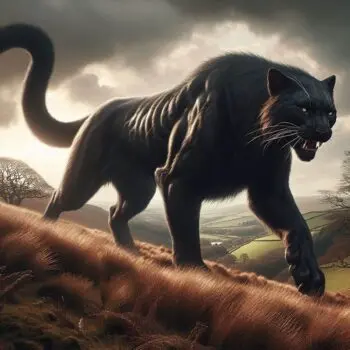
The Beast of Exmoor is classically defined as a large, dark, feline predator roaming the countryside of South-West England. While sightings vary in precise detail, a distinct consensus has emerged among witnesses over the decades regarding the creature’s physical characteristics.
According to those who claim to have crossed paths with the beast, it is typically described as a massive, muscular cat resembling a hybrid between a panther and a puma. Observers frequently estimate its length to be upwards of seven feet from nose to tail tip. It is said to possess sleek, midnight-black or dark-grey fur, piercing eyes, and an extraordinary capacity for stealth, often observed moving low to the ground while hunting.
Beyond its physical description, the beast is notoriously characterized by its alleged dietary habits: a voracious appetite for local farm livestock. Unlike standard predators native to the British Isles, the Beast of Exmoor has long been blamed not just for opportunistic kills, but for calculated, large-scale slaughters of sheep and lambs, often marked by clean, surgical precision bites or sheer, crushing brute force that leaves experienced farmers entirely confounded.
Chronology of the Legend: Decades of Fear and Sightings
While wild cat rumors in the British countryside date back centuries, the modern narrative of the Beast of Exmoor took root in the 1970s, steadily escalating into a national fixation by the 1980s.
The 1970s: The First Whispers
The initial reports began trickling in during the mid-to-late 1970s. Walkers, farmers, and rural residents reported fleeting glimpses of a large, cat-like creature bounding across country lanes or vanishing into the dense bracken. At the time, these accounts were largely dismissed by local authorities as misidentified domestic dogs, escaped farm cats, or the vivid imaginations of rural folk. However, the sheer consistency of the descriptions—specifically the size and coloration—began to trouble local agricultural workers.
1983: The Crisis in South Molton
The tipping point for the Exmoor myth occurred in 1983, centered around the rural area of South Molton in Devonshire. Over a terrifying two-and-a-half-month span, a local farmer suffered the catastrophic loss of more than 100 sheep.
The nature of the deaths was deeply unsettling. Unlike typical fox attacks, which usually target vulnerable newborn lambs and leave messy, torn carcasses, these sheep—many of them fully grown ewes—were found dead with massive trauma, crushed throats, and, in some cases, cleanly severed heads. The scale and brutality of the losses galvanized the local community and brought the national press flocking to the sleepy Devonshire countryside. The Beast of Exmoor had officially transitioned from local folklore to mainstream news.
The 1990s to Present: Ongoing Encounters
Throughout the 1990s and into the 21st century, the wave of sightings continued unabated. Farmers reported hearing blood-curdling screams in the night that resembled the vocalizations of large African or American cats. Motorists occasionally slammed on their brakes as massive feline silhouettes vaulted stone walls with effortless grace. Even as decades passed—a span far exceeding the natural lifespan of any illegally kept exotic pet from the 1970s—reports persisted, cementing the creature’s status as a permanent fixture of the British unexplained.
Supporting Data and Theories: Nature, Escape, or Myth?
Investigating the Beast of Exmoor requires navigating a complex web of ecological data, historical context, and psychological phenomena. Experts generally divide the potential explanations into three primary categories: escaped exotic pets, breeding populations of non-native felines, and misidentifications driven by folklore.
The Dangerous Pets Act of 1976 and the "Escape" Theory
The most widely accepted rational hypothesis revolves around the Dangerous Wild Animals Act of 1976. Prior to this legislation passing, it was entirely legal in the United Kingdom to purchase and keep exotic predators—such as pumas, panthers, and leopards—as private pets.
When the strict new licensing fees and housing requirements came into effect, animal owners suddenly faced heavy financial and legal burdens. Rumors quickly spread that rather than surrendering their dangerous pets to zoos or paying exorbitant permit fees, a number of owners deliberately released their exotic cats into the wild countryside of Exmoor and surrounding counties.
From a biological standpoint, this theory holds initial weight. Exmoor provides an abundant food supply—thousands of free-roaming sheep and a massive population of red deer and rabbits—along with vast tracts of uninhabited terrain where a solitary apex predator could easily hide.
However, zoologists frequently push back against the longevity of this theory. A solitary released cat would have a finite lifespan, typically 12 to 15 years in the wild. For sightings to continue reliably for over 40 to 50 years, there would necessarily have to be a breeding population of these animals—a scenario that experts argue would leave behind definitive scat, hair samples, kills, and carcasses that simply have never materialized in a conclusive manner.
Misidentification and Folklore Amplification
Skeptical investigators, including local wildlife trusts and naturalists, argue that the Beast of Exmoor is largely a product of mass hysteria, misidentified domestic fauna, and folkloric amplification.
Common culprits for "big cat" sightings in Britain frequently include:
- Large Domestic and Feral Cats: Domestic felines viewed at a distance in fog, twilight, or across uneven terrain can easily trigger optical illusions regarding scale, especially when silhouetted against familiar landmarks.
- Exmoor Ponies and Red Deer: The peculiar gait of a red deer stag moving through tall brush or mist has frequently been mistaken by startled motorists for a crouching panther.
- The Power of Suggestion: Once a legend takes hold in the public consciousness, ambiguous visual stimuli are automatically filtered through the lens of expectation. A flash of black fur or a rustle in the heather is immediately attributed to the Beast of Exmoor rather than a badger or a fox.
Official Responses: The Ministry and the Military
The persistence of the Beast of Exmoor has not gone unnoticed by the British government. Over the decades, public pressure and agricultural devastation forced official bodies to investigate the phenomenon, yielding mixed and occasionally bizarre results.
The Ministry of Agriculture Investigation (1983)
Following the devastating sheep losses in South Molton in 1983, the Ministry of Agriculture, Fisheries and Food (MAFF) took the unprecedented step of sending official marksmen and investigators to Exmoor to track and neutralize the creature.
For weeks, government trackers scoured the moors, setting traps and staking out fields where attacks had occurred. Despite their efforts, the marksmen failed to catch a glimpse of the animal, let alone capture or shoot it. The official government stance ultimately concluded that while livestock had undeniably been killed by an animal, there was insufficient physical evidence—such as a captured specimen or clear paw prints—to confirm the presence of a non-native big cat. The official reports suggested that many kills were likely the work of feral dogs, though local farmers vehemently rejected this conclusion, citing the specialized nature of the wounds.
The Royal Marines Deployment
Perhaps the most surreal chapter in the official response to the Beast of Exmoor occurred in the late 1980s. According to numerous reports and documentary accounts, units of the Royal Marines—stationed nearby—were reportedly deployed on exercises in the Exmoor region with unofficial authorization to attempt to track or locate the elusive predator. Equipped with advanced night-vision gear and fieldcraft training, the commandos swept the moorland valleys. Yet, much like the Ministry of Agriculture officials before them, the elite soldiers came up empty-handed, adding an almost mythical aura of invincibility to the creature they sought.
Implications: Agriculture, Tourism, and the Cultural Psyche
The legacy of the Beast of Exmoor extends far beyond the realm of cryptozoology; it touches deeply upon the economic, social, and cultural fabric of South-West England.
The Economic and Emotional Toll on Farmers
For the farming community of Exmoor, the beast is no amusing campfire tale. It represents a persistent economic threat and a source of deep anxiety. Livestock farming on the moors is already a grueling, economically precarious way of life. The sudden, unexplained loss of dozens of sheep—often uninsured or inadequately compensated—can spell financial ruin for a family-run farm. Beyond the financial ledger, the psychological toll of knowing an unseen, predatory force is operating in the shadows of one’s pastures has fostered a lingering sense of vulnerability among rural residents.
Tourism and the Modern Mythos
Conversely, the legend has proven to be a powerful boon for the regional tourism industry. Exmoor now embraces its mysterious reputation, drawing thousands of curious travelers, paranormal enthusiasts, and hikers hoping to catch a glimpse of the legendary predator. Local pubs, bed-and-breakfasts, and gift shops lean heavily into the lore, offering "Beast of Exmoor" themed merchandise, ales, and guided ghost and monster walks.
Furthermore, the enduring interest in the creature has made it a staple of media exploration, featured extensively in television documentaries such as MonsterQuest, regional news broadcasts, and countless investigative podcasts and books.
The Cultural Need for Mystery
On a broader psychological level, the Beast of Exmoor speaks to a fundamental human desire for mystery in an increasingly mapped, measured, and digitized world. In the 21st century, satellite imagery covers every square inch of the globe, and wildlife cameras monitor almost every recognized ecosystem. Yet, the continued existence of an untamed, unverified predator roaming the hidden coombes of the British countryside reassures us that nature still holds secrets we cannot fully quantify or control.
Whether the Beast of Exmoor is a surviving descendant of an illegally released exotic predator, a statistical anomaly born of misidentified wildlife, or a pure figment of rural folklore amplified by media attention, it remains an irreplaceable part of the British cultural landscape. As long as the mists roll across the dark heather of Somerset and Devon, the ghost cat of Exmoor will continue to hunt through the collective imagination of the nation.