









CALONGE I SANT ANTONI, Spain — Deep within the sun-drenched ruins of a Roman villa overlooking the Bay of Palamós in modern Catalonia, archaeologists have unearthed a fragment of ceramic history that is challenging long-held assumptions about the spread of ancient mystery religions.
Recent research published in the prestigious academic journal Antiquity details the discovery of a rare, serpent-decorated vessel fragment at the rural Roman villa of Collet, located approximately 90 kilometers (55 miles) north of Barcelona. According to the team of researchers—Marc Bouzas Sabater, Josep Burch Rius, Elisabet Moner Coll, Carles Roqué Pau, and David Vivo Codina—this artifact provides some of the earliest physical evidence that the secretive, ecstatic mystery cult of the Thracian and Phrygian deity Sabazios penetrated rural communities on the far western fringes of the Roman Empire.
While major urban centers like Rome and Emporiae are well-documented hubs of cosmopolitan religious exchange, this discovery suggests that obscure, foreign mystery cults possessed far wider networks than their sparse archaeological footprints historically implied.
Main Facts: The Collet Discovery and the Cult of Sabazios
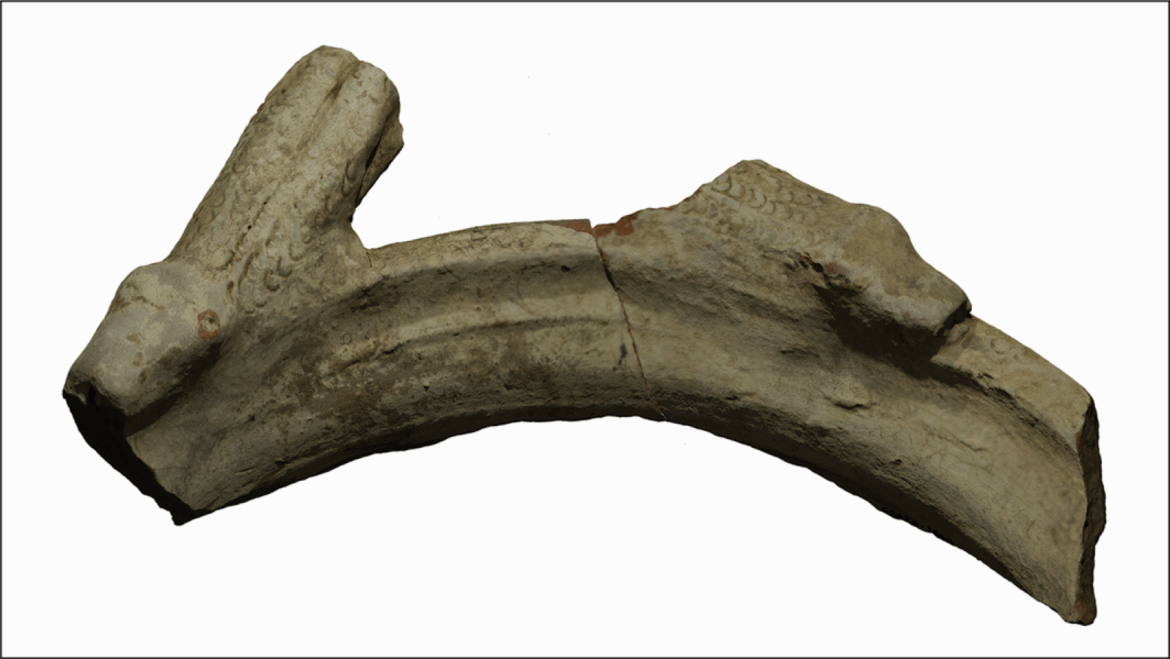
The centerpiece of the recent study is a collection of ceramic fragments belonging to a large vessel measuring approximately 230 millimeters (nine inches) in diameter. Unearthed from the Collet site, the most striking feature of the vessel is its surviving handle, meticulously fashioned into a two-headed serpent. Rows of precise semicircular incisions mimic scales, while the two distinct heads preserve recognizable, intricately detailed eyes and mouths.
Through advanced 3D digital reconstruction and comparative morphological analysis, the researchers connected the iconography directly to the worship of Sabazios.
- Who was Sabazios? Originally a nomadic sky and father god of horsemen originating in Thrace and Phrygia (modern-day southeastern Europe and Anatolia), Sabazios was gradually absorbed into Greek and Roman pantheons through religious syncretism, becoming closely linked with Zeus and, eventually, Jupiter.
- The Nature of the Cult: Unlike civic religions centered around public sacrifice and state temples, Sabazios was worshipped through mystery rites. These practices were largely conducted in private, domestic settings (sacra privata), making them notoriously difficult for modern archaeologists to detect.
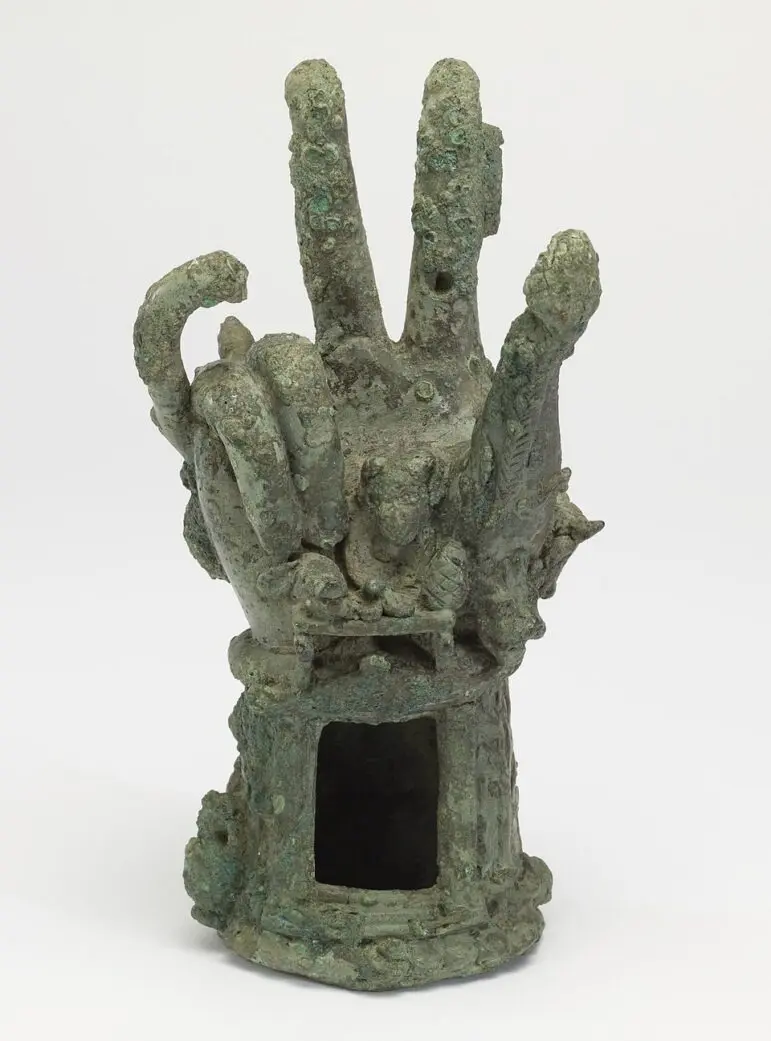
- Iconography: The cult is primarily identified through specific material culture: bronze votive hands (sabazeas) adorned with climbing snakes and other symbols, portable triptych plaques, and uniquely decorated ritual ceramics.
The discovery at Collet bridges a significant gap, proving that domestic and rural elites in remote corners of Hispania were participating in complex, foreign religious traditions that originated thousands of miles away in the eastern Mediterranean.
Chronology: From Thracian Plains to the Western Mediterranean
To understand the significance of the Collet vessel, historians must trace the long, often turbulent journey of Sabazios from an indigenous tribal deity to a recognized, if occasionally mocked, Mediterranean mystery god.
1. Origins and Classical Suspicion
In his earliest iterations, Sabazios was revered by the tribes of Thrace and Phrygia. As Greek influence expanded, his cult migrated into the Hellenistic world, eventually reaching Classical Athens. However, Athenian reception was far from welcoming. Because of the cult’s foreign origins and emotionally charged, ecstatic rituals, it was frequently viewed with suspicion, derision, and xenophobic anxiety.
The playwright Aristophanes openly mocked Sabazios and other imported foreign deities in his comedies. Later literary sources depict Sabazian mysteries as loud, chaotic affairs involving secret initiations and the handling of live snakes.
2. Integration into the Roman World
By the rise of the Roman Republic and the subsequent establishment of the Empire, the cult had shed some of its localized stigma, diffusing across Mediterranean trade and military routes. Yet, because worship was clandestine and private, physical traces remained remarkably scarce, particularly in the western provinces of the empire.
3. The Augustan Era in Hispania
The fragments recovered from the Roman villa of Collet have been securely dated to a remarkably early period. Archaeological contexts indicate that the vessel was broken and deposited during the Augustan period—stretching roughly from the reign of Emperor Augustus (27 B.C.E. to 14 C.E.) or slightly beforehand.
This chronology makes the Collet vessel an unusually early rural example of serpent-decorated ritual pottery in the Iberian Peninsula, predating many similar finds and demonstrating that the cult took root in Spain almost immediately following the consolidation of Roman imperial control.
Supporting Data: Material Analysis and Regional Context
The physical evidence marshaled by Sabater and his colleagues goes far beyond visual iconography. The team subjected the ceramic fragments to rigorous laboratory testing, including optical microscopy and X-ray diffraction analyses.
Laboratory Findings
The scientific tests revealed that the vessel was constructed from a compact red ceramic paste densely populated with mineral inclusions such as quartz and mica. Crucially, the mineral signature of the paste does not match local pottery manufacturing workshops in the immediate vicinity of Collet.

Furthermore, traces of a white slip coating led researchers to theorize a potential North African origin for the vessel, though the team exercises caution, noting that existing data is insufficient to pinpoint the exact manufacturing center. Whether imported from across the Mediterranean or acquired through regional trade hubs, the vessel was clearly a valued, specialized import.
The Emporiae Connection
The Collet discovery does not stand in a vacuum. It aligns with a growing body of evidence centered around the nearby ancient Roman city of Emporiae (modern Empúries). Previous excavations in and around Emporiae have yielded:
- A rare series of silver-plated bronze plaques forming a portable triptych, depicting Sabazios surrounded by religious symbols alongside the divine twins Castor and Pollux (the Dioscuri).
- Other serpent-decorated ceramic vessels recovered from nearby Roman settlements such as Tolegassos and Camp de la Gruta.
- Isolated finds elsewhere in the Iberian Peninsula, including a bronze votive hand near Cartagena and a small bronze bust from l’Alcúdia.
While serpent pottery alone is not exclusively tied to Sabazios—similar motifs occasionally appear in Mithraic or domestic contexts—the high concentration of these items around Emporiae, combined with the definitive Sabazios triptych, creates a compelling geographical and cultural cluster.
Official Responses and Academic Perspectives
The publication of the study in Antiquity has drawn considerable attention from classical historians, archaeologists, and scholars of ancient religion, who view the find as a methodological breakthrough in tracking elusive religious minorities.
Dr. Elena Vance, a classicist specializing in Mediterranean mystery cults who was not involved in the study, noted the importance of shifting focus away from monumental architecture toward domestic and rural spaces.
"For decades, our understanding of Roman religion was skewed by what survived in major civic centers—temples, inscriptions, and public statues," Vance explained. "Finds like the Collet vessel remind us that religious life at the edge of the empire was deeply personal, pluralistic, and remarkably mobile. People brought their gods with them in their luggage, in their ritual habits, and in their trade goods."
The authors of the Antiquity paper emphasize that the vessel’s presence in a rural agricultural villa—rather than an urban temple—forces a re-evaluation of how religious ideas trickled down through socioeconomic strata in provincial Hispania. They argue for the presence of itinerant religious specialists.

"The distribution of these high-status and specialized ritual objects suggests the presence of itinerant Sabazian priests or missionaries," the researchers wrote. "Operating out of larger urban nodes like Emporiae, these religious entrepreneurs traversed regional networks, introducing mystery rites to wealthy landowners and rural estate managers who sought personal spiritual connection beyond the traditional civic pantheon."
Implications: Rewriting the Geography of Ancient Mystery Religions
The implications of the Collet serpent vessel extend far beyond regional Iberian archaeology. They offer a window into the micro-mechanics of cultural transmission in the ancient world.
1. Expanding the Network Model
Traditional historical narratives often portray mystery cults as centralized movements radiating outward from major metropolises in neat, concentric circles. The discovery in Collet suggests a more decentralized, leapfrog-style diffusion model. Specialized religious traditions could bypass intermediate towns and appear suddenly in remote rural estates if an individual landowner, merchant, or itinerant priest possessed the inclination and the network to acquire foreign ritual goods.
2. The Intersection of Trade and Faith
The material journey of the Collet vessel—potentially manufactured in North Africa, traded through Emporiae, and smashed on a rural estate in Catalonia—underscores how deeply intertwined ancient commerce and religion were. Sacred objects moved along the exact same maritime and overland trade corridors as olive oil, wine, and grain.
3. Personal Piety at the Edge of Empire
For modern observers, the image of a Roman villa owner in rural Spain engaging in ecstatic, serpent-based mystery rites dedicated to a Thracian god highlights the astonishing religious diversity of the ancient Mediterranean. Long before the rise of Christianity homogenized the religious landscape of Europe, individuals living under the Pax Romana freely blended local identities, imperial citizenship, and esoteric foreign faiths.
As archaeological techniques become more refined and scholars pay closer attention to the fragments of domestic life, the invisible networks of the ancient world continue to snap into focus. The serpent vessel of Collet ensures that Sabazios—once an obscure, mocked outsider god of the Thracian hills—will continue to cast his long, winding shadow across the history of Roman Spain.