







Main Facts: Beyond Poetic Labels to Indigenous Timekeeping
Long before the advent of digital calendars, atomic clocks, and glowing smartphone screens, humanity relied on a much grander timepiece: the night sky. For thousands of years, Indigenous peoples across North America looked upward, treating the lunar cycle not merely as a nightly spectacle, but as an essential, highly sophisticated ecological calendar. By coupling the phases of the moon with subtle environmental transitions—the migration of fish, the blooming of wildflowers, the freezing of swamplands, and the ripening of berries—they established a dynamic system of timekeeping.
The full moon names recognized widely today—such as the Wolf Moon, Pink Moon, and Harvest Moon—are frequently mischaracterized as mere poetic relics of the past. In reality, they are linguistic archives of ecological observation and tribal wisdom. Primarily rooted in the Algonquian language family, these names were subsequently adopted and adapted by European settlers who arrived in North America. Yet, far from being a static folklore tradition, lunar naming systems represent a fluid, living library of scientific data gathered over millennia. They reflect a profound, reciprocal relationship between human communities and their surrounding ecosystems, acting as a bridge between celestial mechanics and terrestrial survival.
Chronology: The Evolution of the Lunar Calendar and Colonial Adaptation
To understand how contemporary society came to recognize names like the "Strawberry Moon" or the "Beaver Moon," one must trace a timeline stretching back millennia before European contact, followed by centuries of cultural synthesis.
Pre-Colonial Era: The Indigenous Lunar Foundation
Long before the imposition of the Julian or Gregorian calendars, North American Indigenous nations tracked time through the rhythm of the seasons and lunar months. In Anishinaabe tradition, Nookomis Dibik-Giizis (Grandmother Moon) is revered as a primary teacher.
Tribal calendar structures varied significantly according to geography and ecological needs:
- The 12-to-13 Moon Cycle: While some communities structured their year around 12 lunar months, others tracked 13 moons, inserting an intercalary moon to realign the lunar cycle with the solar year.
- Seasonal Variations: Rather than adhering to a rigid four-season model, certain tribes observed five distinct seasons, beginning their annual cycle in the spring or the fall.
These calendars dictated vital survival tasks. For the Ojibwe—one of the largest Algonquian-speaking tribes in the Great Lakes region—every critical activity, from copper mining and birchbark canoe construction to the intricate harvesting of wild rice (manoomin) and maple syrup, was strictly timed by the lunar phases.
The Colonial Era: Cultural Synthesis
As European settlers arrived in North America, they encountered a landscape radically different from their own. The incoming settlers brought with them their own traditional moon names, many of which had Celtic and Old English origins (such as the "Wolf Moon" for January). Furthermore, medieval European agricultural traditions contributed monikers like the "Mead Moon" for July, the "Grain Moon" for August, and the "Barley Moon" for September.
Upon settling, colonists quickly realized that European timekeeping methods poorly suited North American weather patterns and agricultural cycles. Through necessity and observation, they adopted and adapted Indigenous naming conventions. This cultural exchange created a hybrid system that blended European linguistic elements with deep-seated Native American environmental wisdom, laying the groundwork for modern almanacs.
The 18th Century to the Present: Institutionalization and Preservation
By the late 1700s, publications such as The Old Farmer’s Almanac began codifying and publishing these full moon names, introducing them to mainstream American culture. While this widespread distribution successfully preserved a fraction of Indigenous nomenclature, it also homogenized a vastly diverse linguistic landscape, often reducing regionally specific tribal observations into singular, universalized "traditional" names.
Supporting Data: A Seasonal Journey Through the Twelve Moons
Because North America spans vast climatic zones—from the subarctic forests of Ontario to the temperate woodlands of New England—moon names varied dramatically by region. However, examining the traditional seasonal classifications reveals a masterclass in survival intelligence.
Winter Moons: Survival, Endurance, and Scarcity
Winter was a test of resilience, reflected starkly in the names given to the deep-freeze months.
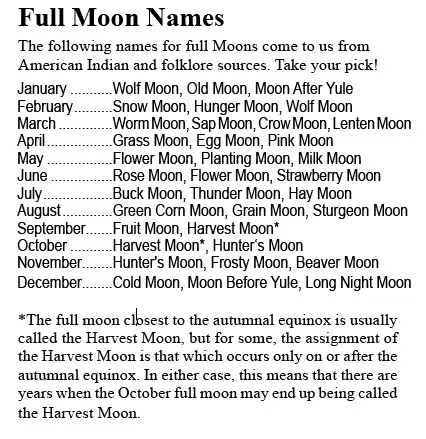
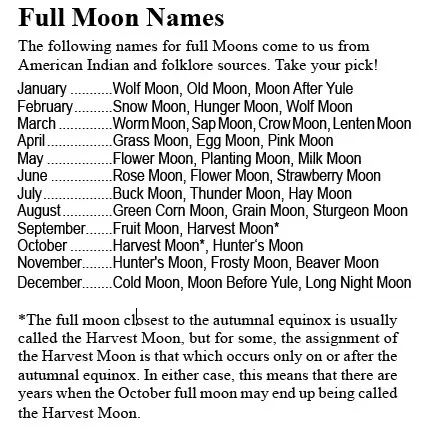
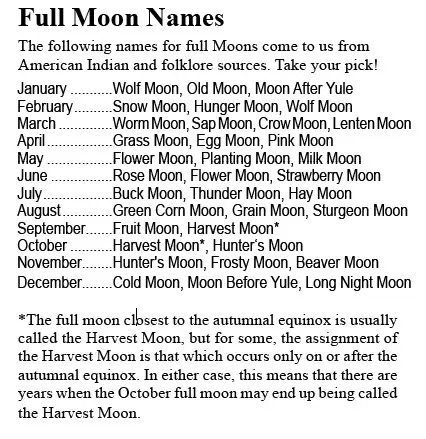
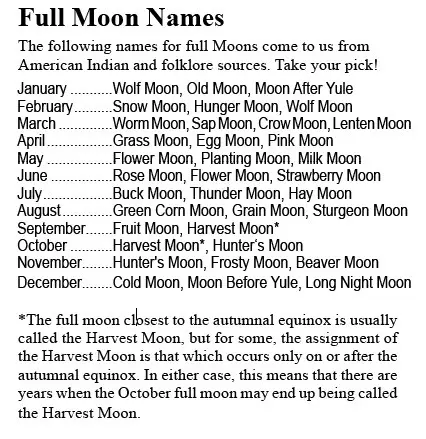
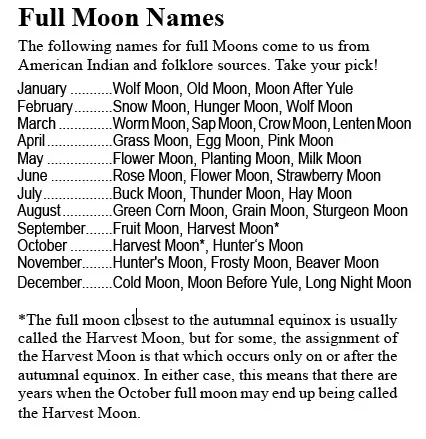
- January – Wolf Moon: While European settlers named this moon after the howling of hungry wolves echoing through winter nights, many Native American tribes designated it the Severe Moon or Center Moon, marking the brutal midpoint of winter.
- February – Snow Moon / Hunger Moon: Reflecting peak winter intensity, this moon was widely called the Hunger Moon due to depleted food stores. Conversely, the Ojibwe named it after the sucker fish—a crucial lifeline for winter survival—while other tribes called it the Bear Moon, aligning with the birth of bear cubs.
Spring Moons: Renewal, Thaw, and Emergence
As temperatures rose, the lunar focus shifted from endurance to rebirth.

- March – Worm Moon: Named for the reappearance of earthworm casts as the soil softened, signaling the return of robins. Northern tribes, however, knew it as the Crow Moon (signaled by the cawing of returning crows), Snow Crust Moon, or Sap and Sugar Moon, marking the onset of maple syrup production.
- April – Pink Moon: Named for the carpets of wild ground phlox (Phlox subulata) blooming across North America. The Ojibwe associated this period with boiling maple sap, while other eastern and midwestern nations called it the Breaking Ice Moon or The Moon of the Red Grass Appearing.
Summer Moons: Abundance, Harvest, and Natural Rhythms
Summer brought a bounty of resources, dictating periods of intense agricultural and foraging activity.
- May – Flower Moon: Honoring the peak of spring floral blooms and serving as a seasonal marker for planting corn.
- June – Strawberry Moon: Universally recognized across numerous tribes (including the Ojibwe) for the ripening of wild strawberries. Coastal communities simultaneously tracked it as the Fish Moon, marking the upstream migration of shad.
- July – Buck Moon / Thunder Moon: Named because male deer (bucks) grow their antlers at peak velocity during this month. It is also termed the Thunder Moon due to frequent summer tempests.
- August – Sturgeon Moon: Highlighting the peak catch of sturgeon in the Great Lakes and Lake Champlain. For the Anishinaabe, this moon (Manoomini-giizis) directed the vital ritual harvest of wild rice.
Autumn Moons: Preparation and Gathering
Autumn required intensive labor to secure provisions before the return of frost.
- September – Harvest Moon: The full moon closest to the autumnal equinox, signaling the gathering of core staples: corn, pumpkins, squash, beans, and wild rice.
- October – Hunter’s Moon: Historically marked as the optimal hunting window, as game animals were fattened from summer grazing and cleared fields exposed hiding prey.
- November – Beaver Moon: Signaled the time to set beaver traps before swamps froze to secure pelts for winter warmth, or simply observed as the period when beavers actively fortified their lodges.
- December – Cold Moon: Marking the return of heavy snows, deep-winter isolation, and long nights, frequently dubbed the Long Night Moon or Hunger Moon.
Official Responses and Perspectives: Respect, Recognition, and Cultural Stewardship
In recent decades, folklorists, ecologists, and Indigenous leaders have spoken out regarding how these lunar traditions are taught, consumed, and commercialized.
Cultural Preservation vs. Homogenization
Cultural historians emphasize that the popularization of moon names through commercial almanacs has often divorced the monikers from their specific tribal creators. Anthropologists note that with 576 federally recognized tribes in the United States alone—alongside hundreds of First Nations in Canada—there is no single, monolithic "Native American calendar."
For instance, the Anishinaabeg people continue to utilize Gookomisinaan dibik-giiziso-mazina’igan (their traditional lunar calendar) to govern cultural and ecological practices, maintaining a direct line to ancestral heritage that operates entirely outside the Gregorian calendar.
The Call for Ethical Engagement
Tribal educators and indigenous rights advocates stress that appreciating full moon names requires more than casual stargazing curiosity; it demands cultural literacy and respect. Official guidance from cultural heritage organizations highlights several core principles for modern nature enthusiasts:
- Acknowledge Indigenous Origins: Public media, astronomy clubs, and weather outlets are increasingly urged to explicitly credit the specific tribal nations (such as the Algonquian, Ojibwe, or Cree) from which specific moon names originate.
- Local Ecological Awareness: Rather than blindly applying terms like "Worm Moon" or "Snow Moon" to regions where those phenomena do not align with local climate realities, modern observers are encouraged to study the indigenous histories and ecological markers of their specific geographic localities.
Implications: Climate Change and the Resilience of Living Traditions
The study and utilization of traditional lunar calendars carry profound implications for contemporary environmental science and climate resilience.
The Disruption of Phenology
Phenology—the study of cyclic and seasonal natural phenomena, especially in relation to climate and plant and animal life—is currently undergoing rapid disruption worldwide. Climate change has accelerated spring thaws, shifted migration patterns, and altered flowering times across North America.
Interestingly, traditional lunar naming systems were never rigid; they were inherently flexible, designed to adapt to shifting environmental conditions. Today, many Indigenous communities are utilizing their ancestral calendars to document climate anomalies. By comparing historical lunar observations with modern ecological shifts, tribal scientists and environmental researchers are tracking the impacts of global warming on local ecosystems with remarkable precision.
Reconnecting with the Natural World
In an era dominated by hyper-connectivity, artificial lighting, and digital timekeeping, the ancient practice of tracking the moon offers a psychological and ecological anchor. Modern psychologists and environmentalists note that tuning into lunar cycles encourages a deeper mindfulness of the natural world.
By recognizing that names like the "Strawberry Moon" or "Hunter’s Moon" were born out of absolute reliance on—and respect for—Earth’s biological rhythms, contemporary society can cultivate a renewed sense of environmental stewardship. Ultimately, honoring the cultural heritage behind full moon names transforms stargazing from a passive hobby into an active dialogue with the cosmos and the rich, enduring wisdom of the Indigenous peoples who first mapped the skies.