Long before the advent of digital calendars, atomic clocks, or smartphones glowing with real-time notifications, humanity synchronized its existence with the celestial clockwork overhead. For thousands of years, Indigenous peoples across North America looked up at the full moon and found deep ecological, spiritual, and practical meaning in its shifting faces. These lunar cycles served as an essential, dynamic timekeeping system—a living calendar inextricably linked to the rhythm of the changing seasons.
Today, terms like "Wolf Moon," "Pink Moon," and "Harvest Moon" are widely recognized in popular culture, weather almanacs, and stargazing communities. However, these monikers are far more than poetic or whimsical labels. They represent a sophisticated framework of environmental observation, ecological stewardship, and ancient cultural wisdom cultivated by Indigenous communities long before European contact.
Main Facts: The Intersection of Cosmos and Ecology
At its core, the traditional naming of full moons is a masterclass in reading the natural world. While modern society relies predominantly on the static Gregorian solar calendar—where months march forward uniformly regardless of whether snow is falling or flowers are blooming—ancestral lunar calendars were remarkably fluid and responsive.
Within Anishinaabe tradition, the moon is referred to as Nookomis Dibik-Giizis, or Grandmother Moon, considered a primary teacher and guide. Unlike the solar year, which fixes a strict 365-day count divided into 12 rigid months, traditional Indigenous timekeeping often tracked 12 or 13 lunar months, aligning closely with the Earth’s seasonal transitions.
The nomenclature most widely adopted in contemporary mainstream culture derives primarily from the Algonquian language family. Stretching historically from New England to Lake Superior, Algonquian-speaking groups—most notably the Ojibwe (Chippewa)—passed down a rich lexicon of moon names that European settlers later encountered, adapted, and integrated into early American colonial life. These names acted as mnemonic devices, reminding communities of critical survival tasks: when to tap maple trees, when to set traps, when to harvest wild rice, and when to prepare for the bitter hardship of deep winter.
Chronology and Historical Adaptation: Bridging Two Worlds
The historical trajectory of North American moon names is a story of cultural synthesis, adaptation, and preservation.
Pre-Colonial Era: The Indigenous Foundation
Long before European vessels reached North American shores, hundreds of distinct Indigenous nations maintained sophisticated oral and observational histories. With roughly 576 federally recognized tribes in the United States alone—and many more across Canada—there was never a single, monolithic "Native American calendar."
Instead, lunar naming was profoundly localized. Climate variations meant that a tribe in southeastern Ontario experienced spring thaws weeks earlier or later than a community in North Dakota. Tribes observed animal migrations, the blooming of specific flora, the freezing and thawing of waterways, and celestial alignments, weaving these observations directly into their tribal governance and survival strategies. Among the Ojibwe, activities such as copper mining and trade, birchbark harvesting, wild rice gathering (Manoomin), and maple sugaring were strictly timed according to the phases of Grandmother Moon.
The Colonial Era and European Influences
When European settlers arrived in North America, they brought their own agricultural and folkloric traditions for tracking time. Medieval European traditions, for instance, utilized terms like the "Mead Moon" for July, the "Grain Moon" for August, and the "Barley Moon" for September, reflecting a parallel human desire to connect celestial bodies with terrestrial labor.
Upon interacting with Algonquian-speaking tribes, settlers quickly realized the practical value of Indigenous ecological knowledge. Colonial Americans adopted many Native American moon names, blending them with their own linguistic habits and Old English or Celtic traditions. For example, the term "Wolf Moon" for January is widely believed to have roots in Old English folklore—signifying the eerie sound of hungry wolves howling outside winter settlements—even as Indigenous communities used names like "Severe Moon" or "Center Moon" to denote the stark realities of midwinter survival.
Supporting Data: A Journey Through the Twelve Moons
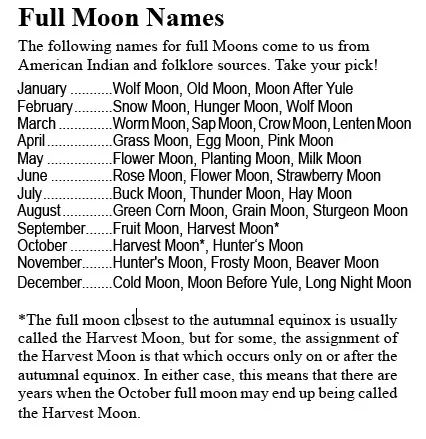
To truly understand the depth of this timekeeping system, one must examine how the moon names trace the wheel of the year, tracking the cyclical drama of survival, renewal, abundance, and preparation.

Winter Moons: Survival and Endurance
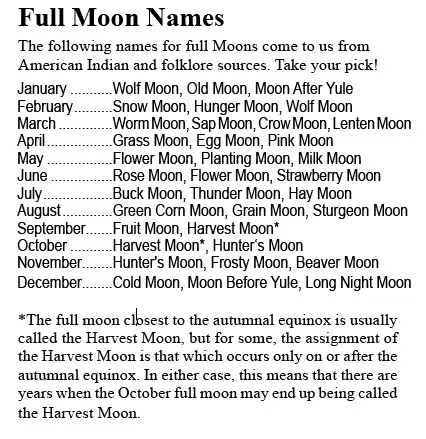
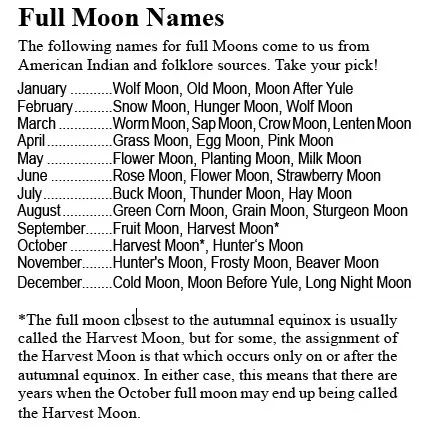
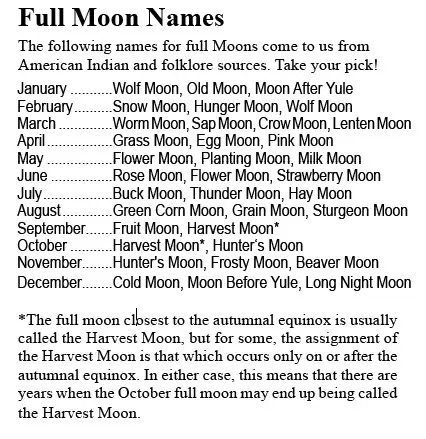
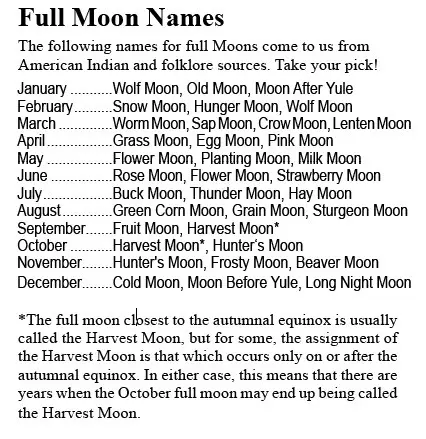
- January – Wolf Moon: Marking the dead of winter, when freezing temperatures and deep snows made food scarce, driving wolves to howl near human encampments. Native equivalents often highlighted endurance, such as the Ojibwe observations of deep-winter stillness.
- February – Snow Moon / Hunger Moon: February represents winter’s peak intensity. Referred to by some northern tribes as the Hungry Moon due to depleted winter stores, it was also called the Bear Moon, marking the birth of bear cubs, or named after the sucker fish, a vital late-winter food source.
Spring Moons: Renewal and Growth
- March – Worm Moon: As the ground softens and spring approaches, earthworm casts reappear, signaling the return of robins. Northern tribes often knew this as the Full Crow Moon, marking the cawing of crows, or the Sap and Sugar Moon, as maple syrup production began.
- April – Pink Moon: Named for the vibrant pink phlox wildflowers (Phlox subulata) blooming across North America. Indigenous groups also tracked this period through environmental shifts, calling it the Breaking Ice Moon or the Moon of the Red Grass Appearing.
Summer Moons: Abundance and Activity
- May – Flower Moon: Spring reaches its crescendo, with blossoms blanketing the landscape. This moon also served as a strict agricultural timer, indicating the ideal window for planting corn.
- June – Strawberry Moon: Highlighting the brief, sweet window when wild strawberries ripen. Coastal tribes frequently called this the Fish Moon, as shad began migrating upstream.
- July – Buck Moon / Thunder Moon: Male deer grow their antlers at maximum velocity during this period. Frequent summer electrical storms also earned it the title Thunder Moon.
- August – Sturgeon Moon: Marked by the peak harvest of sturgeon in the Great Lakes and Lake Champlain. For the Anishinaabe, this moon (Manoomini-giizis) signifies the critical sacred harvest of wild rice.
Autumn Moons: Harvest and Preparation
- September – Harvest Moon: Traditionally defined as the full moon closest to the autumnal equinox. It provided the prolonged twilight needed for farmers and gatherers to secure the season’s final crops—corn, beans, squash, and wild rice.
- October – Hunter’s Moon: With fields cleared of crops and trees stripped of leaves, game animals stood exposed, fattened from a summer of foraging. It was historically the prime month for hunting and securing winter meat.
- November – Beaver Moon: Signaled the ideal time to set beaver traps before swamps froze solid, securing warm pelts, or observed the frantic dam-building activity of beavers preparing for the cold.
- December – Cold Moon / Long Night Moon: Deep winter returns, bringing the longest nights of the year, heavy snows, and renewed challenges in foraging and survival.
Official Responses and Cultural Perspectives
In contemporary discourse, cultural institutions, environmental scientists, and tribal leaders increasingly emphasize the necessity of respecting the Indigenous origins of these lunar traditions.
For generations, popular publications like The Old Farmer’s Almanac—which has published traditional moon names since the late 18th century—helped popularize these terms globally. However, cultural historians and Indigenous scholars stress that extracting a name from its cultural context without acknowledging its roots strips away its profound educational value.
Tribal councils and cultural preservationists across North America point out that these names are manifestations of living, breathing legal and ecological relationships with the land. The Anishinaabe people continue to utilize Gookomisinaan dibik-giiziso-mazina’igan (their traditional lunar calendar) to guide cultural practices, language revitalization, and ecological monitoring.
Academic institutions and environmental agencies have also begun recognizing the value of Traditional Ecological Knowledge (TEK). By integrating Indigenous insights into modern climate tracking, researchers gain a nuanced, generational perspective on how ecosystems respond to long-term environmental shifts.
Implications: Climate Change and the Evolution of Tradition
The preservation and study of traditional moon names carry significant implications for our modern relationship with the planet.
First, these naming systems highlight the adaptability of human timekeeping. Far from being rigid dogma, ancestral calendars were inherently flexible, shifting in response to environmental feedback. Today, as anthropogenic climate change disrupts global weather patterns, traditional lunar calendars face unprecedented stress. Unseasonably warm winters, erratic spring thaws, and shifting animal migrations mean that historical markers—such as the emergence of worms in March or the ripening of strawberries in June—are increasingly out of sync with calendar dates.
This disruption serves as an environmental warning sign. Indigenous communities, whose traditional knowledge systems are sensitive to micro-climatic changes, are at the forefront of documenting these ecological anomalies. By observing how traditional markers shift, modern scientists can better understand the real-time velocity of climate change.
Second, re-engaging with traditional moon names encourages a cultural shift away from passive consumption of time toward active ecological mindfulness. For modern nature enthusiasts and stargazers, learning these names offers a gateway to deeper environmental literacy. It encourages individuals to look beyond urban light pollution and concrete jungles to notice the subtle, cyclical changes happening in local flora and fauna.
Conclusion: Honoring Ancestral Wisdom in the Modern Age
The full moon names we encounter today are far more than poetic linguistic artifacts; they are windows into a sophisticated, time-tested system of ecological science and cultural memory. Developed over millennia by Indigenous peoples who read the land as closely as the stars, these names reflect an intimate, reciprocal relationship with the natural world.
As we look toward the night sky to witness the next full moon, we are invited to do so with renewed intentionality. By acknowledging the Indigenous origins of these lunar traditions, supporting tribal sovereignty and cultural preservation, and attuning ourselves to the changing rhythms of the local environment, we bridge the gap between ancient wisdom and modern stewardship. Grandmother Moon continues to teach those willing to watch, listen, and respect the living traditions written across the cosmos.
Note: When engaging with traditional lunar names, individuals are encouraged to honor their Indigenous roots and research the specific tribal nations native to their geographical region, whose unique local histories and lunar traditions offer an even deeper connection to the land beneath our feet.