









By Global Wellness & Psychology Desk
Published: August 2026
Main Facts
In an era defined by rising rates of clinical anxiety, burnout, and hyper-vigilance, stories of unconventional recovery offer profound insights into mental health treatment. Dr. Daniel H. Shapiro, a noted keynote speaker, mentor, and author of The 5 Practices of the Caring Mentor, has shared a deeply personal account of overcoming debilitating panic attacks not through traditional pharmaceutical or therapeutic breakthroughs alone, but through an unexpected bond with nature—specifically, a magnificent banyan tree in a Florida park.
The core narrative highlights a universal psychological trap: chronic anxiety forces an individual into an inward-facing loop of self-monitoring, where every heartbeat, chest tightening, and stray thought is treated as an impending catastrophe. Shapiro’s experience underscores how shifting focus outward—toward the care of another living organism—can radically disrupt the neurological feedback loops of panic. What began as a desperate flight from urban stress transformed into a decades-long lesson in ecological connection, resilience, and the power of altruistic presence. Today, the banyan tree, affectionately named "Nelly" by Shapiro’s children, stands as a living testament to the symbiotic relationship between human mental health and environmental stewardship.
Chronology of Events
The Philadelphia Crucible and the Onset of Panic
The journey began in the early 2000s, shortly after Shapiro graduated from college. Following what he believed to be the conventional blueprint for success, he relocated to Philadelphia to pursue a master’s degree. Balancing grueling daytime work with evening classes in an unfamiliar and demanding metropolis, Shapiro found himself stretched thin.
Though he had managed baseline anxiety for most of his youth, the cumulative stress triggered a sudden, severe physiological shift. Without warning, he began experiencing acute panic attacks. Characterized by sudden surges of internal trembling, severe chest constriction, and a terrifying inability to catch his breath, the attacks rapidly eroded his quality of life. Standard environments, such as classrooms, workplaces, and even movie theaters, became zones of high alert. Initial attempts at psychotherapy yielded few immediate answers. Overwhelmed and believing he had failed, Shapiro packed his belongings after his first semester and returned home to Florida, carrying his psychological distress with him.
The Sanctuary by the Pond
At twenty-two years old, directionless, and feeling as though his mind and body were "constantly on fire," Shapiro sought refuge outdoors. He began taking daily walks through a local park featuring a small pond and an expansive banyan tree.
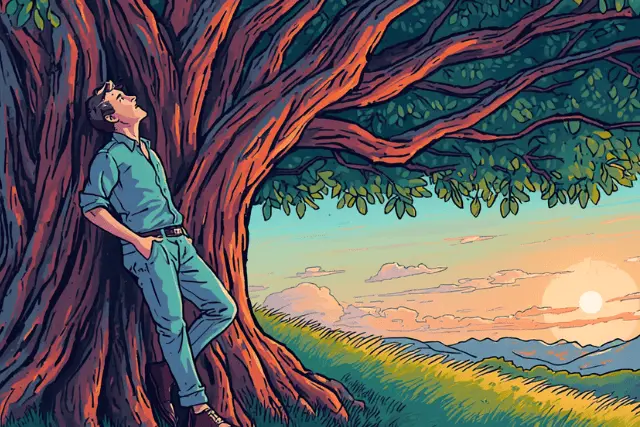
Unlike conventional trees that rely solely on upward growth, banyan trees drop secondary aerial roots from their massive branches, anchoring them into the soil to form living pillars and overarching canopies. Drawn to its protective architecture, Shapiro climbed into the diverging limbs of the tree one afternoon. For the first time in months, his nervous system settled. Resting against the bark, he experienced a profound sense of relief, feeling as though the massive organism was absorbing his distress and grounding it into the earth.
The Act of Healing Through Stewardship
During subsequent visits, Shapiro noticed a troubling detail: the trunk and limbs were scarred with old, rusted nails and newer fasteners driven into the wood by anonymous visitors. Perceiving these embedded spikes as acts of careless violence against a generous shelter, Shapiro began a quiet campaign of remediation. He climbed higher into the branches, painstakingly prying out each nail.
This physical labor shifted his psychological state entirely. As he worked to free the tree from foreign obstructions, his panic attacks diminished in frequency and intensity. He realized that the act of tending to the tree had temporarily freed him from the suffocating prison of self-monitoring. Even when away from the park, simply visualizing the banyan tree could instantly slow his heart rate and soothe his body.
Generational Legacy
Decades later, the banyan tree remains central to Shapiro’s life. Following his marriage and the birth of his children, the park was the first destination he shared with them. His daughter formally christened the tree "Nelly." Today, watching his own children climb the exact same branches that once cradled him through his darkest season provides Shapiro with a deep sense of generational continuity and gratitude.

Supporting Data and Psychological Context
While Shapiro’s narrative is deeply personal, it aligns closely with emerging clinical research regarding eco-therapy, somatic healing, and attention regulation models in psychology.
The Mechanics of Hyper-Vigilance
Clinical psychologists note that panic disorders frequently trap patients in a cycle of hyper-vigilance. According to cognitive-behavioral frameworks, anxiety heightens interoceptive awareness—the ability to perceive internal bodily sensations. For someone experiencing panic, normal physiological shifts (like an elevated heart rate from walking up stairs) are catastrophized as signs of a heart attack or psychological collapse. Shapiro’s observation that anxiety forces attention entirely inward is validated by brain-imaging studies, which show heightened activity in the default mode network (DMN) of individuals experiencing chronic rumination and anxiety.
Eco-Therapy and Biophilia
The therapeutic benefits of nature are increasingly backed by empirical data. The concept of "biophilia," popularized by biologist E.O. Wilson, suggests that human beings possess an innate, genetically determined affinity for the natural world. Research published in environmental psychology journals demonstrates that immersion in natural settings—often referred to as "forest bathing" or Shinrin-yoku—reduces cortisol levels, lowers blood pressure, and dampens sympathetic nervous system arousal.
Furthermore, studies on altruism and outward-focused tasks show that engaging in prosocial behavior or environmental care activates the brain’s reward pathways (releasing dopamine and oxytocin). By shifting energy from internal threat detection to external caretaking, Shapiro inadvertently utilized a somatic distraction and mindfulness technique that interrupted his panic cycle.
Official and Expert Responses
Mental health advocates, educators, and environmental psychologists have praised Shapiro’s essay for bridging the gap between clinical theory and lived experience.
Dr. Elena Rostova, a clinical psychologist specializing in anxiety disorders in young adults, commented on the psychological mechanisms highlighted in the account:
"What Dr. Shapiro describes is a masterclass in shifting the ‘attentional spotlight.’ In therapy, we spend a tremendous amount of time trying to teach patients to argue with their anxious thoughts. But often, the most effective antidote to internal panic is a radical shift in perspective—turning our gaze outward. When we care for a plant, an animal, or another human being, we step outside the echo chamber of our own fears. The nervous system recognizes safety not just through logic, but through connection."
Environmental education advocates have also pointed to the story as a powerful reminder of urban conservation’s role in public health. Parks departments across the United States have increasingly emphasized the "therapeutic infrastructure" of public green spaces, arguing that investment in urban forestry yields direct dividends in community mental health metrics.
Implications for Modern Mental Health
Shapiro’s reflection offers several critical takeaways for contemporary discourse surrounding mental health, personal development, and holistic healing:
- Re-evaluating the Healing Journey: Society often frames recovery from mental health crises as a linear process achieved strictly within clinical offices. Shapiro’s narrative demonstrates that healing is frequently ecological, relational, and multidisciplinary, drawing strength from unexpected environments.
- The Danger of Hyper-Focus: Modern digital culture—imbued with endless notifications, self-tracking apps, and hyper-individualism—often exacerbates the inward-looking panic that Shapiro experienced. The antidote may lie in intentional practices of outward service, ecological stewardship, and community engagement.
- Passing Down Resilience: The emotional resonance of returning to the banyan tree with his children highlights the importance of intergenerational spaces. Healing environments do not merely cure the individual; they become sanctuaries that can be passed down to anchor future generations.
As Dr. Daniel H. Shapiro continues his work as a mentor and author, his experience with Nelly the banyan tree serves as an enduring reminder: while inner emotional work is indispensable, true recovery often begins the moment we look past our own suffering, tend to the world around us, and discover that we are part of something much larger than ourselves.