There is a precise, fleeting threshold that Los Angeles-based sculptural artist Katrien Van der Schueren searches for in her work—not the moment a piece is definitively finished, but the moment it arrives. It is the instant when an object ceases to be merely raw elements manipulated by human hands and instead becomes, as she describes it, a true version of itself. It is not necessarily the only version, nor is it a rigid destination; rather, it is the singular iteration that exists for the present moment.
It is perhaps the most honest declaration an artist can make about a creative practice rooted in transformation. This underlying philosophy dictates every object, vessel, and lighting fixture that leaves her studio. In a contemporary design landscape often dominated by mass-produced uniformity and frictionless digital rendering, Van der Schueren’s tactile practice offers a stark, grounding counter-narrative: a celebration of friction, intuition, and heavy materials coaxed into soft, undeniable grace.
Main Facts: Industrial Might Meets Intimate Form
Katrien Van der Schueren works masterfully with a palette of materials that possess, by all traditional standards, no business being delicate. Her primary mediums include raw timber, heavy structural metals, dense plaster, bio-resin, and industrial concrete. Yet, through an intuitive alchemy, she transforms these rigid, heavy components into forms that are entirely, unmistakably feminine and profoundly poetic.
The Mediums: Concrete, metal, wood, plaster, and bio-resin.
The Aesthetic Tension: The heavy weight of industrial components against the ethereal lightness of organic forms; the collision of the industrial landscape with intimate domestic spaces.
The Portfolio: Ranging from dramatic wall sconces and sculptural vessels to bespoke architectural installations, such as the striking Gold Mural Fireplace.
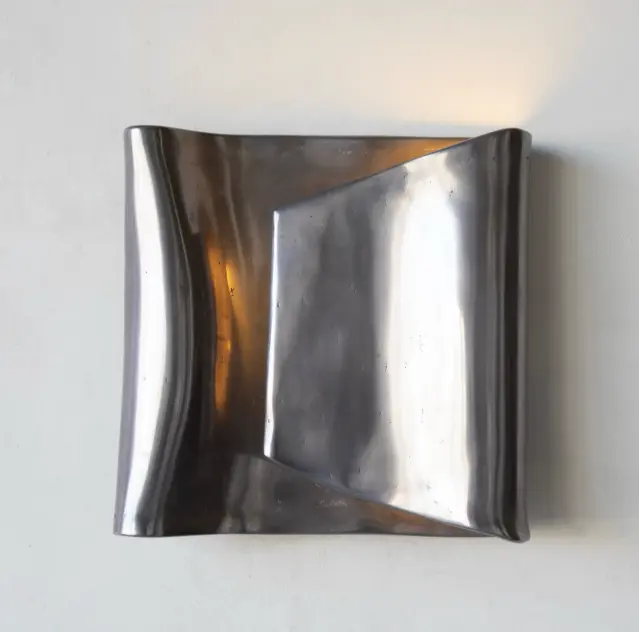
The Standout Piece: The Envelope Sconce—a 12-by-12-inch concrete wall light featuring a cold-applied liquid bronze tin and white bronze finish that mimics folded paper.
The Location: Los Angeles, California, where her working studio serves as a crucible for material experimentation.
Chronology: The Evolution of a Material Practice
To understand Van der Schueren’s current standing in the international design community, it is helpful to trace the trajectory of how industrial sculpture transitioned from heavy infrastructure to high-end interior architecture.
Early Experimentation: Van der Schueren’s foundational years were defined by an intense, hands-on exploration of hard construction materials. Moving away from traditional fine art mediums, she gravitated toward the unyielding nature of concrete and metal, seeking to uncover emotional resonance within stubborn, rigid substances.
The Shift Toward Function and Sculpture: As her practice matured, the boundary between pure fine art and functional design began to dissolve. She expanded her portfolio to include lighting and architectural elements—such as wall sconces and statement fireplaces—that occupy the rare space between museum-grade sculpture and everyday utility.
Commercial and Residential Integration: Over the past decade, her work has been increasingly specified by elite interior designers and collectors across Los Angeles and international markets. Her pieces have found homes in high-end residential estates and sophisticated commercial spaces where spatial narrative is paramount.
The Digital and Editorial Recognition: Through regular features in architectural and design editorial series—most notably Roomhints’ Studio Visit—Van der Schueren’s physical workspace and artistic philosophy have been brought to a broader audience of design professionals and connoisseurs.
Supporting Data & Technical Specifications
In the world of bespoke artisanal design, the marriage of technical execution and material integrity dictates an object’s longevity and impact. Van der Schueren’s work relies heavily on precise physical properties and meticulous surface treatments.
Material Resiliency and Composition
Concrete as a Canvas: Unlike structural concrete used in civil engineering, the concrete utilized in Van der Schueren’s studio is carefully refined to capture micro-textures, retaining the raw honesty of the aggregate while allowing for razor-thin edges and fluid curvatures.
Surface Finishes: The application of cold-applied liquid bronze tin and white bronze finishes requires specialized techniques. These metallic skins interact dynamically with ambient environments, shifting visual properties depending on the angle and intensity of natural and artificial light.
Dimensional Constraints: Pieces like the Envelope Sconce demonstrate a strict adherence to human-scaled interaction—measuring 12 × 12 inches—ensuring that the object commands attention without overwhelming the architectural plane it inhabits.
Official Statements & Studio Philosophy: On Surrender and Obsession
When asked about her creative formulas, Van der Schueren resists traditional methodologies, offering instead a deeply philosophical approach to the act of making.
"Sculpting, to me, is very much an intuitive process. Almost subconscious, really," Van der Schueren reflects. "I can think about a piece, and what I want to make, but it’s only once I start playing with the materials, shaping, adding, removing… that it becomes clear what the piece needs to be. And mostly, the only thing I can do is to surrender to that process."
This perspective rejects the assembly-line mentality of modern production, favoring an ethos of listening rather than forcing. By refusing to impose an artificial geometry onto unyielding elements, she allows the material to dictate its own final configuration. The concrete never pretends to be anything other than concrete; instead, it honors its own heavy nature while achieving a weightless visual rhythm.
Furthermore, Van der Schueren notes that her creations do not happen in isolation:
"Everything, everything you go through, everything that happens in the world, the surroundings that you create—everything finds its way into a piece. Nothing is ever made in a vacuum."
Describing the intensity of her studio practice, she likens the creative process to an all-consuming state of mind:
"It’s an amazing, wonderful love affair. And it’s also very much… an obsession. You’re in this bubble. Time dissolves. There is no Tuesday, Wednesday. You’re just obsessed. You can’t stop thinking about the piece."
Implications: The Future of Spatial Design and Quiet Luxury
The resonance of Katrien Van der Schueren’s work extends far beyond individual residential installations; it signals a broader shift in how interior designers and architects conceptualize "quiet luxury."
1. The Death of the Catalog Interior
As digital platforms increasingly flood the market with replicable, trend-driven decor, discerning clients and top-tier designers are rebelling against rooms "assembled from a list." Van der Schueren’s pieces cater to spaces that require deep intellectual and emotional consideration. Her sculptures do not shout for attention; rather, they anchor a room, elevating everything in their immediate vicinity without engaging in visual competition.
2. The Humanization of Industrial Materials
By forcing heavy industrial mediums to behave with organic grace—such as making thick concrete read visually like folded paper—Van der Schueren challenges our preconceptions of built environments. This practice encourages architects to look at structural materials not merely as load-bearing necessities, but as expressive artistic surfaces.
3. Collecting as an Intimate Dialogue
For collectors and specifiers, acquiring a piece from Van der Schueren’s studio—whether through direct inquiry or via her digital footprint (@katrienscult)—is an investment in narrative-driven craftsmanship. It represents a move away from disposable consumerism toward objects that alter their appearance as day turns to night, promising enduring engagement over time.
In an era defined by velocity and ephemera, Katrien Van der Schueren’s studio stands as a reminder of the power of stillness, obsession, and the quiet beauty of a material finally arriving at its true self.