Main Facts
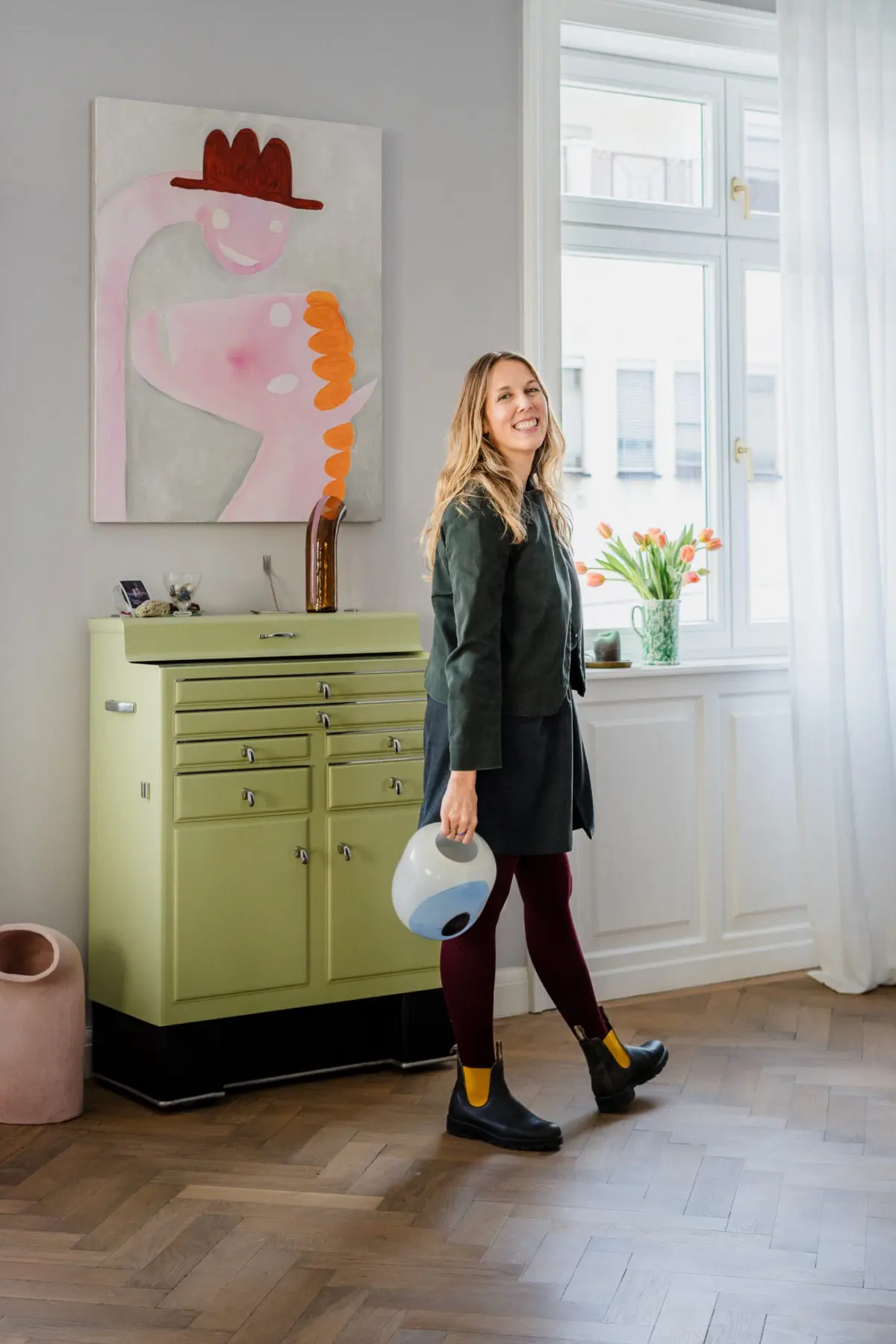
In the contemporary landscape of design, where mass production frequently homogenizes aesthetic expression, a quiet revolution in color and form is taking place in Vienna, Austria. Designer Kathrin Schaden, operating under the unyielding and exuberant alter ego Ursula Futura, is redefining modern glassware and lighting.
At the core of Schaden’s practice is mouth-blown glass originating from the historic furnaces of Bohemia, shaped by human breath and intense heat. Rejecting industrial casting and automated perfection, Schaden embraces the imperfections of the medium—retaining trapped air bubbles and subtle textural variations as evidence of the hand that made them. Her catalog features standout sculptural objects and lighting fixtures such as NESSIE, PHANTOM, and the flagship PULSAR series.
The Pulsar lamp, in particular, has become the centerpiece of the brand’s offerings. Characterized by softly stepped, wave-like cone shapes rendered in opaque colored glass, the fixture plays with light, shadow, and geometry. Depending on the viewing angle and whether the lamp is switched on or off, the object transforms, revealing complex layers of color and surface topography.
With pendants and wall lamps currently in active development, Ursula Futura represents a growing movement toward emotional, narrative-driven interior objects that prioritize poetic resonance over clinical minimalism.
Chronology: The Evolution of Ursula Futura
The trajectory of Ursula Futura is deeply tied to Schaden’s personal and professional journey through the design world.

- The Formative Years of Self-Editing: For much of her early career, Kathrin Schaden navigated a design landscape that frequently favored restraint, neutrality, and strict minimalism. Constantly told that her visceral reactions to color, dramatic shapes, and light play were "too much," she spent years filtering her creative impulses to fit conventional commercial molds.
- The Birth of the Alter Ego: Recognizing that creative stagnation was the direct result of self-censorship, Schaden established Ursula Futura. Conceived not merely as a studio name, but as an unapologetic alter ego, Ursula Futura became a sanctuary for the ideas and visual obsessions that Schaden "couldn’t stop thinking about."
- Establishing the Viennese Connection and Bohemian Craftsmanship: Schaden moved her base of operations to Vienna, establishing a collaborative network with master glassblowers in Bohemia. This partnership married traditional, centuries-old glassblowing techniques with contemporary, avant-garde design concepts.
- The Introduction of Foundational Objects: The studio rolled out its initial conceptual pieces, including NESSIE—an object designed to evoke the gentle, lumbering movement of a massive form through deep water—and PHANTOM, a piece defined by its optical persistence.
- The Launch of the Pulsar Series: Evolving from sculptural objects into functional art, Schaden introduced the Pulsar lamp. By translating the dynamic concept of a wave into stacked, opaque glass cones, the project bridged sculpture and lighting design.
- Present Day and Future Expansions: Today, Ursula Futura stands as a recognized name in independent European design. Building on the success of the table lamps, the studio has announced the upcoming expansion of the Pulsar collection to include pendant and wall-mounted lighting variants.
Supporting Data & The Mechanics of Glass
To understand the work of Ursula Futura, one must understand the unique physical properties of the medium. Glass is fundamentally a liquid frozen in time; when heated within a furnace, it softens and "remembers" its fluid state.
Material Specifications and Production Workflow
- Technique: Exclusively mouth-blown. No molds with automated injection or industrial casting are utilized. Every piece requires a collaborative dance between the glassblower, a blowpipe, and an extreme heat source.
- Geography: Production bridges Vienna (where conceptualization and design occur) and Bohemia (renowned for its rich, centuries-old glassblowing heritage).
- Material Choice: Opaque colored glass is heavily favored for its ability to absorb, refract, and block light in unexpected ways, creating a deep interplay between the exterior surface and internal illumination.
- Design Signatures: Retained micro-bubbles, minor asymmetrical variances in the wave forms, and shifting opacity profiles based on ambient daylight angles.
| Object Name | Form Inspiration | Primary Characteristics | Production Status |
|---|---|---|---|
| NESSIE | Deep-water movement, massive organic shapes | Fluid, heavy presence; commands spatial awareness | Available |
| PHANTOM | Optical illusions, lingering visual memories | Haunting silhouette; high visual persistence | Available |
| PULSAR (Table Lamp) | Cosmic phenomena, oceanic waves, rhythmic breath | Stepped opaque cones; dynamic color-layering under light | Available |
| PULSAR (Pendants/Walls) | Continuation of the wave motif | Scaled for architectural integration | In Development |
Official Responses and Creative Philosophy
Kathrin Schaden has been remarkably transparent about the emotional impetus behind her work. Rather than framing design as an exercise in problem-solving or utility, she positions Ursula Futura as a visceral reaction to sensory stimuli.
"A rainbow appears from nowhere," Schaden reflects when describing the origin of her creative process. "Light hits glass and the room shifts and you stop and you stare and you feel something you can’t explain. And you don’t want to. That’s where Ursula begins. That’s why she makes anything at all."
This philosophy directly challenges the sterile, hyper-functional ethos that dominated interior design through the late 2010s and early 2020s. By leaning into her instinctual attraction to vivid hues and dramatic refractions, Schaden has cultivated a space where emotional resonance supersedes muted safety.
Addressing the repeating wave motif found in the Pulsar series, Schaden notes:

"I keep coming back to the wave because it never really stops moving, even when it’s frozen in glass. The repetition in the form feels meditative to me. Like breathing, or tides."
This quote underscores the conceptual depth of the objects. While the material is rigid and cold to the touch once cooled, the visual language communicates motion, biological rhythm, and temporal fluidity. Furthermore, by deliberately refusing to polish away the "arguments" of the material—such as trapped air bubbles or minute shifts in wall thickness—Schaden honors the physical reality of hot glass pushing back against human breath.
Implications: The Shift Toward Emotional and Unapologetic Design
The rise of studios like Ursula Futura signals a broader cultural and economic shift within the contemporary design and interior architecture markets. For years, the luxury sector leaned heavily toward minimalist restraint, characterized by neutral palettes, brushed metals, and uniform, factory-perfect finishes.
However, a fatigue with hyper-sanitized aesthetics has opened the door for expressive, artisanal craftsmanship that celebrates the idiosyncrasies of the maker.
1. The Revival of Imperfection as Luxury
In an era dominated by 3D printing, computer-aided manufacturing, and flawless digital renderings, true luxury is increasingly defined by the unmistakable trace of the human hand. When consumers purchase a piece from Ursula Futura, they are not buying a replicated SKU; they are acquiring a singular atmospheric event. The retention of air bubbles and wave asymmetries acts as a badge of authenticity in a world flooded with duplicates.

2. Lighting as Ambient Sculpture
The success of the Pulsar lamp highlights a growing demand for functional lighting that holds its own aesthetic weight even when powered down. Consumers are moving away from recessed or purely utilitarian fixtures, opting instead for statement pieces that alter the narrative of a room through color refraction, material density, and sculptural presence.
3. The Validation of "Too Much"
On a cultural level, Schaden’s narrative—moving away from self-censorship and embracing an exuberant alter ego—resonates deeply with a generation of creators rebelling against creative conformity. Ursula Futura serves as a case study in commercial viability for maximalist, emotionally charged design. By refusing to water down her vision to appease conventional market metrics, Schaden has carved out a distinct, highly defensible niche in the high-end European design market.
As Ursula Futura expands its footprint with upcoming pendant and wall lamp releases, the brand continues to prove that the most compelling spaces are those built not on strict rules, but on moments of unexplainable, radiant wonder.