








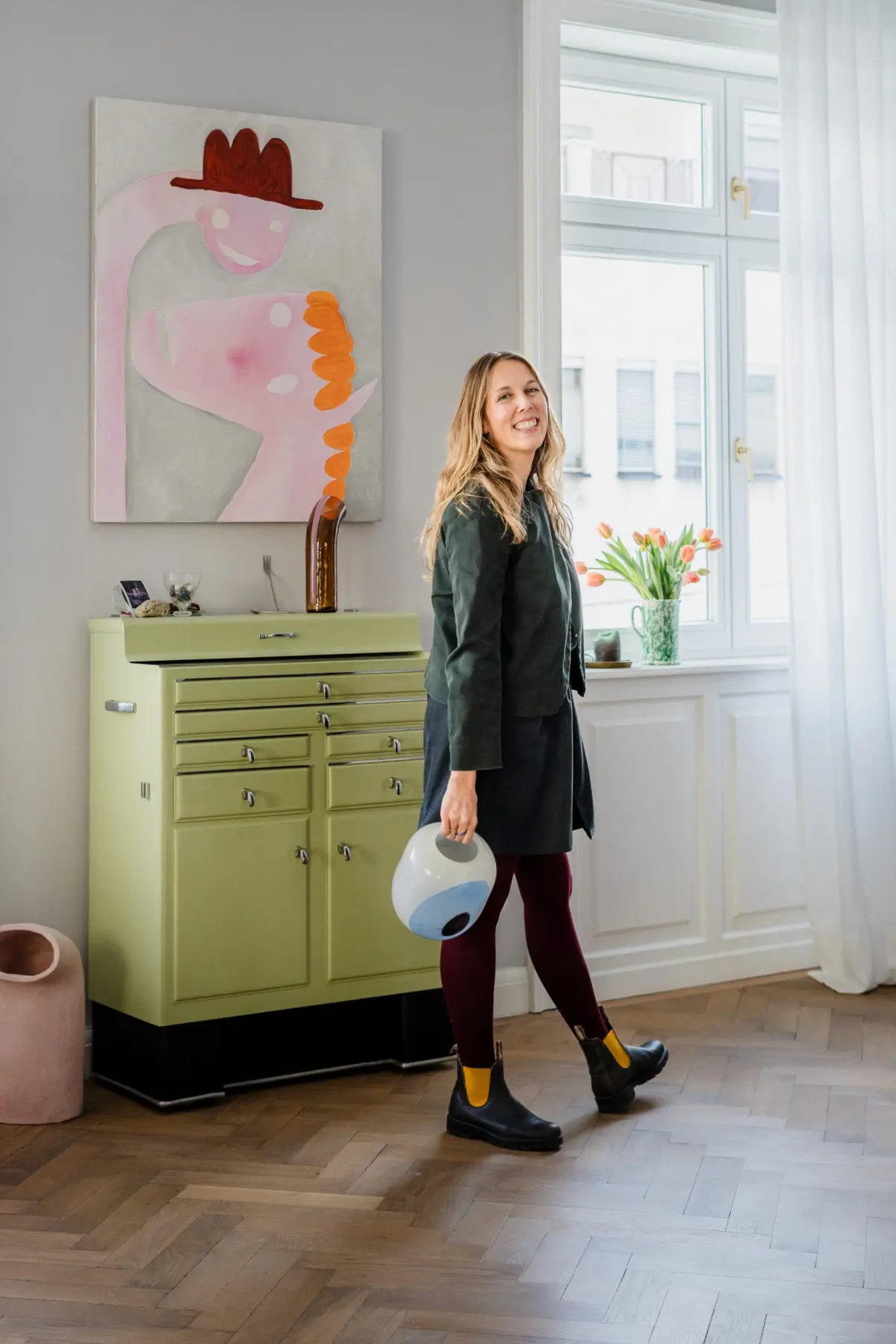
VIENNA — A sudden fracture of light across a blank wall. A transient rainbow materializing out of nowhere, stopping you dead in your tracks. For a fleeting second, the entire architectural geometry of a room shifts, evoking an ineffable, deeply visceral emotional response.
This exact moment of uncalculated wonder is where Ursula Futura begins. It is the core philosophy, the driving heartbeat behind every piece of glasswork conceptualized and brought to life by designer Kathrin Schaden. Operating out of Vienna, Schaden has cultivated a design language that fiercely rejects minimalist restraint in favor of emotional resonance, vibrant color theory, and an unapologetic celebration of organic form.
Her studio, Ursula Futura, functions less as a commercial enterprise and more as a psychological and artistic liberation. It is an alter ego—an unfiltered iteration of Schaden who refuses to self-censor her fascination with an arresting color shift, an unconventional curve, or the way afternoon sunlight ignites a jagged piece of mouth-blown glass.
Main Facts: The Art and Philosophy of Ursula Futura
At its foundational core, Ursula Futura is a Vienna-based design studio specializing in mouth-blown, handcrafted glass objects, sculptural lighting, and experimental decor. Unlike mass-produced industrial glassware, every piece produced under the Ursula Futura banner originates from traditional furnaces in Bohemia, shaped entirely by human breath, intense heat, and molten alchemy.
The label’s portfolio includes statement-making creations such as NESSIE, an undulating, voluminous form that evokes the gentle, lumbering movement of a mythical creature through deep water; PHANTOM, an optical illusion in glass that commands permanent visual attention; and PULSAR, a series of sculptural lamps that bridge the gap between astronomical surrealism and tactile design.
Key Takeaways:

- Craftsmanship: Entirely mouth-blown, prioritizing artisanal techniques over mechanical casting.
- Production Origin: Crafted in historical glass-making hubs in Bohemia, finished and curated in Vienna.
- Design Philosophy: Embracing "imperfections" such as trapped air bubbles and asymmetrical waves as proof of human touch and material authenticity.
- Current Expansion: Expanding from the flagship Pulsar table lamps into forthcoming pendant and wall-mounting lighting fixtures.
Chronology: The Evolution of an Uncompromising Vision
The trajectory of Ursula Futura cannot be separated from the personal and professional evolution of its founder, Kathrin Schaden. Her journey into the upper echelons of contemporary European design is marked by a deliberate departure from conventional industry expectations.
Phase One: The Years of Conformance and Critique
Long before the inception of Ursula Futura, Schaden spent years navigating standard design environments. Throughout her early career, she frequently encountered feedback that clipped her creative wings. She was repeatedly told she was "too much"—her color palettes too saturated, her emotional connection to her materials too intense, and her sculptural inclinations too radical for mainstream interior trends. Rather than dampening her creative output, this friction planted the seed for a radical alter ego.
Phase Two: The Birth of Ursula Futura
Seeking absolute creative autonomy, Schaden established Ursula Futura as a sanctuary for unedited expression. The brand was built on a simple, uncompromising premise: nothing would be created unless she found herself utterly obsessed with it. This phase marked her transition into deep collaboration with master glassblowers, diving headfirst into the unpredictable, volatile medium of hot glass.
Phase Three: Mastering the Medium and the Debut of ‘Pulsar’
Moving away from rigid, predictable manufacturing processes, Schaden leaned into the organic behavior of glass. She recognized that glass is essentially a liquid caught in a temporary state of suspended animation—a solid only by illusion. By collaborating with elite artisans in Bohemia, she began translating transient natural phenomena, such as fluid waves and shifting tidal patterns, into permanent structural forms. This period culminated in the creation of the Pulsar lamp series, cementing her reputation as an innovative voice in modern lighting design.
Phase Four: Present Day and Future Horizons
Today, Ursula Futura stands as a celebrated name among interior architects and collectors seeking soul in their spaces. With the table lamp iterations receiving widespread critical acclaim, the studio is actively developing sophisticated pendant lights and wall sconces, translating the signature wave motif into new architectural dimensions.
Supporting Data: The Technicality of Fluid Art
To truly understand the value and weight of an Ursula Futura piece, one must examine the physics and material science of mouth-blown glass.

Glass is an amorphous solid—thermodynamically, it behaves as a supercooled liquid. When subjected to temperatures exceeding 1,000°C (1,832°F) inside a Bohemian furnace, the material enters a hyper-malleable state where it regains its molecular memory of liquidity.
- The Human Element: Unlike automated glass-casting factories that produce thousands of identical units per hour, mouth-blowing requires immense lung capacity, precise physical stamina, and decades of generational expertise. The glassblower introduces air through a steel blowpipe, expanding the molten bubble while continuously rotating it on a marver (a flat casting table).
- Embracing the Flaw: In industrial production, trapped micro-bubbles, minor optical distortions, and infinitesimal thickness variations are categorized as defects. In Schaden’s world, these are celebrated as the material arguing back. They serve as tangible records of the creative struggle between human breath and cooling silica.
- The Physics of Opaque Color: The Pulsar lamps utilize heavily saturated, opaque colored glass. This specific chemical composition prevents light from simply passing straight through, forcing photons to refract, bounce, and scatter internally. The result is a multi-layered chromatic experience that transforms completely depending on whether the lamp is powered on or resting in daylight.
Official Responses and Creative Statements
Kathrin Schaden’s design ethos relies heavily on meditative repetition, emotional intuition, and a profound respect for natural rhythms. In statements detailing her creative process, she has consistently emphasized the psychological weight of her objects.
"I keep coming back to the wave because it never really stops moving, even when it’s frozen in glass," explains Schaden regarding her signature design inspiration. "The repetition in the form feels meditative to me. Like breathing, or tides."
Art critics and design curators have increasingly pointed to Ursula Futura as a necessary antidote to the sterile, hyper-minimalist trends that dominated the 2010s. By reintroducing emotional volatility, high-chroma color palettes, and tactile irregularities into high-end interiors, Schaden has carved out a distinct niche that bridges fine art sculpture with functional domestic objects.
Design historians note that her work echoes the rebellious spirit of the Vienna Secession and the organic curves of Art Nouveau—movements deeply rooted in Austrian cultural history that sought to rescue craftsmanship from the soul-crushing machinery of the Industrial Revolution.
Implications: The Shift Toward Emotional Interior Architecture
The rise of studios like Ursula Futura signals a profound paradigm shift in how contemporary consumers interact with their living spaces. For decades, interior design was dominated by safety: neutral beige tones, frictionless surfaces, and mass-market uniformity designed for broad demographic appeal.

However, post-pandemic architectural trends reveal a surging psychological need for spaces that harbor personality, narrative, and emotional warmth. People are no longer seeking homes that look like glossy magazine showrooms; they are curating sanctuaries that evoke specific feelings.
1. The Death of Sterile Minimalism
Schaden’s work champions maximalism of the soul. By integrating objects that react dynamically to natural sunlight—throwing rainbows, casting deep shadows, and shifting opacity—she proves that home decor can be an active participant in human emotion rather than passive background staging.
2. The Resurgence of Hyper-Localized Craft
In an era dominated by digital renderings and algorithmic manufacturing, physical objects that bear the un-airbrushed "trace of the hand" carry immense cultural capital. Consumers are increasingly willing to invest in pieces with a provenance—knowing precisely where, how, and by whom an item was blown.
3. Lighting as Kinetic Art
The success of the Pulsar lamp points to a broader interior movement: lighting is no longer just a utility meant to illuminate a dark room. It is treated as kinetic art. Whether switched on to project layered chromatic gradients or switched off to function as a sculptural totem, pieces like those from Ursula Futura redefine the boundary between lighting design and fine art sculpture.
As Ursula Futura continues to expand its offerings into wall-mounted fixtures and pendant lighting, Kathrin Schaden stands at the vanguard of a sensory renaissance. Her work reminds us of a fundamental truth too often forgotten in modern design: the things worth bringing into our homes are the ones that make us stop, stare, and feel something we can’t entirely explain—and leave us with no desire to apologize for it.