





There is a specific, quiet threshold that Los Angeles-based sculptural artist Katrien Van der Schueren often returns to when discussing her craft. It is not the moment a piece is finally finished, polished, and signed. Rather, it is the precise, fleeting instant when a piece simply arrives.
It is the moment an object transforms, as she describes it, into a truer version of itself. Not necessarily the only version—for art is notoriously mutable—but the definitive one, at least for now. In the mercurial world of contemporary fine art and high-end interior design, this level of creative honesty is rare. It forms the conceptual bedrock behind every heavy, industrial, yet startlingly intimate object that leaves her studio.
Main Facts: The Intersection of Industry and Intimacy
At its core, Van der Schueren’s practice challenges conventional definitions of fragility and strength. Working out of her dynamic Los Angeles workshop, she deliberately chooses raw, uncompromising materials that historically "have no business being delicate"—wood, heavy metals, plaster, bio-resin, and industrial concrete.
Yet, under her guidance, these brutalist, utilitarian substances undergo a radical metamorphosis. She transmutes them into forms that are undeniably feminine, deeply poetic, and charged with an inherent tension.

- The Mediums: Concrete, structural steel and iron, raw plaster, bio-resins, and treated metals.
- The Aesthetic: A deliberate friction between the cold, heavy permanence of industrial materials and the fluid lightness of feminine, organic forms.
- The Catalogue: A diverse array of high-concept functional sculptures, ranging from dramatic wall sconces and architectural vessels to bespoke focal points like the striking Gold Mural Fireplace.
- The Philosophy: A surrender to intuition over rigid formulas, allowing each object to dictate its own physical evolution through the tactile act of making.
For interior designers and architectural collectors navigating the upper echelons of residential and commercial spaces, Van der Schueren’s work occupies a coveted category. Her pieces elevate an environment entirely on their own terms, acting not as loud statement pieces that demand all the oxygen in a room, but as quiet anchors that hold a space together.
Chronology: The Evolution of a Practice
While a comprehensive timeline of an artist’s inner life cannot always be measured in calendar years, Van der Schueren’s creative trajectory is marked by a deep, chronological immersion into the dialogue between maker and material.
Phase One: The Gathering of Influences
Long before her pieces began appearing in elite residential and commercial interiors across Southern California and beyond, Van der Schueren absorbed the complex visual language of her surroundings. As she frequently notes, nothing of consequence is ever created in a vacuum. Every environment experienced, every historical friction absorbed, and every texture touched finds a subterranean path into her sculptures.
Phase Two: Entering the Studio
The workspace is where the theoretical meets the physical. Far from being a sterile, dust-free gallery white-box, Van der Schueren’s studio is a place of active, messy alchemy. It is an industrial theater where the rigid resistance of concrete meets the fluid spontaneity of human touch. Here, time is measured not in standard operational hours, but in shifts of perspective and phases of curing.

Phase Three: The Rise of Functional Sculpture
As her portfolio expanded from purely abstract forms to functional objects—such as wall sconces, lighting fixtures, and sculptural hearths—Van der Schueren solidified her reputation among elite interior specifiers. Her recent collaborative and commissioned projects, including her viral mural treatments and signature lighting, have positioned her at the forefront of contemporary West Coast craft.
Supporting Data: The Anatomy of a Masterpiece — The Envelope Sconce
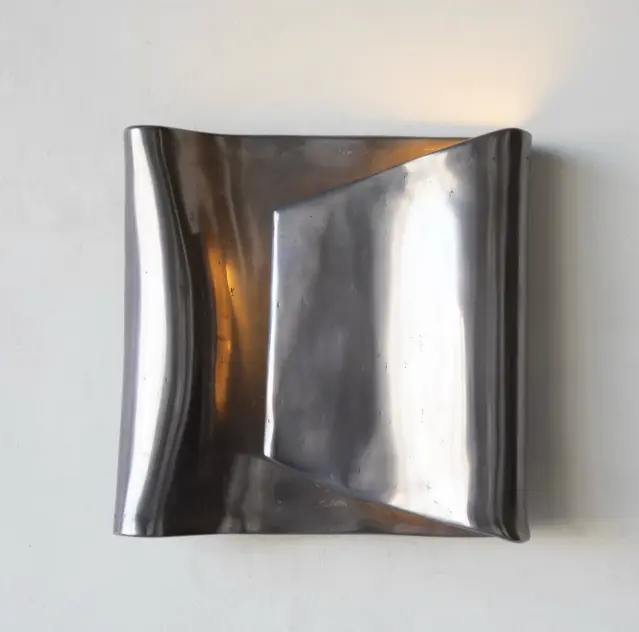
To truly understand Van der Schueren’s mastery over her chosen mediums, one need only examine a representative piece from her portfolio: The Envelope Sconce.
- Dimensions: 12 inches by 12 inches.
- Core Material: High-density architectural concrete.
- Surface Treatment: Cold-applied liquid bronze tin and white bronze finish.
- Visual Effect: A wall-mounted lighting fixture engineered to mimic the delicate, precise folds of folded paper, executed entirely in heavy industrial media.
The Envelope Sconce serves as a masterclass in material subversion. By coaxing rigid, unforgiving concrete and bronze into soft, origami-like configurations, Van der Schueren forces observers to question their baseline assumptions about weight and structure.
Furthermore, the piece is inherently dynamic. Because of the cold-applied liquid metal finishes, the sconce reacts profoundly to shifting atmospheric conditions. The golden and bronze patinas read one way under the crisp, directional illumination of morning light, and transform entirely into deep, moody shadows by evening. It is an object designed to be noticed, yet one that refuses to remain static in its visual identity.

Official Perspectives: On Surrender, Obsession, and the Creative Bubble
To extract a rigid, formulaic blueprint from Van der Schueren is to misunderstand the very nature of her art. When asked to articulate her step-by-step process, she speaks instead of an organic surrender.
“Sculpting, to me, is very much an intuitive process. Almost subconscious, really,” Van der Schueren explains. “I can think about a piece, and what I want to make, but it’s only once I start playing with the materials, shaping, adding, removing… that it becomes clear what the piece needs to be. And mostly, the only thing I can do is to surrender to that process.”
This perspective rejects the assembly-line mentality of modern mass production. Instead, it positions the artist as a medium through which the material speaks. She does not forcibly impose a preconceived shape onto the concrete; rather, she collaborates with it, uncovering the form that was implicitly waiting to emerge.
This intense, highly personal relationship with her work borders on the psychological. When describing the hours spent in her studio, Van der Schueren speaks of a total immersion that suspends reality:

“It’s an amazing, wonderful love affair. And it’s also very much… an obsession. You’re in this bubble. Time dissolves. There is no Tuesday, Wednesday. You’re just obsessed. You can’t stop thinking about the piece.”
Implications: The Future of Intentional Spaces and Design Culture
The resonance of Katrien Van der Schueren’s work extends far beyond individual homes or commercial properties; it speaks directly to a broader, shifting paradigm in contemporary interior architecture.
In an era dominated by hyper-efficient, digitally manufactured home goods and algorithmic decor trends, environments assembled from generic shopping lists are beginning to feel hollow. Discerning clients and elite interior designers are increasingly searching for spaces that carry emotional weight, historical resonance, and authentic human intention.
Van der Schueren’s sculptures—characterized by their obsessive craftsmanship, material honesty, and quiet authority—represent an antidote to disposable design culture. They prove that spaces designed with intense intellectual and emotional rigor require objects that match that same frequency.

Finding and Following the Work
For collectors, architects, and interior designers looking to source or commission Van der Schueren’s functional sculptures and lighting objects, inquiries can be made directly through her official studio channels.
- Instagram: @katrienscult
- Official Website: katrienvanderschueren.com
This profile is part of Studio Visit, a weekly editorial series by Roomhints celebrating master makers, their uncompromising studio practices, and the singular objects that define the future of intentional design.