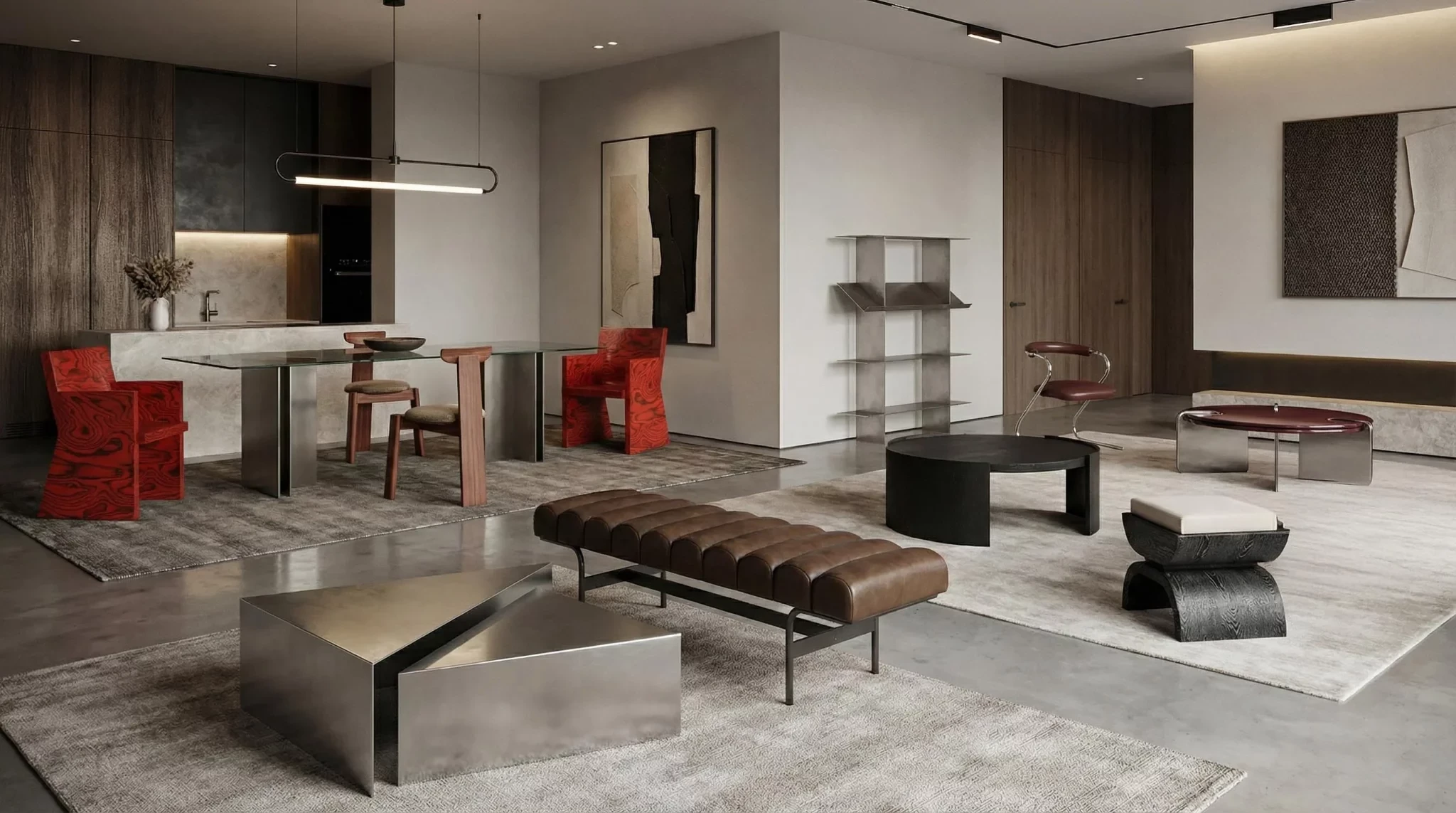
SAN FRANCISCO BAY AREA — In the upper echelons of residential architecture and interior design, longevity is the ultimate metric of success. Trends fracture and fade, materials fall out of favor, and stylistic paradigms shift with every passing decade. Yet, very few practitioners navigate these transitions while maintaining a standard of unyielding excellence.
Enter Jerry Jacobs. Based in Belvedere-Tiburon, California, Jacobs is a foundational pillar of the Bay Area design community. Holding credentials that few in the industry can match—including International Associate AIA, ASID, and Certified Interior Designer in California—Jacobs has spent more than forty years shaping the spaces where elite clients live, unwind, and entertain.
As part of the Roomhints Designer Spotlight series, this retrospective explores Jacobs’ remarkable trajectory, his architectural pedigree, his unvarnished philosophy on the business of design, and the foundational elements that separate a mere room from an architectural masterpiece.
Main Facts: The Blueprint of a Master Architect
To understand Jacobs’ approach to interior design, one must first understand his training as a structural architect. His career has not been limited to residential decoration; rather, it spans massive corporate structures, sprawling clubhouses, and high-profile retail environments.
Perhaps most notably, Jacobs designed the once-world-famous Aca Joe retail stores across 30 states and three continents. His architectural footprint was cemented in San Francisco with the iconic Union Square location, a grand storefront whose historic façade still stands today.
In 1991, Jacobs made a calculated pivot, turning his full professional attention toward high-end residential architecture and interiors. Over the decades that followed, he built one of the most respected independent practices in Northern California. His portfolio is breathtakingly diverse, encompassing:
Waterfront villas nestled along the rugged coast of Marin County.
Penthouses towering over San Francisco’s prestigious Pacific Heights.
Custom-built smart homes anchoring the tech-driven landscape of Silicon Valley.
Exquisite resort residences crossing international borders into Mexico.
Beyond his built works, Jacobs has heavily influenced the academic and professional spheres of design. He has served as a professor of architecture, guiding the next generation of spatial thinkers, and held the esteemed position of President of ASID Northern California. His peerless eye for detail was further validated when he claimed the coveted San Francisco Decorators Showhouse Room Award from House Beautiful—widely regarded as one of the most fiercely competitive recognitions in American residential design.
Chronology: From Corporate Scale to Residential Refinement
Phase I: The Commercial Era and Global Scale
Jacobs began his career in the demanding world of large-scale commercial and corporate architecture. Designing spaces meant accounting for massive foot traffic, structural integrity, zoning laws, and sweeping branding statements. The pinnacle of this era was his extensive work with the international retail giant Aca Joe. Overseeing store rollouts across three continents required a mastery of logistical coordination, fast-paced construction timelines, and spatial psychology—understanding how consumers move through and interact with a physical environment.
Phase II: The Residential Pivot (1991)
By the early 1990s, Jacobs felt a pull toward a more intimate, narrative-driven scale of architecture. In 1991, he pivoted decisively toward high-end residential work. This transition allowed him to apply his rigorous architectural training to deeply personal spaces. Instead of designing for thousands of transient shoppers, Jacobs began designing for individuals, couples, and families, translating their private lives into tangible, built environments.
Phase III: Leadership and Industry Acumen
As his residential practice flourished in the Bay Area, Jacobs assumed leadership roles within the broader design ecosystem. His tenure as President of ASID Northern California and his time spent in academia as a professor of architecture allowed him to shape industry standards. He transitioned from a practitioner of design to an institutional voice, advocating for professionalism, ethical business practices, and rigorous technical training. Today, operating out of Belvedere-Tiburon, Jacobs remains an active, hands-on designer, balancing architectural commissions with high-end interior transformations.
Supporting Data & Professional Insights
In conversation, Jacobs strips away the romanticized myths often propagated by lifestyle magazines, offering instead a candid, masterclass-level breakdown of what it actually takes to conceptualize and execute elite design.
1. The Art of Listening
For Jacobs, the design process never begins with a sketchpad or a material swatch; it begins with deep, active listening.
"Listen to the client. Often they do not know what they want, but listening you help them by suggesting approximations, and they will say, that is it."
Clients rarely walk through a designer’s door with a fully realized blueprint. Instead, they arrive burdened with abstract feelings, fragmented inspirational images, fleeting memories, and underlying anxieties about the construction process. Jacobs views the designer’s primary role as a translator. By listening to what lies beneath the words, proposing educated approximations, and refining those ideas iteratively, a true design concept emerges. This requires profound patience, psychological attentiveness, and the professional confidence to suggest rather than impose.
2. The Engine of Great Design: Passion
When asked what drives exceptional design, Jacobs dismisses the obvious answers. It is not raw talent, formal training, or prestigious credentials. It is passion.
"Keep seeking perfection and design as art, beauty. Hard to achieve but keep trying. Hope for the best but be prepared to struggle."
Jacobs is refreshingly candid about the daily grind of the profession. Most high-end designers operate as solitary entities or small teams—true jacks-of-all-trades. A designer must conceptualize space, source rare materials, manage client relations, handle complex accounting, and oversee every minute detail of execution on the job site. It is a grueling, non-linear career path. Without an overriding passion for beauty and spatial art, the friction of the profession will wear a practitioner down.
Official Responses & Industry Stance: Valuing the Discipline
One of the most defining aspects of Jacobs’ philosophy is his willingness to address uncomfortable truths within the design industry—specifically, the pervasive expectation that creative professionals should give away their expertise for free.
"Do not work for free or do things for nothing. It does not only affect your budget and survival, but it hurts the profession and the industry. Value yourself and your time."
In an era of digital mood boards, speculative design pitches, and clients asking for "quick favors" in exchange for future exposure, Jacobs takes a hardline stance. This principle goes far beyond immediate billable hours; it is a matter of systemic respect. Architecture and interior design require years of rigorous education, continuous technical development, and immense emotional labor. When individual designers undervalue their time, they depress the market value for the entire profession, encouraging a race to the bottom. Jacobs’ warning serves as a vital manifesto for design professionals striving to run sustainable, respected practices.
Implications: The Anatomy of a Space
When analyzing what transforms a raw room into a breathtaking sanctuary, Jacobs breaks down interior elements into a strict hierarchy of sensory importance.
[ LIGHT ]  --> Controls perception and emotional tone of the space.
    ↓
[ FLOOR ]  --> The tactile foundation; experienced physically before anything else.
    ↓
[ ART   ]  --> Emotional investment; the ultimate differentiator (better blank than bad).
Light: The Invisible Architecture
While light is not a physical product one can purchase off a showroom floor, Jacobs identifies it as the ultimate controlling element of any space. Without proper lighting design—accounting for natural sun paths, ambient glow, task illumination, and architectural layering—no physical finish or piece of furniture will ever perform as intended. Light dictates mood, spatial perception, and human comfort.
The Floor: The Tactile Foundation
Jacobs offers a provocative take on spatial hierarchy:
"You really can’t walk into a space without it. Ceiling can go and wall can be transparent, but all rooms need a floor."
Long before a single chair, sofa, or table is brought into a room, the floor has already established the tone. Whether it is wide-plank European white oak, honed Calacatta marble, seamless poured concrete, or a bespoke antique area rug, the floor is the element people look at the least yet feel the most. It grounds the human body within the architecture.
Art: The Emotional Anchor
On the subject of art, Jacobs holds uncompromising standards. Well-chosen art is an investment that carries profound emotional weight—far outlasting furniture and decorative finishes, which inevitably wear out.
Crucially, Jacobs champions the power of negative space. He notes that leaving a wall completely blank is frequently superior to displaying mediocre art. The decision to exercise restraint is a sophisticated design choice in its own right.
Advisory for Clients: How to Partner with a Master
For prospective clients preparing to embark on a high-end architectural or interior design journey, Jacobs outlines three non-negotiable principles for a successful collaboration:
Do Your Homework: Before making contact, clients must build a detailed brief, establish clear spatial priorities, thoroughly research prospective professionals, and study their past portfolios. While interpersonal chemistry is vital, walking into a partnership with informed expectations ensures mutual respect.
Commit to a Realistic Budget: High-end design is a substantial, capital-intensive investment. Jacobs warns against trying to stretch inadequate funds across an entire project: “Don’t try to do too much with too little. You get what you pay for.”
Practice Patience: Design and construction are marathon events involving dozens of artisans, contractors, and fabricators. When clients support their design team with patience and trust, productivity soars. Conversely, manufactured pressure degrades the creative output, resulting in a compromised final product for all parties involved.
Conclusion
Jerry Jacobs’ four-decade career stands as a masterclass in architectural rigor, business integrity, and aesthetic refinement. From the bustling retail centers of Union Square to the serene waterfront villas of Marin County and the sun-drenched coasts of Mexico, his work reflects an unyielding commitment to spatial art. Through decades of changing trends, Jacobs has remained a steady, guiding light in the Bay Area design community—proving that true luxury is built on a foundation of deep listening, professional self-respect, and an unwavering passion for beauty.
Jerry Jacobs is based in Belvedere-Tiburon, California. His comprehensive portfolio and architectural services can be explored at jerryjacobsdesign.com.
This feature is part of the ongoing Roomhints Designer Spotlight series—intimate conversations with the visionary architects and interior designers who shape the rooms that matter most.