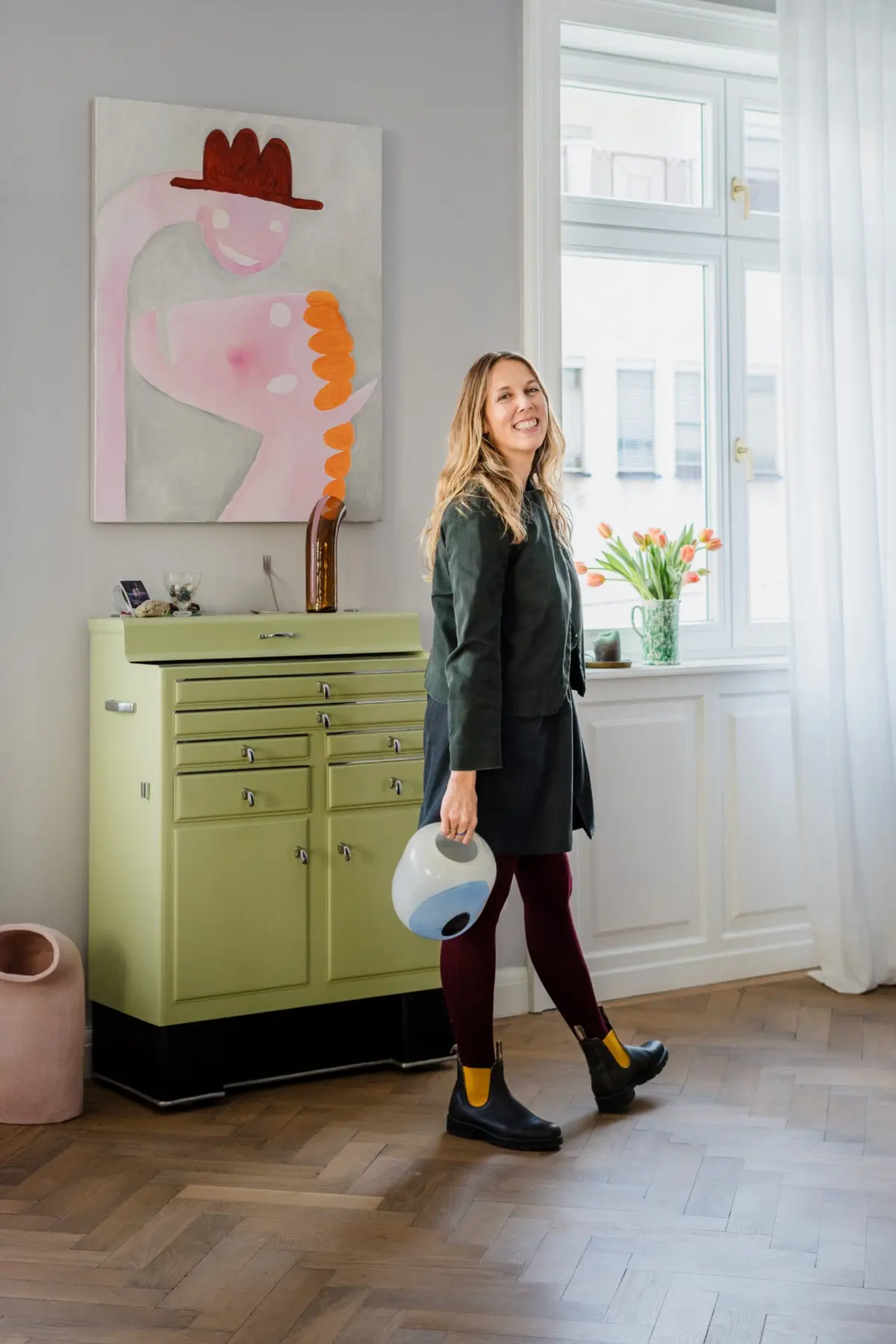
VIENNA — A sudden refraction of sunlight catches the edge of a hand-blown glass vessel, casting a fleeting, iridescent rainbow across an otherwise neutral room. For a split second, the environment transforms. Time suspends. You stop, you stare, and you experience a visceral reaction that defies immediate translation into words.
This exact moment of uncalculated, emotional interruption is where the Vienna-based design studio Ursula Futura begins. It is the fundamental heartbeat behind every object the studio brings into existence.
Main Facts: The Anatomy of Ursula Futura
Ursula Futura is not merely a commercial design house; it is a manifestation of uncompromised creative liberty. Conceived as an alter ego by founder and designer Kathrin Schaden, the studio serves as a sanctuary for ideas that refuse to be edited down, neatened, or flattened for mass consumption.
Core Highlights:
- The Medium: Hand-blown opaque colored glass, created using traditional mouth-blowing techniques in collaboration with master artisans in Bohemia and Vienna.
- The Philosophy: Embracing structural imperfections—such as minor internal bubbles and subtle asymmetries—as physical proof of human agency and the material’s fluid heritage.
- Signature Works: A portfolio of evocative sculptural objects and lighting fixtures, prominently featuring pieces like NESSIE, PHANTOM, and the critically acclaimed Pulsar lamp collection.
- Availability: Currently encompassing table lamps and sculptural objects, with upcoming expansions into pendant and wall-mounted lighting systems.
Chronology: From Self-Editing to Radical Expression
To understand the aesthetic vocabulary of Ursula Futura, one must trace the personal and professional trajectory of its creator, Kathrin Schaden.
For years within the conventional design sphere, Schaden operated under the quiet, persistent pressure of self-censorship. In an industry that often rewards streamlined uniformity, neutral palettes, and predictable market trends, her natural inclination toward high-impact color, voluminous shapes, and emotional maximalism was frequently met with a familiar critique: she was "too much."

Rather than retreating into stylistic conformity, Schaden chose expansion. She cultivated Ursula Futura as a deliberate alter ego—a creative persona designed specifically to bypass the internal editor. It was a commitment to chasing ideas that she simply "couldn’t stop thinking about."
The evolution of the studio transitioned from conceptual sketches to physical reality through a rigorous exploration of glass. Working alongside historic glassblowing furnaces in Bohemia—a region globally renowned for its centuries-old glassmaking heritage—Schaden immersed herself in the unpredictable physics of hot glass.
The timeline of the studio’s breakout pieces reflects this growing confidence:
- The Genesis (The Exploratory Phase): Early experiments focusing on capturing ambient light and organic, fluid movement.
- The Character Era (NESSIE and PHANTOM): The introduction of sculptural objects with distinct personalities that dictate the mood of an entire interior space.
- The Light Intersection (Pulsar): The successful translation of dynamic kinetic concepts into functional lighting design, merging opaque color fields with geometric yet soft silhouettes.
Supporting Data: The Physics and Philosophy of Glass
To appreciate an Ursula Futura piece, one must understand the paradoxical nature of the material itself. Glass is, fundamentally, a supercooled liquid masquerading as a solid.
The Alchemy of the Breath
When glass is subjected to extreme furnace temperatures, it sheds its rigid facade and remembers its liquid origins. In the hands of a skilled blower using a traditional blowpipe, the material responds to human breath, expanding, shifting, and recording the exact kinetic energy of its creation.

- The Cooling Process: Once removed from the heat, the glass rapidly cools, effectively "forgetting" its fluid state and locking the breath of the maker into a permanent, frozen archive.
- The Resistance of the Material: In industrial manufacturing, internal bubbles, streaks, and slight surface waves are classified as defects to be eliminated. Ursula Futura subverts this standard entirely. The tiny air bubbles trapped within the walls of the glass are viewed as the material "arguing back"—a vital dialogue between human intent and natural resistance.
- Uniqueness as a Metric: Because every piece is mouth-blown without the sterile perfection of automated molds, no two items in the Ursula Futura collection are identical. This variance is not an oversight; it is the core value proposition.
Official Responses and Creative Vision
The reception to Ursula Futura’s design language highlights a growing hunger within the contemporary interior landscape for objects possessing genuine narrative weight and emotional resonance.
In statements regarding her creative process, Kathrin Schaden has consistently emphasized the meditative, almost biological rhythm embedded in her work. Discussing the conceptual framework behind her flagship lighting piece, the Pulsar lamp, Schaden notes:
"I keep coming back to the wave because it never really stops moving, even when it’s frozen in glass. The repetition in the form feels meditative to me. Like breathing, or tides."
The Pulsar table lamp begins as a gesture—an attempt to translate the dynamic, pulsing energy of life into a tangible wave. This wave is rendered physically as a series of softly stepped cone shapes, sculpted from dense, opaque colored glass.
Design critics and interior stylists have praised the dual nature of these objects. When unlit, the lamps read as minimal, architectural sculptures whose surfaces catch daylight in shifting, unpredictable patterns. When powered on, internal light sources interact with the layered colored glass, diffusing a warm, atmospheric glow that alters the perceived geometry of the room.

Implications: The Shift Toward Emotional Interiority
The rise of studios like Ursula Futura points toward a broader, significant shift in modern interior design and consumer psychology.
For the past decade, global interior trends have leaned heavily toward minimalist restraint, monochromatic palettes, and industrial reproducibility. While functional, this hyper-curated aesthetic has occasionally left living spaces feeling sterile, temporary, and emotionally detached.
Ursula Futura challenges this clinical approach by championing what can be termed emotional interiority. The implications of this design philosophy are manifold:
- Rejection of Planned Obsolescence: Objects that carry a distinct narrative, bear the visible marks of human labor, and evoke a sense of wonder are inherently less susceptible to rapid cyclical trends. They are designed to be kept, lived with, and passed down.
- The Rehabilitation of Maximalism: By proving that intense color and organic, oversized forms can coexist with sophisticated spatial design, Schaden opens doors for a new generation of designers who have previously been told to tone down their vision.
- The Renaissance of Traditional Craft: By anchoring high-concept contemporary art design in centuries-old European glassblowing traditions (such as those in Bohemia and Vienna), studios like Ursula Futura help ensure the survival of specialized artisan skills that face erasure in automated economies.
Ultimately, Ursula Futura offers an antidote to the frictionless, digital scroll of modern life. In a world increasingly dominated by flat screens and identical mass-produced goods, a heavy, breathing, light-catching piece of colored glass reminds us of the profound power of physical presence.