










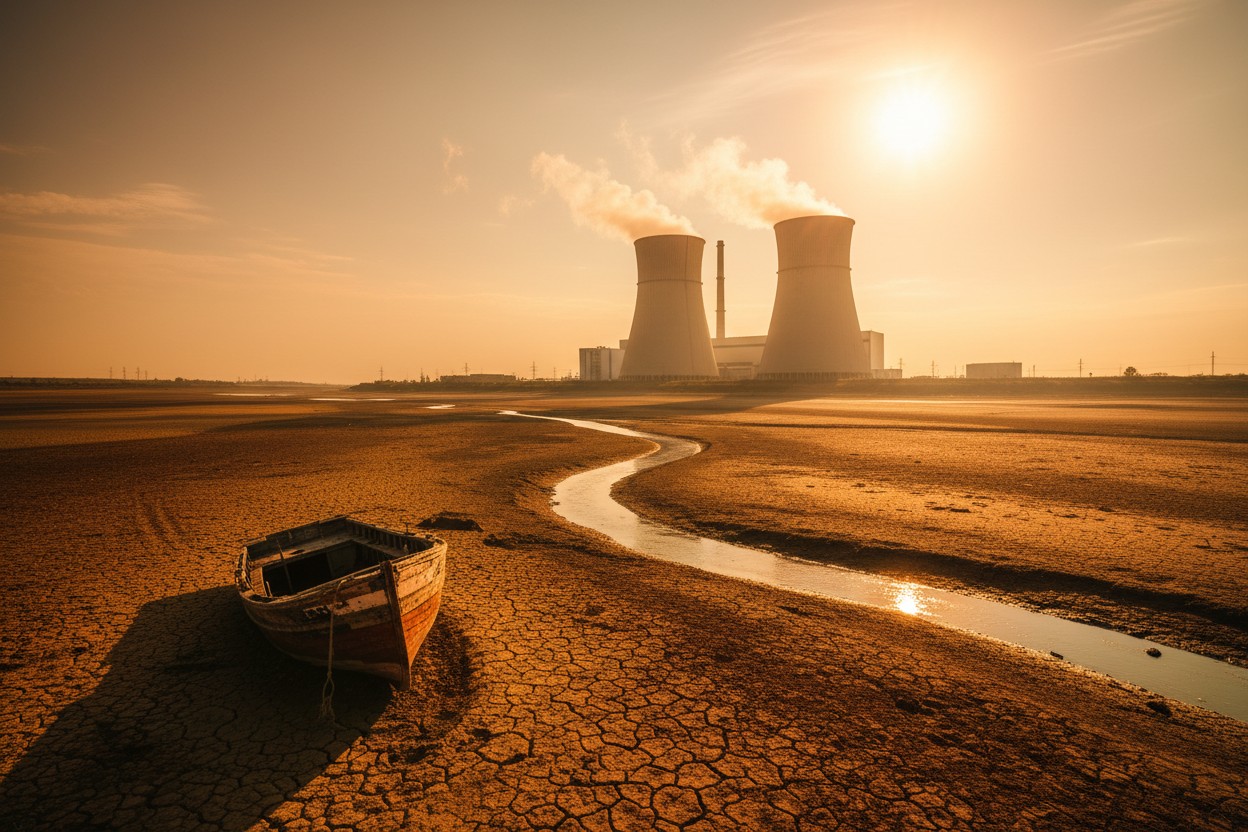
BUCHAREST — Romania’s critical energy infrastructure has suffered a severe blow as state-owned energy company Nuclearelectrica announced the total shutdown of the country’s only nuclear power facility. The Cernavoda Nuclear Power Plant, which single-handedly accounts for approximately 20% of Romania’s domestic electricity generation, was fully disconnected from the national power grid after water levels in the adjacent Danube River dropped precipitously below the mandatory safety and operational thresholds.
The unprecedented stoppage impacts both of the facility’s primary reactors, each boasting a generation capacity of 706 megawatts. According to international monitors and facility reports, the critical cooling systems—which rely continuously on massive volumes of river water—could no longer safely function under the current hydrological deficits. Industry projections indicate that the facility is not expected to resume operations within the next ten days, leaving a massive void in southeastern Europe’s baseline power supply.
This dramatic operational halt is not an isolated incident. It is part of a sweeping, continent-wide energy and environmental emergency driven by severe, prolonged heatwaves and historic droughts that have crippled major European waterways from the Rhine to the Danube.
Chronology of an Escalating Crisis: From Warning Signs to Total Shutdown
The sequence of events leading to the complete shutdown of Cernavoda underscores the speed at which environmental stressors can dismantle modern industrial grids.
- Late July: As unrelenting summer heatwaves baked the Balkan Peninsula and Central Europe, water levels in the Danube began a steep, unseasonal decline. Responding to initial safety triggers, Nuclearelectrica took the decisive step of scaling back generation by shutting down Cernavoda’s first reactor.
- Early August: Despite emergency mitigation efforts by Romanian authorities, hydrological conditions worsened. Water levels breached absolute minimum operating thresholds, forcing engineers to disconnect the plant’s second and final operational reactor, bringing the entire complex to a standstill.
- Mid-August: The Romanian government formally declared a national state of energy emergency for the month, implementing voluntary and mandatory power-reduction protocols for both civilian and industrial sectors. Neighboring states, heavily reliant on Romanian electricity imports—most notably Moldova—began scrambling to cover massive power deficits.
Unsuccessful Engineering Interventions
Before admitting defeat to nature, Romanian authorities launched frantic, highly unusual engineering maneuvers to artificially redirect water toward the plant’s intake channels. Last week, military engineers deployed nearly 400 pounds of high explosives to blast a navigable, deeper channel through the hardened riverbed near the Danube’s Bala Canal. Following the blasts, heavy machinery and military logistics teams sank four massive, rock-filled barges directly into the river to forcibly steer the dwindling current toward Cernavoda’s cooling infrastructure.
Ultimately, these high-stakes measures proved insufficient. The sheer scale of the hydrological deficit outpaced human intervention, leaving engineers with no alternative but to execute a complete grid disconnection.
Supporting Data: The Continental Hydrological Drought
The crisis facing Cernavoda is symptomatic of a broader, continent-wide climate shock affecting European waterways, thermocline stability, and industrial cooling capacities.
Parched Waterways Across Europe
The Danube and the Rhine—Europe’s twin commercial and industrial lifelines—have fallen to historic lows not witnessed since official record-keeping began.
- The Rhine: In key transit bottlenecks such as Cologne, Germany, and Lobith on the Dutch-German border, Rhine water levels hit all-time lows, severely disrupting barge transport, raw material supply chains, and manufacturing logistics.
- The Danube: Beyond restricting the Cernavoda plant in Romania, the plunging Danube exposed long-submerged historical artifacts, including World War II warships laden with explosives, while simultaneously halting regional grain and cargo shipping.
Cross-Border Nuclear and Hydro Strain
The thermal constraints of rivers are proving to be an Achilles’ heel for European baseload power:
- Hungary: Hungary’s Paks Nuclear Power Plant, which relies heavily on the Danube for cooling, was forced to scale back operations—marking a historic first for the nation. Hungarian leadership warned that the country’s broader energy security had entered a "critical" phase.
- France: France experienced significant generation cuts across multiple nuclear installations as river temperatures rose past regulatory limits and water volumes fell, restricting the plants’ ability to discharge heat safely.
- Hydropower Deficits: Italy’s vital hydroelectric capacity has been severely degraded by dwindling alpine snowpack and depleted reservoirs, while Norwegian hydro reservoirs dropped to their lowest levels in thirty years.
According to comprehensive energy assessments, Europe’s current wind and solar deployment rates remain insufficient to bridge the massive baseline deficits left by simultaneous drops in hydro and nuclear output.
Official Responses and Emergency Measures
In response to the mounting crisis, the Romanian government and regional partners have enacted stringent emergency protocols to prevent widespread blackouts.
Bucharest’s Emergency Decree
The government in Bucharest declared a formal state of energy emergency for the month of August. Authorities have issued urgent appeals to civilian households and commercial entities to voluntarily curtail electricity consumption, particularly during high-stress evening peak hours (7:00 PM to 11:00 PM). Furthermore, the Ministry of Energy has prepared a rolling schedule for industrial load-shedding, allowing authorities to systematically cut power to major industrial consumers with advance notice if grid stability is threatened.
Impact on Moldova
The shutdown reverberates well beyond Romania’s borders. Neighboring Moldova, which traditionally relies on Romanian electricity imports to plug up to 60% of its domestic energy shortfalls, faces an acute supply squeeze. Moldovan officials have echoed calls for energy conservation as regional grid operators race to source alternative power supplies from western interconnectors.
Broader Implications: Energy Security, Geopolitics, and Deindustrialization
The paralysis of Cernavoda compounds an already fragile European energy landscape, triggering deep concerns among market analysts and geopolitical strategists.
Market Pressures and Import Dependence
The sudden loss of over 1.4 gigawatts of reliable domestic nuclear capacity forces Romania—and by extension, the wider Central and Eastern European market—to turn to costly electricity imports. Analysts warn that this forced reliance will drive up wholesale power prices across the European Union, hitting vulnerable member states hardest.
This latest disruption exacerbates a multi-layered energy crunch that originated with the phasing out of cheap Russian natural gas following sanctions related to the conflict in Ukraine. Subsequent global trade disruptions, including tensions in the Middle East and the effective constriction of the Strait of Hormuz, have kept global energy markets on edge.
The Threat of Deindustrialization
European heavy industry, already battered by years of elevated electricity and gas prices, faces renewed threats. Energy-intensive sectors—ranging from chemical processing and metallurgy to automotive manufacturing—are being forced to scale back production lines to remain solvent. Analysts point out that prolonged energy supply shocks significantly increase the long-term risk of structural deindustrialization within the European Union, as industrial capital migrates to regions with more stable and affordable energy inputs.
Geopolitical analysts, such as Glenn Diesen, have noted that such systemic supply shocks expose structural vulnerabilities within the EU single market, creating openings for external economic pressures and exacerbating internal divisions over resource allocation and burden-sharing.
Conclusion
As international monitors confirm that the Cernavoda plant will remain offline for the foreseeable future, the event serves as a stark warning regarding the vulnerability of critical energy infrastructure to extreme weather events.
The convergence of historical droughts, soaring ambient and river temperatures, and geopolitical energy constraints has transformed what was once viewed as a localized environmental anomaly into a continental economic challenge. For Romania and its neighbors, the coming weeks will test the resilience of their emergency grids, the efficacy of conservation mandates, and the continent’s ability to navigate an increasingly volatile climate future.