









Introduction: The Tangible and the Intangible
There is a profound, often unspoken dialogue that exists between a craftsman and their material. For Coulton Becker, founder and principal designer of Studio Becker, wood is not merely a medium for structural utility or aesthetic ornamentation; it is a living language. Every grain, knot, and hue tells a story of time, environment, and endurance. Based out of the rugged alpine setting of Breckenridge, Colorado, Becker has carved out a distinct space in contemporary American woodworking—one where minimalist restraint meets deep emotional resonance.
In a modern consumer landscape dominated by mass production, flat-pack convenience, and disposable trends, Studio Becker represents a deliberate counter-movement. Becker’s portfolio consists of spare, highly considered pieces crafted exclusively from premium hardwoods such as walnut, white oak, and maple. Yet, what truly sets his work apart is a foundational philosophy that physical objects should carry an intangible weight: a memory, a feeling, or an intentional decision about how one wants to inhabit a space.
This feature explores the trajectory of Studio Becker, examining the personal tragedy that ignited a lifelong passion, the professional evolution from architectural design to independent studio woodworking, the meticulous craftsmanship behind the acclaimed Una Bench, and the broader implications of artisanal revival in modern interior design.
1. Main Facts
- Subject: Coulton Becker, furniture maker, designer, and founder of Studio Becker.
- Studio Location: Breckenridge, Colorado (with historical roots in Kansas City and Frisco, Colorado).
- Founding Date: 2020, amidst the global upheaval of the COVID-19 pandemic.
- Core Materials: Premium hardwoods (walnut, white oak, maple) paired with hand-wrapped Danish cord.
- Signature Piece Highlight: The Una Bench ($4,600; dimensions: 60” x 16” x 18”).
- Design Philosophy: Fusing tactile physical form with intangible emotional narratives—making objects that hold memories, feelings, and intentional living practices.
- Editorial Context: Part of Studio Visit, a weekly Friday editorial series by Roomhints highlighting independent makers and their craft.
2. Chronology: From Architecture Student to Master Woodworker
The journey of Studio Becker is not linear; it is a narrative defined by pivotal moments of disruption, grief, and clarity.
The University of Missouri and Fluss Ewig (2018–2019)
Long before establishing his own studio, a twenty-year-old Coulton Becker was navigating the demanding corridors of the University of Missouri, where he was studying architecture and interior design. During his sophomore year, personal tragedy struck when his father passed away. Faced with a profound, disorienting loss, Becker turned to the only outlet he knew: the creative process.
Rather than retreating into academic theory, he decided to build. He conceptualized and constructed a memorial piece titled Fluss Ewig—a German phrase translating to "constantly changing." Having never built anything at that physical scale before, Becker threw himself into the labor of woodworking.

When the piece was finally complete, Becker stepped back to observe his creation. In that quiet, reflective moment, a profound realization crystallized. "The moment I took a step back from the completed memorial, I realized my passion for design and woodcraft," Becker recalls. That singular, cathartic project became the ideological and spiritual genesis for everything that followed.
Graduation, Luxury Mountain Homes, and the Pandemic (2019–2020)
Following his graduation in 2019, Becker initially stepped into the traditional professional pipeline. He accepted a position designing luxury mountain homes in Frisco, Colorado. On paper, it was an enviable career start: stable, prestigious, and aligned with his academic training.
However, the onset of the COVID-19 pandemic in early 2020 radically altered the cultural and professional landscape. For Becker, the global crisis collapsed the distance between what he was doing to check professional boxes and what he needed to do to fulfill his creative calling. He began working with wood in earnest—transitioning from a conceptual hobby to a rigorous daily practice.
In 2020, amidst widespread economic and social uncertainty, Studio Becker was officially founded. The timing was poetically apt; a studio built on the premise that objects carry deep emotional meaning found its footing precisely when the world was forced to reevaluate the significance of home, sanctuary, and personal belongings.
Geographic Evolution: Kansas City to Breckenridge (2020–2025)
To refine his technical mastery and develop his signature aesthetic, Becker relocated to Kansas City, immersing himself in the craft and expanding his technical vocabulary. Eventually drawn back to the magnetic pull of the Rocky Mountains, he returned to Colorado, ultimately settling his permanent studio practice in Breckenridge by 2025.
Surrounded by the dramatic topography of the continental divide, Becker’s work evolved. It grew quieter, more specific, and intensely personal. The ornate excesses sometimes associated with mountain architecture were stripped away, leaving behind a pure, disciplined focus on form, negative space, and material integrity.

3. Supporting Data and Craftsmanship
To understand Studio Becker is to understand the uncompromising parameters of its production model. Every piece of furniture is produced entirely by hand, individually, within Becker’s studio. There are no automated assembly lines, no flat-pack compromises, and no mass production.
Material Selection and Longevity
The foundation of the studio’s output relies entirely on premium hardwoods—predominantly American walnut, white oak, and hard maple. These materials are not chosen at random; they are hand-selected for their distinct grain patterns, natural character, and how they will weather and patina over decades of daily human interaction.
The Aesthetic Vocabulary
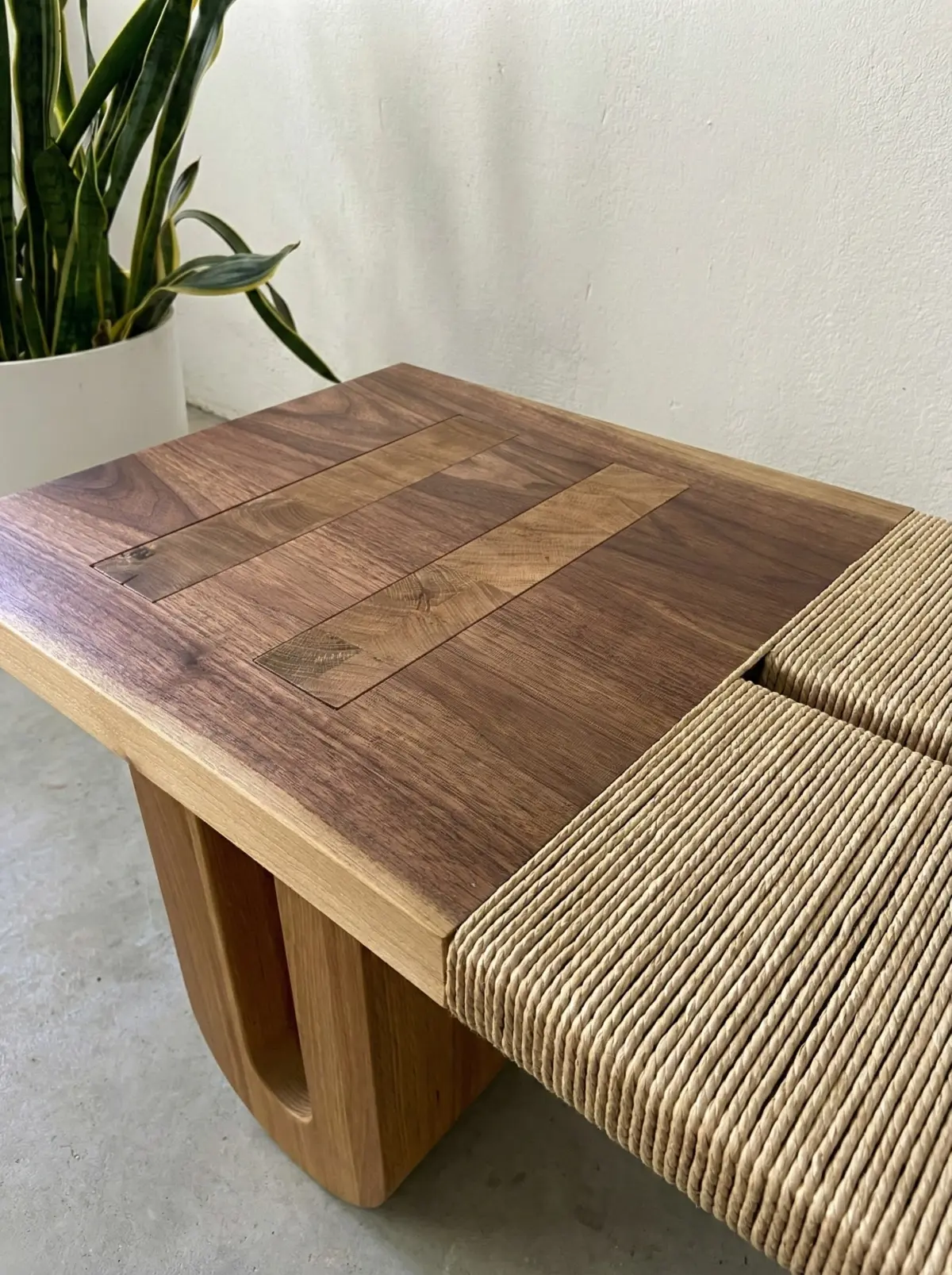
Studio Becker’s collection is characterized by spare, deliberate geometry. Clean lines intersect with organic textures. A signature element of many pieces is the incorporation of hand-wrapped Danish cord, a meticulous technique requiring immense patience and physical precision. The resulting objects possess a visual lightness that belies their sturdy construction. As design critics often note of Becker’s portfolio, these are pieces that do not loudly demand attention upon entering a room; instead, through their quiet authority, they change the energy of the entire space.
The Una Bench: A Case Study in Modern Craft
While the studio’s broader catalog spans various domestic applications, the centerpiece of critical acclaim—and the standout selection for editorial features—is the Una Bench.
- Price: $4,600
- Dimensions: 60 inches long, 16 inches deep, and 18 inches high.
- Materials: Premium hardwood frame paired with hand-woven Danish cord seating.
The Una Bench encapsulates everything Becker strives to achieve. At sixty inches of uninterrupted hardwood and cord, it sits at a standard eighteen inches off the floor, offering functional versatility that few furniture items achieve. It is equally at home anchoring the foot of a custom king-sized bed, providing a functional sculptural element at the end of a long hallway, or serving as a minimalist anchor in an open-concept living room.
The silhouette is so refined that it can visually recede into a room’s background, yet its craftsmanship is distinct enough that it never truly disappears from view. Furthermore, adhering to the studio’s bespoke ethos, the Una Bench—like all Studio Becker works—is available with full customization options upon direct request from clients and interior designers.

4. Official Perspectives and Design Philosophy
The driving force behind Studio Becker is an explicit rejection of the superficiality of modern consumer goods. In an era where furniture is frequently designed for planned obsolescence, Becker approaches each commission as a permanent addition to a client’s life narrative.
"Physical objects often have a meaning and emotion associated with them, and that’s what I aim to instill in every piece I work on." — Coulton Becker
This philosophy bridges the gap between industrial design and fine art. Becker works directly with homeowners, architects, and interior designers on custom commissions. These collaborative projects represent some of the most intellectually stimulating aspects of his practice, as they require translating a client’s personal history or spatial requirements into a physical language of wood and joinery.
By maintaining direct oversight from the initial sketch on paper to the final application of natural finishes, Becker ensures that the emotional integrity of the work is never diluted by outsourcing or mass manufacturing.
5. Implications for the Future of Independent Design
The trajectory of Studio Becker holds significant implications for the broader worlds of interior architecture, artisanal manufacturing, and consumer spending habits.
1. The Counter-Revolution Against Fast Furniture
For decades, the democratization of interior design has been synonymous with mass-market retailers offering low-cost, quick-assembly furniture. While accessible, this trend has generated staggering amounts of waste and resulted in interiors that feel generic and transient. Studios like Becker’s point toward a growing counter-movement: consumers are increasingly willing to invest heavily ($4,600 for a bench, for instance) in fewer, higher-quality items that tell a genuine human story and last multiple lifetimes.

2. The Rise of Regional Craft Hubs
Breckenridge, Colorado, is traditionally known as a hub for winter tourism and alpine recreation. However, the migration of skilled artisans like Becker to mountain and rural enclaves highlights a decentralization of the American design industry. Creators no longer need to base their operations in traditional coastal capitals (such as New York or Los Angeles) to command national attention. Through digital portfolios, Instagram (@studio.becker), and specialized editorial partnerships (such as Roomhints’ Studio Visit series), independent makers can build direct-to-consumer relationships from anywhere in the world.
3. Healing Through Making
On a cultural level, Becker’s origin story—turning to the tactile labor of woodworking to process profound personal grief—speaks to the therapeutic and grounding power of physical craft in an increasingly digital world. As society grapples with burnout, digital fatigue, and a loss of connection to the physical environment, the meditative process of shaping wood offers a powerful reminder of the human need to create, touch, and leave a lasting mark.
Conclusion
Studio Becker is more than a boutique furniture brand; it is a testament to resilience, intentionality, and the transformative power of design. From a grieving twenty-year-old architecture student building a memorial in Missouri to a master woodworker shaping bespoke hardwoods in the Rocky Mountains, Coulton Becker has remained steadfast to a singular realization: that the objects we live with should reflect who we are and what we value.
As the studio continues to evolve from its Breckenridge headquarters, its work challenges us to look closer at the spaces we inhabit. In an Una Bench or a custom oak console, we are reminded that true luxury is not about excess or brand prestige, but about the quiet, enduring resonance of a life’s work crafted by hand.
To explore Studio Becker’s full collection or inquire about custom commissions, visit studiobecker.design or follow the journey on Instagram at @studio.becker.