By the Science and Culture Desk
Published: November 2025
Main Facts
As stargazers, astronomers, and art enthusiasts alike look ahead to the coming year, Celestial Products has officially announced the launch of its highly anticipated 2026 moon calendar collection. Renowned for bridging the gap between rigorous astronomical accuracy and captivating visual aesthetics, the new lineup features a diverse array of formats designed to suit every lifestyle and space.
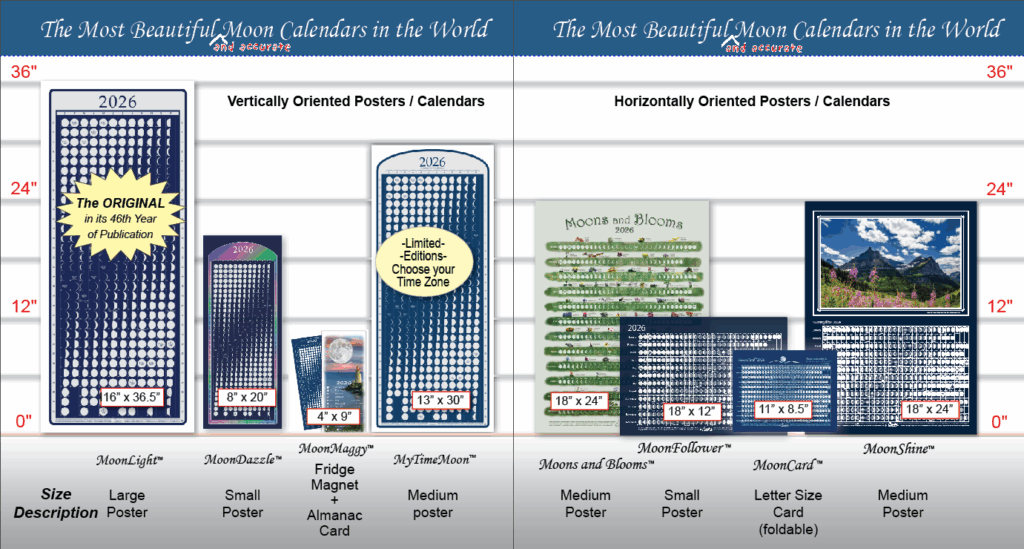
From compact, everyday items such as greeting cards and fridge magnets to small, medium, and large statement posters, the collection caters to both casual observers of the night sky and dedicated amateur astronomers. Among the standout offerings for the upcoming year are fan-favorite titles like MoonLight 2026 and MoonMaggy 2026, both of which have transitioned from concept to consumer availability.

The launch is accompanied by a fully digital, interactive 2026 catalog hosted via Adobe InDesign, allowing prospective buyers to preview the entire product range seamlessly. Purchases can now be made through multiple channels, including the official Celestial Products storefront on Amazon and direct orders through the company’s customer service portal.
Chronology
The journey toward the release of the 2026 collection is the result of a year-round, meticulous process combining precise astronomical calculations with high-end graphic design.
- Early 2025: Celestial Products began drafting the lunar ephemeris data for 2026, mapping out exact moon phases, apogees, perigees, eclipses, and orbital intersections across the calendar year.
- Mid-2025: Designers integrated these complex scientific datasets into visual layouts. The team focused heavily on balancing legibility for stargazers with artistic framing that appeals to interior designers and art collectors.
- Late 2025 (October–November): The final proofs for signature editions—including the MoonLight 2026 and MoonMaggy 2026 series—were locked in. Promotional size galleries and the comprehensive digital catalog were published to give consumers a complete preview of formats ranging from handheld magnets to large wall posters.
- Present Day: The complete 2026 collection is officially live. Online distribution channels via Amazon have been stocked, and direct ordering pathways are fully operational for customers seeking specialized formats or bulk purchases.
Supporting Data
The appeal of Celestial Products’ offerings lies in their unique dual purpose: serving as practical scientific tools while doubling as fine art. To understand the scope of the 2026 collection, several key metrics and product dimensions define the release:

- Format Variety: The catalog features more than five distinct sizing tiers, ensuring products fit various environments:
- Miniature & Novelty: Fridge magnets and greeting cards designed for daily micro-interactions.
- Standard & Medium Posters: Ideal for home offices, classrooms, and study spaces.
- Large-Format Wall Calendars: Statement pieces engineered for observatories, living rooms, and professional design studios.
- Digital Accessibility: The 2026 catalog is distributed via a responsive digital format (hosted externally via Adobe platforms), allowing global users to inspect layout details, typography, and imagery before purchase.
- Distribution Reach: Utilizing a hybrid sales model, items are accessible globally through major e-commerce infrastructure (Amazon) alongside dedicated direct-to-consumer fulfillment lines managed directly by Celestial Products.
Official Responses and Creator Insights
While specific corporate statements from leadership remain focused on the user experience, the philosophy driving Celestial Products has long centered on making celestial mechanics accessible and beautiful to the general public.
In past commentary regarding their design ethos, representatives for Celestial Products emphasized that understanding the moon’s phases should not feel like reading a dry textbook. By applying fine-art printing techniques, premium paper stocks, and mathematically precise lunar tracking, the company bridges a historical gap between science education and decorative arts.
Customer service representatives have also highlighted the streamlined ordering process for 2026. Recognizing the high demand for holiday gifts and early-year planning tools, customer support channels have been optimized to handle direct inquiries, ensuring that both individual buyers and educational institutions receive prompt assistance when ordering specialized calendar sizes.
Implications
The release of the 2026 moon calendar collection carries several broader implications for hobbyist astronomy, educational tools, and the niche market of science-inspired home decor.
1. Enhanced Public Engagement with Astronomy
In an era dominated by digital screens and app-based notifications, tactile astronomical tools like physical wall calendars offer a grounded, analog way to connect with nature. By tracking lunar cycles visually on a wall or refrigerator, individuals—particularly children and students—develop a deeper, intuitive understanding of orbital mechanics, tidal forces, and lunar phases without needing to unlock a smartphone.
2. The Intersection of Art and STEM Education
The ongoing success of products like MoonLight and MoonMaggy demonstrates that rigorous scientific data does not need to be sterilized of aesthetic value. By treating astronomical charts as canvases, Celestial Products influences how science communication is packaged. This approach validates the idea that STEM (Science, Technology, Engineering, and Mathematics) fields can heavily intersect with art, inspiring a broader demographic to appreciate celestial events.

3. Retail and Consumer Trends in Planning Tools
As consumers increasingly seek personalized and aesthetically pleasing organizational tools for their living spaces, generic mass-market calendars are facing stiff competition from specialty publishers. Celestial Products’ hybrid retail strategy—combining the wide reach of Amazon with direct customer service engagement—serves as a robust model for boutique publishers looking to maintain personal connections with their clientele while scaling distribution.
Looking Forward
As the world transitions into the new year, the 2026 moon calendars are positioned to guide observers through every lunar cycle—from the first new moon of January to the final phases of December. Whether utilized as an educational resource in a classroom or a striking visual centerpiece in a modern home, these calendars continue to prove that humanity’s timeless fascination with Earth’s natural satellite remains as vibrant as ever.