





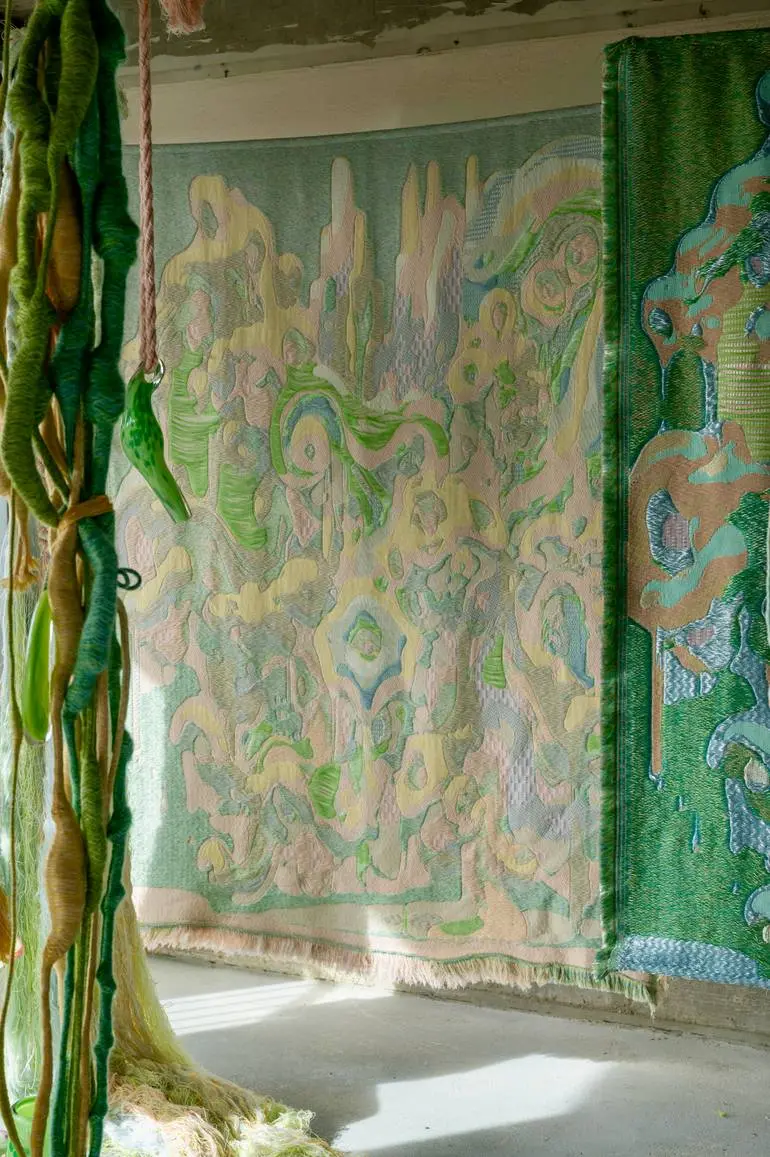
AMSTERDAM — In an era dominated by flat digital screens, algorithmic feeds, and the relentless acceleration of contemporary visual culture, Dutch contemporary artist Sandra Keja Planken is carving out a defiant space for tactility, emotional resonance, and material vitality. Operating from the Netherlands, Planken creates works that resist easy categorization, occupying a liminal zone somewhere between living tissue and manufactured object. Her creations—pulsing woven structures that mimic biological organisms, glass elements that challenge perceptions of rigidity, and immersive environments that straddle the boundaries of dreamscape, memory, and ecological body—are designed to do one primary thing: restore our emotional connection to the physical world.
This profile explores the philosophy, evolution, technical process, and real-world conservation impact of an artist who believes that sensitivity and imagination are not luxuries, but vital antidotes to modern detachment.
Main Facts: The Architecture of the Senses
Sandra Keja Planken’s artistic practice is rooted in a fundamental rebellion against visual fatigue. While much of modern art relies primarily on optical consumption, Planken’s installations demand total bodily engagement.
- The Mediums: Planken works across an interdisciplinary spectrum that includes textile weaving, glassblowing, sculpture, drawing, and large-scale immersive installation.
- The Core Philosophy: Her practice is driven by a lifelong exploration of how sensory experience, material presence, and tactility can heal emotional alienation in spaces.
- Key Collaboration & Project: Her acclaimed installation, Weaves of Saltwater Dreams, debuted at BIG ART Amsterdam in collaboration with ValorosaViva. The work serves as both a breathtaking visual spectacle and a functional ecological intervention.
- Real-World Conservation Impact: Through her ongoing initiative, Nature’s Visual Sound, Planken collaborates with the Branch Foundation and Wageningen University to grow heat-resilient algae and corals on specialized glass and textile structures deployed on the seabed.
- Philanthropic Commitment: Ten percent of the proceeds from every acquisition of her artwork goes directly toward supporting these active underwater reef restoration projects.
Chronology: The Evolution of a Sensorial Practice
To understand how Planken arrived at her current position as a pioneer of ecological-textile art, one must trace a personal and artistic trajectory shaped by cultural contrast and material discovery.
Formative Years: Between Restraint and Openness
Planken’s sensitivity to spatial and emotional environments began in childhood. Growing up caught between the emotional warmth and expressiveness of Spanish culture and the structured restraint of Northern Europe, she developed an acute awareness of atmospheric shifts. She noticed early on that certain physical environments felt vibrant and alive, while others felt sterile and devoid of human essence. This sensitivity never left her; instead, it became the central inquiry of her creative life, translated from abstract feeling into physical, material form.
The Turn to Textile
Initially, Planken was drawn to textiles because of their inherent tactility and deep emotional resonance. To her, threads, knots, and woven structures felt almost human—possessing a vulnerability and memory that flat surfaces lacked. Over time, her studio practice naturally expanded. What began as intimate textile objects evolved into monumental sculptures, which eventually broke free of pedestals to become total immersive environments capable of enveloping the viewer.

The Introduction of Glass and Ecological Fusion
Glass entered her practice during a subsequent phase of material exploration, valued for its capacity to capture fragility, reflection, and suspended light. This introduced a fascinating tension into her work: the juxtaposition of softness and hardness, the organic and the industrial. As she experimented with merging woven textiles with blown glass, the materials began to behave less like static art objects and more like living, breathing organisms.
Simultaneously, the natural world—particularly delicate marine ecosystems and coral reefs—became a defining influence. Planken transitioned from merely representing nature to asking how art can actively participate in ecological care, regeneration, and emotional repair.
Supporting Data & The Creative Process: How the Work Comes to Life
Planken’s methodology is entirely intuitive, rejecting rigid blueprints in favor of an organic dialogue between the artist and her materials.
Observation and Intuition
The creative journey typically begins with observation. Planken collects fragments of the world around her: atmospheric light reflections, underwater movements, the delicate structures of flowers and seaweed, forgotten industrial scraps, and the subtle emotional tensions hidden within physical spaces. Rather than enforcing a predetermined outcome, she allows forms to emerge organically through a multi-disciplinary interplay of drawing, weaving, glass manipulation, and sculptural building.
Material Contradictions
Tactility remains the cornerstone of her work. Textiles invite physical closeness, empathy, and an acknowledgment of vulnerability, while glass introduces the contrasting sensations of luminous fragility and optical depth. Planken excels at creating moments of material contradiction—instances where rigid glass appears fluid and soft, or where woven thread takes on the structural logic of architecture or cellular tissue.
The Role of Light
As works grow layer by layer through accumulation and material transformation, light steps in as the final, essential collaborator. Depending on the time of day, the specific environment, and the perspective of the viewer, changing light conditions continuously shift the atmosphere of the installation, ensuring the artwork is never static.

Official Responses and Artist Statements
In an industry driven by rapid trends, hyper-commercialization, and algorithmic conformity, Planken’s reflections offer a grounded manifesto for contemporary creators. In her own words, she articulates the often-invisible labor and philosophical weight behind her creations:
"I wish more people understood that being an artist is not only about creating objects, but about learning how to remain deeply sensitive within a world that constantly pushes towards speed, distraction, and sameness. Most artworks are built through years of experimentation, doubt, observation, and invisible labor. The final piece often carries countless emotional and material decisions that are never immediately visible on the surface."
She further emphasizes the societal necessity of artistic spaces:
"I also believe artists help create emotional and cultural space within society. Art can slow people down, reconnect them to wonder, and allow them to experience the world differently for a moment. In a time where so much becomes flattened into fast images and algorithms, I think sensitivity and imagination become increasingly important."
Implications: Weaves of Saltwater Dreams and Environmental Action
The true synthesis of Planken’s artistic vision and ecological commitment is manifested in her masterwork, Weaves of Saltwater Dreams. Showcased at BIG ART Amsterdam alongside ValorosaViva, the installation is a sprawling, multi-hued tapestry of green, cream, copper, and teal that unfurls like an alien yet familiar submarine cartography. Suspended ropes cascade downward, morphing into uncanny, sea-creature-like appendages. The textiles shimmer with a wet, organic gloss, functioning not merely as a representation of the ocean floor, but as a visceral rehearsal of our return to it.
Crucially, this work is built entirely from recycled or donated materials—discarded wardrobes and forgotten industrial stock reborn as coral topographies. This circular approach to materiality is not a superficial design choice; it is deeply tied to her broader scientific and ecological initiatives.

Bridging Art and Marine Science
Through her ongoing initiative, Nature’s Visual Sound, Planken has taken her studio practice into the ocean. Working hand-in-hand with the Branch Foundation and Wageningen University, she has been instrumental in engineering glass and textile substrates designed to cultivate and support heat-resilient algae and corals directly on the seabed.
This approach subverts traditional environmental art. Instead of lecturing audiences or utilizing guilt-inducing didactic labels, Planken’s work operates on a deeper psychological level. As she frequently demonstrates, the art makes you feel wonder and emotional resonance first; the desire to protect and care for the environment follows naturally.
To solidify this loop of responsibility, Planken maintains a strict philanthropic model: 10 percent of every acquisition goes directly to funding her underwater reef art and restoration projects.
Conclusion: A Blueprint for the Future
Sandra Keja Planken stands at a vital intersection of contemporary sculpture, textile innovation, and ecological activism. Her work challenges the art market to look beyond surface aesthetics and consider how objects can hold memory, evoke deep sensory empathy, and actively participate in planetary healing.
In a cultural climate defined by digital saturation and ecological anxiety, Planken’s woven organisms and luminous glass environments offer a vital sanctuary. They remind us of what it means to feel, to touch, and to remain radically sensitive in a fast-paced world—proving that art, at its highest level, can be both a mirror to our emotional depths and a catalyst for ecological renewal.