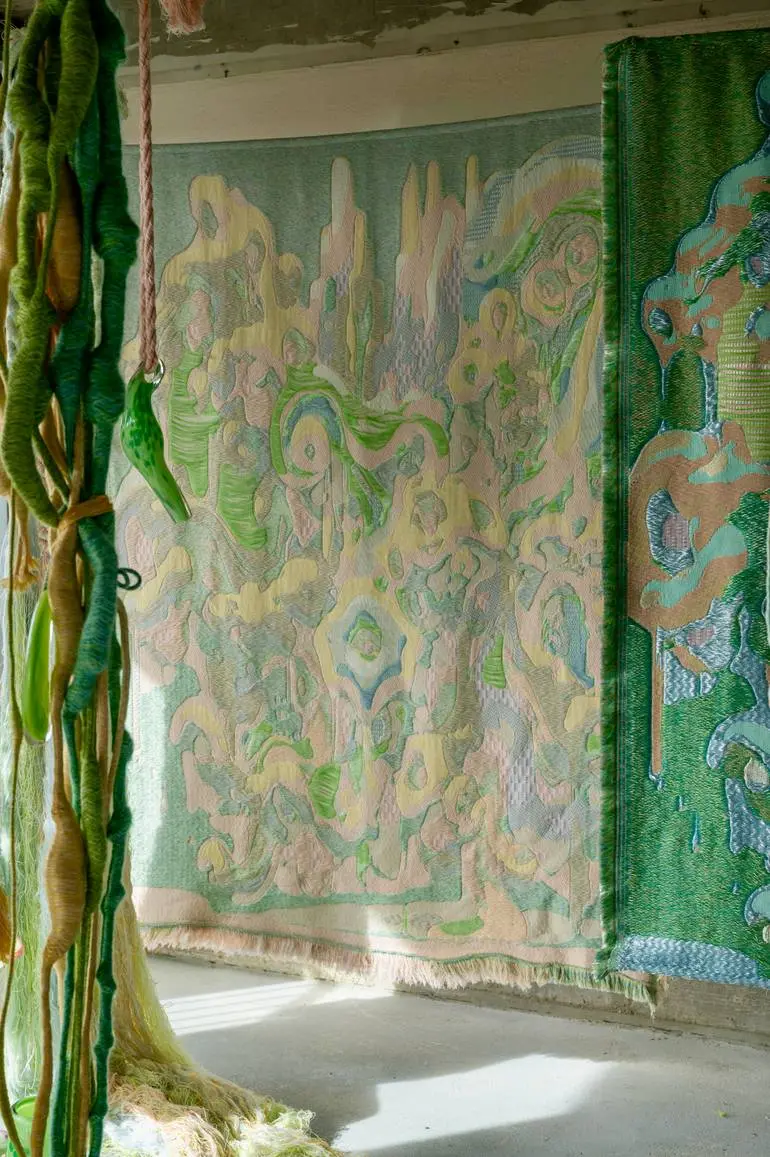
AMSTERDAM — In an era dominated by flat screens, algorithmic feeds, and a pervasive digital detachment, Dutch contemporary artist Sandra Keja Planken is carving out a vital space for physical resonance. Operating at the intersection of sculpture, textile design, and immersive environmental installation, Planken creates works that defy easy categorization. Her pieces—woven structures that pulse like living tissue, and glass elements that possess an uncanny, yielding softness—function simultaneously as organisms and objects.
Based in the Netherlands, Planken’s artistic footprint extends far beyond the traditional gallery wall. Her practice is anchored by a singular, urgent preoccupation: how sensory experience, tactical engagement, and material presence can restore emotional connection within an increasingly mechanized and hurried global culture. By dissolving the boundaries between hard and soft, natural and artificial, human and environment, Planken’s work invites audiences to step out of passive consumption and into a state of deep, corporeal awareness.
Main Facts: The Anatomy of an Unclassifiable Practice
At its core, Sandra Keja Planken’s work challenges the traditional hierarchies of fine art and craft. Working primarily with textiles, recycled fibers, and blown or slumped glass, she constructs environments that bridge the gap between dreamscapes, memory, and ecological bodies.
- Interdisciplinary Mediums: Planken seamlessly merges weaving, textile sculpture, blown glass, and immersive lighting design. Her works frequently oscillate between wall-mounted tapestries and room-spanning spatial installations.
- The Philosophy of Tactility: Each piece is engineered to elicit a physical response. Through rich textures, unexpected weight distributions, and visual contradictions—such as rigid glass that appears supple or textiles that mimic rigid architecture—she subverts expectations.
- Ecological Integration: Nature, specifically coral ecosystems and marine regeneration, serves as both muse and medium. Her projects frequently incorporate sustainable materials, with tangible intersections into marine biology and underwater conservation.
- Philanthropic Commitment: Planken’s market presence is directly tied to environmental action. Ten percent of the proceeds from every acquisition of her major works goes directly toward marine restoration initiatives.
Chronology: The Evolution of a Sensorial Vision
Planken’s path to becoming one of the most innovative contemporary textile and installation artists working today is rooted in a lifelong sensitivity to her surroundings.
Early Sensitivities: Between Two Cultures
Planken’s artistic sensibilities were forged in childhood, growing up bridging two distinct cultural paradigms: the emotional warmth and openness of Spanish culture and the structured restraint of Northern Europe. This bicultural upbringing instilled in her an early, acute awareness of spatial atmospheres. She recognized that certain environments felt vibrant and alive, while others felt sterile and emotionally vacant. This sensitivity never left her; instead, it became the foundational question of her artistic career: How can spaces and objects be made to feel alive?
The Turn to Textile
Initially, Planken was drawn to textiles because of their inherent tactility and deep historical ties to human emotion. Threads, knots, and woven structures felt inherently anthropomorphic, carrying the weight of human labor, vulnerability, and intimacy. What began as traditional woven objects gradually expanded over the years into large-scale sculptures, and eventually into fully immersive spatial environments designed to completely envelop the viewer.

The Introduction of Glass
As her sculptural vocabulary matured, Planken sought a material that could capture light, fragility, and reflection in ways fabric could not. Glass entered her practice as a counterpoint to the organic warmth of textiles. She became consumed by the material tension between softness and hardness—the alchemy of making glass look as though it might give way under pressure, or conversely, making woven fibers stand with architectural rigidity.
Ecological Awakening and "Nature’s Visual Sound"
In recent years, Planken’s focus has sharpened toward ecological transformation, specifically marine and coral reef ecosystems. This evolution birthed her ongoing conceptual universe, Nature’s Visual Sound. Through this platform, she transitioned from merely representing nature to actively participating in its preservation, collaborating with scientific institutions to foster real-world ecological regeneration.
Supporting Data: Materials, Metrics, and Marine Science
Planken’s studio practice is as rigorous scientifically and logistically as it is poetic. Her methodology relies on heavy experimentation, material upcycling, and scientific collaboration.
Material Provenance
Sustainability is not an afterthought in Planken’s studio; it is the structural skeleton of her work. In landmark installations like Weaves of Saltwater Dreams, the raw materials are almost exclusively sourced from waste streams:
- Recycled Yarns: Discarded wardrobes, industrial textile overstock, and donated commercial yarns form the palette of her underwater topographies.
- Mixed Fibers: Copper, wool, teal, cream, and sea-green synthetic threads are blended to capture the iridescent, luminescent qualities of deep-sea flora and fauna.
Scientific Partnerships
Planken’s commitment to ecology extends far beyond poetic abstraction. Through Nature’s Visual Sound, she has partnered with the Branch Foundation and Wageningen University & Research in the Netherlands.
- Live Coral Cultivation: Planken works alongside marine scientists to cultivate heat-resilient algae and coral strains directly on specially treated glass and textile structures.
- Submerged Habitats: These artistic-scientific hybrids are designed to function as temporary, supportive habitats on the seabed, proving that contemporary art can serve as a functional tool for environmental remediation.
Cataloged Specimen Profile: Weaves of Wool
A representative work from her ongoing sculptural catalog highlights the physical scale and ambition of her practice:

- Classification: Sculpture, Weaving of Wool / Mixed Media
- Dimensions: Variable (Standard presentation formats approx. 55” W x 40” H x 2” D)
- Components: Recycled and donated yarn, woven textile, mixed fibers.
- Impact Metric: 10% of every acquisition directly funds underwater reef art and marine restoration projects.
Official Responses and Artist Statements
In an exclusive statement reflecting on her career, her methodologies, and the socio-cultural role of the artist today, Sandra Keja Planken addresses the friction between modern digital saturation and tactile creation:
"I wish more people understood that being an artist is not only about creating objects, but about learning how to remain deeply sensitive within a world that constantly pushes towards speed, distraction, and sameness," Planken notes.
"Most artworks are built through years of experimentation, doubt, observation, and invisible labor. The final piece often carries countless emotional and material decisions that are never immediately visible on the surface. I also believe artists help create emotional and cultural space within society. Art can slow people down, reconnect them to wonder, and allow them to experience the world differently for a moment. In a time where so much becomes flattened into fast images and algorithms, I think sensitivity and imagination become increasingly important."
Art critics and curators have similarly praised Planken’s ability to cross disciplinary boundaries. Reviewing her presentation of Weaves of Saltwater Dreams at BIG ART Amsterdam (produced in collaboration with ValorosaViva), critics noted the installation’s uncanny ability to evoke a submarine cartography—simultaneously feeling like a living coral reef and a collective human memory.
Implications: The Future of Ecological and Sensory Art
The emergence of artists like Sandra Keja Planken signals a broader, much-needed shift within the contemporary art market and museum world. As ecological crises deepen and digital fatigue mounts, the art world is experiencing a renewed hunger for materiality, tactile authenticity, and genuine ecological stewardship.
1. Redefining the Role of the Artist-Activist
Planken’s practice moves past the traditional model of "greenwashing" or passive environmental awareness. By directly funneling a tithe of her sales into scientific research with institutions like Wageningen University, she establishes a new benchmark for how contemporary artists can fund and directly aid ecological restoration. Her work suggests that the studio and the seabed are not mutually exclusive domains, but can be deeply intertwined laboratories for survival.

2. Countering the Digital Monoculture
In an era where physical craftsmanship is increasingly threatened by generative AI and digital rendering, Planken’s reliance on "invisible labor"—years of weaving, knotting, slumping glass, and material trial-and-error—serves as a radical act of resistance. Her works demand physical presence; they cannot be fully experienced through a phone screen or a digital catalog. They require the viewer to slow down, look closely, and feel.
3. The Convergence of Art and Science
By designing structures that double as marine micro-habitats, Planken challenges the historical white-cube autonomy of fine art. Her sculptures do not merely exist for human contemplation; they host non-human life. This bio-inclusive approach points toward a future where art actively participates in repairing damaged ecosystems, blurring the line between aesthetic creation and biological regeneration.
Ultimately, Sandra Keja Planken reminds us that art is fundamentally a sensory bridge. Whether through a tapestry spun from discarded winter coats that mimics the breathing of a coral reef, or a piece of glass that catches the light like phosphorescent plankton, her work calls us back to our bodies, back to the natural world, and back to one another.