





AMSTERDAM — In an era dominated by flat screens, algorithmic acceleration, and a cultural obsession with digital replication, Dutch contemporary artist Sandra Keja Planken is carving out a visceral counter-narrative. Operating at the hazy intersection of sculpture, ecology, and immersive architecture, Planken creates works that defy easy categorization. Her woven structures pulse like living tissue, while her glass sculptures possess a deceptive pliability, appearing as though they might yield to the touch.
Planken’s artistic footprint spans textiles, blown glass, and room-encompassing installations that blur the boundaries between dreamscapes, personal memory, and biological bodies. Based in the Netherlands, her practice is anchored by a singular, urgent preoccupation: investigating how sensory experience, tactical engagement, and profound material presence can restore emotional connection within an increasingly detached visual culture.
Main Facts: The Anatomy of an Immersive Practice
At the core of Planken’s oeuvre is a commitment to material dualism and ecological symbiosis. Her creations are rarely passive objects to be viewed from a distance; they are dynamic ecosystems that demand physical and emotional engagement from the viewer.
- The Mediums: Planken works primarily with recycled and donated textiles, mixed fibers, and glass, frequently juxtaposing the inherent softness of yarn against the rigid, reflective fragility of glass.
- The Scale: Her projects range from intricate wall-mounted woven tapestries to monumental, multi-sensory installations that envelop entire exhibition spaces.
- The Philosophy: Her work operates on the belief that art must serve as an emotional antidote to societal speed and fragmentation, utilizing tactile intimacy to awaken human sensitivity.
- The Ecological Intersection: Far beyond mere representation, Planken’s art actively engages with marine ecosystems. Through her ongoing initiative, Nature’s Visual Sound, her studio collaborates with scientific bodies to design functional, biodegradable habitats for coral regeneration.
Chronology: From Cultural Dualism to Ecological Awakening
To understand Planken’s distinct artistic vocabulary, one must trace the trajectory of her life and career—a journey defined by an early sensitivity to spaces and a methodical expansion of materials.
Formative Years: The Roots of Spatial Sensitivity
Planken’s artistic inclinations were born from a unique cross-cultural upbringing. Growing up suspended between the emotional warmth and expressive openness of Spanish culture and the structured restraint of Northern Europe, she developed a heightened awareness of spatial atmospheres. She recognized early on that certain environments feel inherently alive, throbbing with a subtle pulse, while others feel strangely vacant and sterile. This foundational sensitivity never left her; instead, it became the central inquiry of her artistic career, translated into material form.
The Textile Period: Exploring Human Vulnerability
Initially, Planken gravitated toward textiles due to their profound tactility and emotional resonance. Threads, knots, and woven structures felt inherently human—frail yet resilient. What began as flat woven experiments quickly evolved into three-dimensional sculptures, and eventually into room-sized installations designed to completely surround the viewer. Textile offered her a way to invite physical closeness and vulnerability, establishing an immediate visceral dialogue with the audience.

The Introduction of Glass and Light
As her practice matured, Planken sought a counterpoint to the organic warmth of yarn, introducing glass into her repertoire. Drawn to its ability to capture, refract, and suspend light, she began exploring the tension between hard and soft materials. Through rigorous experimentation, she discovered how to make these opposing mediums dissolve into one another, creating sensory environments where glass appears malleable and textiles take on architectural permanence.
The Ecological Turn: Coral Topographies and Marine Collaboration
In recent years, nature, coral ecosystems, and ecological transformation have emerged as the defining forces in Planken’s work. Moving past traditional landscape representation, her installations now participate directly in ecological care and regeneration. Today, her practice bridges the gap between high-concept contemporary art and marine biology, positioning the artist not just as a creator of objects, but as a steward of environmental recovery.
Supporting Data: Weaves of Saltwater Dreams and Scientific Collaboration
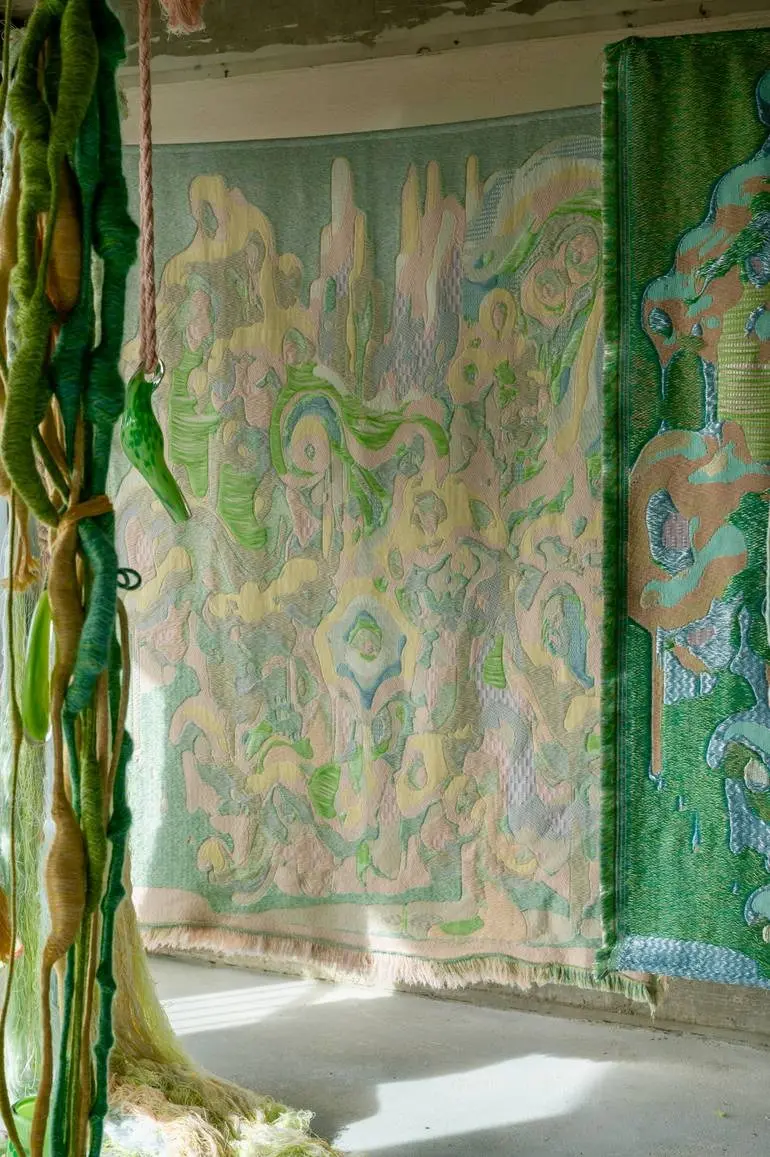
The synthesis of Planken’s artistic vision and ecological commitment finds its most potent expression in Weaves of Saltwater Dreams, an installation presented at BIG ART Amsterdam in collaboration with ValorosaViva.
The Installation
Weaves of Saltwater Dreams is a coral art installation that aggressively defies traditional categorization. A monumental woven tapestry—exploring a palette of deep greens, rich creams, raw copper, and luminous teal—unfurls across the space like a piece of submarine cartography. It reads simultaneously as a living reef and a waking hallucination. Flanking the tapestry are heavy, tactile ropes that elongate into organic, sea-creature-like appendages. The textiles shimmer and appear to ooze, not merely depicting the ocean floor, but rehearsing a visceral return to it.
Material Provenance
True to Planken’s ethos, sustainability is embedded in the molecular level of the work. Every strand of yarn utilized in the installation is recycled or donated—sourced from discarded wardrobes, industrial deadstock, and forgotten textile reserves—and reborn as intricate coral topography.
Nature’s Visual Sound and Scientific Partnership
This artistic recycling is part of a much larger, ongoing universe titled Nature’s Visual Sound. Under this banner, Planken is actively collaborating with the Branch Foundation and the University of Wageningen. Together, they are growing heat-resilient algae and coral species directly on specially engineered glass and textile structures. These artistic-scientific hybrids are designed to function as temporary, life-sustaining habitats on the ocean floor, aiding in marine reef restoration.

Supporting Metric: In a firm commitment to regenerative action, 10 percent of every acquisition of Planken’s work goes directly toward funding these underwater reef art and restoration projects.
Official Responses and Artist Statement
Planken’s work has garnered critical acclaim for its ability to bridge the gap between aesthetic contemplation and tactile reality. In an exclusive statement reflecting on her philosophy, labor, and the role of the artist in modern society, Planken offers deep insight into her creative motivations:
"I wish more people understood that being an artist is not only about creating objects, but about learning how to remain deeply sensitive within a world that constantly pushes towards speed, distraction, and sameness," states Sandra Keja Planken.
"Most artworks are built through years of experimentation, doubt, observation, and invisible labor. The final piece often carries countless emotional and material decisions that are never immediately visible on the surface. I also believe artists help create emotional and cultural space within society. Art can slow people down, reconnect them to wonder, and allow them to experience the world differently for a moment. In a time where so much becomes flattened into fast images and algorithms, I think sensitivity and imagination become increasingly important."
Art critics and curators have similarly praised her ability to sidestep cynical artistic trends in favor of material authenticity. By refusing to treat sustainability as a mere conceptual buzzword, Planken integrates circular design principles directly into the physical integrity of her sculptures.
Implications: The Future of Ecological and Sensory Art
Sandra Keja Planken’s work signals a broader, much-needed shift within contemporary art: the transition from passive environmental commentary to active ecological participation.

1. Countering Digital Fatigue
As augmented reality, artificial intelligence, and digital screens consume larger portions of human attention, the physical hunger for tactility is reaching an all-time high. Planken’s work capitalizes on this psychological deficit. By utilizing heavy wools, mixed fibers, and reflective glass, she forces viewers out of their cognitive detachment and back into their physical bodies. The implication for the art market is clear: objects that engage multiple senses and offer genuine material richness will increasingly outvalue purely conceptual or digitally native works in terms of emotional resonance.
2. Art as Infrastructure for Regeneration
Planken redefines the relationship between the white cube gallery space and the natural world. By funneling financial support from art acquisitions directly into marine biology initiatives—and by designing sculptures that double as functional coral substrates—she breaks the cycle of extractive art production. The studio is no longer an isolated site of consumption, but a laboratory for ecological repair.
3. The Re-Enchantment of Materials
Ultimately, Planken’s practice offers a blueprint for how contemporary creators can navigate the climate crisis without falling into didacticism. Her work does not lecture the viewer about ecological collapse; instead, it seduces them with beauty, texture, and wonder. By making audiences feel the pulse of a simulated saltwater reef, she cultivates an emotional investment that naturally translates into environmental stewardship.
In the hands of Sandra Keja Planken, the boundary between an organism and an object dissolves, leaving behind a luminous space where art heals, breathes, and remembers.