AMSTERDAM — In an era dominated by flat screens, algorithmic feeds, and a relentless cultural acceleration toward speed and sameness, the studio of Dutch contemporary artist Sandra Keja Planken operates as an intentional counter-weight. Operating from the Netherlands, Planken creates works that defy easy categorization, sitting precariously yet purposefully somewhere between biological organism and manufactured object. Her woven structures pulse with the uncanny visual rhythm of living tissue, while her glass sculptures challenge conventional physics, appearing as though they might yield to the touch at any moment.
Her immersive installations blur the boundaries separating dreamscapes, psychological memory, and the ecological body. Yet, beneath the striking aesthetic complexity of her exhibitions lies a singular, driving preoccupation: restoring deep sensory experience, haptic tactility, and profound material presence to a cultural landscape increasingly characterized by emotional and physical detachment.
Main Facts: The Material Universe of Sandra Keja Planken
At the core of Planken’s artistic identity is a restless interrogation of how humans relate—both emotionally and physically—to spaces, materials, the natural world, and one another. Working primarily across textiles, glass, and site-specific installations, she constructs environments that surround the viewer entirely.
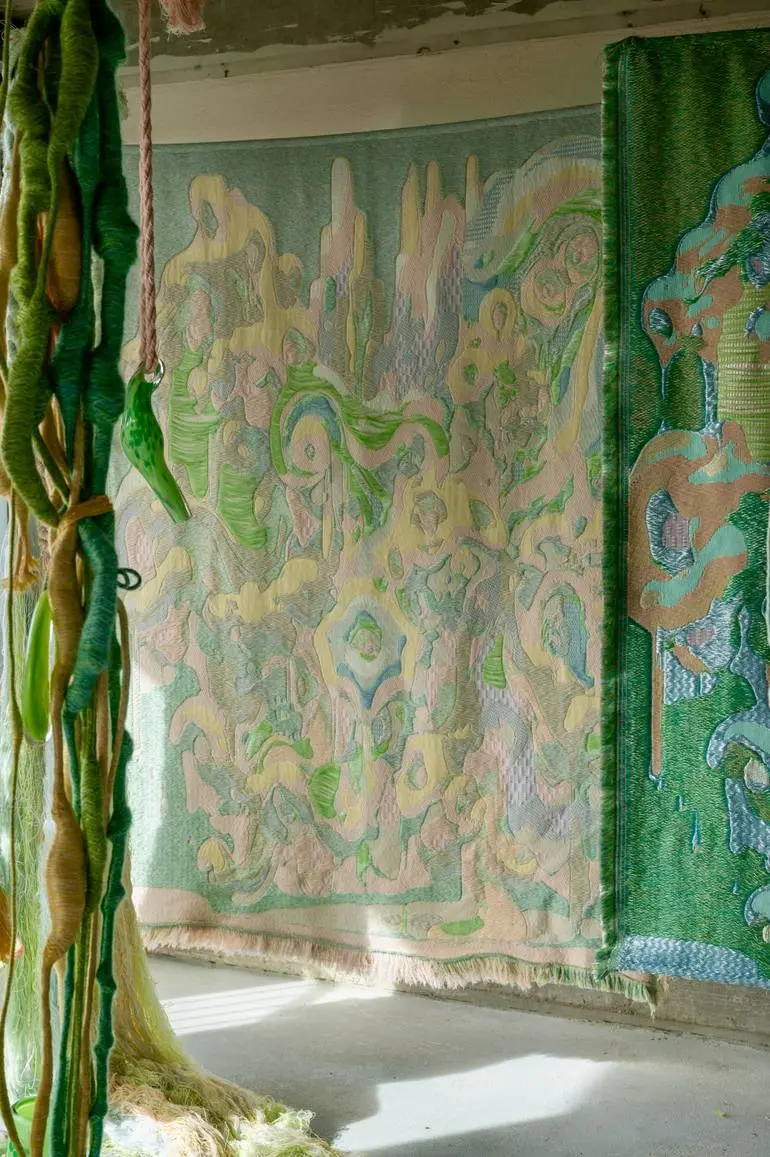
Her recent masterwork, Weaves of Saltwater Dreams—showcased prominently at BIG ART Amsterdam in collaboration with ValorosaViva—exemplifies her cross-disciplinary approach. The large-scale installation features a sweeping woven tapestry rendered in undulating shades of deep green, warm cream, metallic copper, and vibrant teal. Unfurling like a piece of submarine cartography, the piece reads simultaneously as a marine coral reef and a waking hallucination. Heavy ropes hang in dynamic tandem with the textiles, elongating into organic, sea-creature-like forms that shimmer and seemingly ooze under shifting gallery lights.
Crucially, Planken’s materiality is deeply sustainable. Every strand of yarn utilized in her flagship works is either recycled or donated—sourced from discarded wardrobes, industrial deadstock, and forgotten textile archives—before being reborn as intricate coral topography. This commitment to ecological integration is not merely symbolic; it forms the backbone of her ongoing artistic universe, Nature’s Visual Sound. Through this initiative, Planken collaborates scientifically with the Branch Foundation and Wageningen University, cultivating heat-resilient algae and coral species directly onto glass and textile structures engineered to function as temporary marine habitats on the ocean floor.
To cement this circular ethos, ten percent of the proceeds from every acquisition of her artwork goes directly back into funding these vital underwater reef art and restoration projects.
Chronology: The Evolution of a Sensorial Practice
To understand how Planken arrived at this intersection of high art and marine ecology, one must trace a trajectory defined by cross-cultural sensitivity and material experimentation.
Early Life and Cultural Duality
Planken’s artistic sensitivities were forged in early childhood, shaped by a unique bicultural upbringing caught between the emotional warmth and expressive openness of Spanish culture and the structured restraint of Northern Europe. Growing up navigating these contrasting environments instilled in her an acute spatial awareness. She developed a profound sensitivity to the ambient atmospheres of spaces—noticing early on that certain environments feel palpably alive, while others feel strangely absent, sterile, and void of human resonance. This foundational sensitivity became the guiding question of her life’s work: How can spaces and objects be infused with a living pulse?
The Turn to Textiles
Initially drawn to the tactile and emotional immediacy of fiber arts, Planken gravitated toward textiles because of their innate human quality. Threads, knots, and complex woven structures offered a haptic vocabulary that felt inherently biological. Over time, her studio practice evolved organically: starting with small, intimate objects, moving outward into freestanding sculptures, and eventually expanding into room-sized installations capable of enveloping the viewer’s entire sensory apparatus.
The Introduction of Glass and the Ecological Shift
As her conceptual framework matured, Planken sought a material that could converse with textiles through contrast. Glass entered her practice as a medium capable of holding fragility, precision, reflection, and captured light. She became fixated on the physical and visual tension between textile and glass—exploring how the inherent softness of woven fiber and the hard rigidity of molten glass could begin to blur and dissolve into one another.
In recent years, this material experimentation converged with an urgent ecological focus. Nature, complex coral ecosystems, and the mechanics of ecological transformation became defining pillars of her work. Today, her installations function as living systems, engaging directly in processes of care, ecological regeneration, and emotional reconnection.
Supporting Data & The Creative Process
Planken’s workflow rejects rigid, pre-determined blueprints in favor of an intuitive, responsive dialogue with her materials.
The Anatomy of the Process
Observation and Collection: The creative cycle typically begins with ambient observation. Planken gathers fragments from the world around her: light bouncing off urban surfaces, underwater currents captured on film, the structural geometry of seaweeds and blossoms, discarded industrial materials, and the intangible emotional tensions present within built architectural spaces.
Intuitive Materiality: Rather than enforcing a fixed vision, she allows the materials themselves to guide the evolution of the piece. She fluidly cycles through drawing, weaving, glass-blowing, and sculptural assembly, allowing forms to grow organically much like natural biological systems.
Tactile Contradiction: Planken actively seeks out moments of material contradiction. She manipulates glass until it achieves a visual softness, while simultaneously coaxing textiles into adopting rigid, architectural, or organic postures.
Layered Accumulation: Works are constructed slowly, layer by layer, through accumulation and transformation.
The Role of Light: Light serves as the ultimate collaborator in Planken’s installations. Because her surfaces catch, refract, and absorb illumination differently, the atmosphere of an installation shifts continuously throughout the day, altering its emotional resonance with every passing hour.
Featured Artwork Specifications
Title/Type: Sculpture, Weaving of Wool (Recycled and donated yarn, woven textile, mixed fibers)
Dimensions: 55" W x 40" H x 2" D (dimensions variable based on installation site)
Environmental Impact: 10% of every acquisition directly supports underwater reef art and restoration initiatives.
Official Responses & Artist’s Statement
In a rare and candid reflection on the realities of contemporary art-making, Sandra Keja Planken recently articulated the philosophical underpinnings of her studio practice:
"I wish more people understood that being an artist is not only about creating objects, but about learning how to remain deeply sensitive within a world that constantly pushes towards speed, distraction, and sameness," Planken shares.
"Most artworks are built through years of experimentation, doubt, observation, and invisible labor. The final piece often carries countless emotional and material decisions that are never immediately visible on the surface. I also believe artists help create emotional and cultural space within society. Art can slow people down, reconnect them to wonder, and allow them to experience the world differently for a moment. In a time where so much becomes flattened into fast images and algorithms, I think sensitivity and imagination become increasingly important."
This philosophy informs every facet of her output. By refusing to cater to the accelerated consumption cycles of modern visual culture, Planken demands that her audiences pause, breathe, and re-engage their tactile senses.
Implications: Art as an Ecological and Emotional Catalyst
The implications of Sandra Keja Planken’s work extend far beyond the white walls of contemporary art galleries or the exhibition floors of art fairs like BIG ART Amsterdam. By bridging the gap between high conceptual sculpture and hands-on marine conservation, she challenges the traditional boundaries of what an artist’s responsibility entails in the 21st century.
1. Countering Digital Fatigue
In an era where human interaction is increasingly mediated by screens, virtual spaces, and flattened digital imagery, Planken’s work provides a necessary physical antidote. Her heavy emphasis on raw textures, visible labor, and haptic engagement forces viewers out of passive consumption and back into their bodies. The sheer tactile presence of her woven tapestries and glass-fiber hybrids reminds audiences of the physical reality of the material world.
2. Redefining Eco-Art through Direct Action
Much of contemporary ecological art remains purely symbolic or didactic—seeking to inform viewers about environmental crises through stark warning. Planken’s approach bypasses intellectual fatigue by prioritizing emotional connection first. By making viewers feel the mesmerizing, alien beauty of marine ecosystems through her tactile sculptures, the impulse to care for the environment follows naturally. Furthermore, her direct financial and structural partnerships with marine biologists at Wageningen University and the Branch Foundation prove that contemporary art can actively participate in ecological repair, utilizing sculptural installations as literal scaffolding for recovering coral reefs.
Ultimately, Sandra Keja Planken demonstrates that art does not need to choose between rigorous aesthetic innovation and profound social and ecological responsibility. By weaving together discarded threads, resilient glass, and a deep reverence for the natural world, she creates a space where humanity can pause, reflect, and begin the long work of emotional and ecological reconnection.