







Main Facts: Anatomy of a Legend
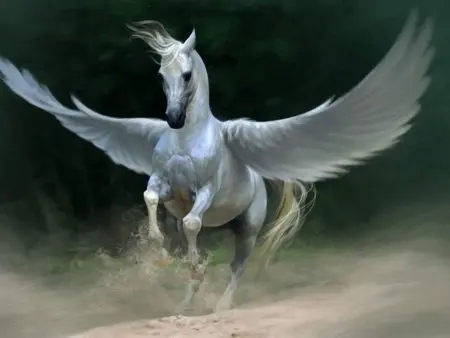
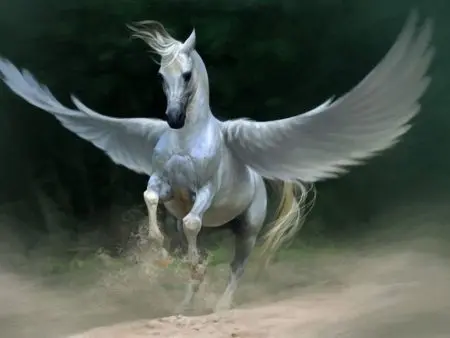
In the vast pantheon of Greek mythology few creatures capture the human imagination quite like Pegasus. Classically depicted as a magnificent, pure white stallion endowed with sweeping, feathered wings, Pegasus is far more than a simple beast of burden in ancient lore. He is a divine creation, a symbol of untamed freedom, and a bridge between the mortal realm and the Olympian heights.
Etymologically rooted in the ancient Greek Pigasos (derived from pēgē, meaning "spring" or "well"), the creature’s name foretells his mythic origins. According to classical accounts, Pegasus was the divine offspring of Poseidon, the formidable god of the sea, and the Gorgon Medusa. His birth was as dramatic as it was unconventional: rather than being carried to term in a traditional manner, Pegasus sprang forth directly from the neck of Medusa after the hero Perseus decapitated her. Armed with Athena’s reflective shield and winged sandals, Perseus struck the fatal blow, inadvertently bringing the winged horse and his golden-sword-bearing brother, Chrysaor, into existence simultaneously.
While classical mythology paints Pegasus as a singular, peerless entity—a wild and untamable force of nature that could only be subdued by mortal hands through the divine intervention of Athena and her golden bridle—modern interpretations have expanded the concept. In contemporary fantasy literature, role-playing games, and modern media, "pegasi" often exist as species or herds, occasionally sporting variations in coat color, elaborate tails, or even horns, bridging the gap between the classic winged horse and the unicorn.
Chronology: From Mythic Birth to the Stars
The timeline of Pegasus spans from his miraculous, violent birth in antiquity to his eventual translation into a permanent celestial landmark.
- The Birth at the Edge of the World: Pegasus is born from the severed neck of Medusa, simultaneously with his warrior brother Chrysaor. Because Medusa perishes at his birth, popular culture adaptations—such as the cinematic representations in Clash of the Titans—often take creative liberties regarding the timeline of Perseus encountering the beast.
- The Creation of Hippocrene: During his earthly travels, Pegasus strikes Mount Helicon with his hoof. The impact causes a spring to burst forth. Named Hippocrene (the Horse’s Fountain), this sacred water becomes famously associated in Greek tradition with inspiring poets, writers, and artists.
- The Taming by Bellerophon: Remaining wild and free for much of his early existence, Pegasus is eventually captured near the spring of Peirene. With the help of a golden bridle gifted by the goddess Athena, the hero Bellerophon successfully tames the winged stallion.
- Heroic Exploits: Bound to Bellerophon, Pegasus plays a pivotal role in several legendary victories. Most notably, the duo defeats the terrifying Chimera—a fire-breathing monster composed of a lion’s head, a goat’s body, and a serpent’s tail—by striking it from the safety of the skies. They also successfully fend off the warlike Amazons.
- The Fall and the Heavens: Emboldened by his success, Bellerophon attempts to ride Pegasus all the way to Mount Olympus to join the gods. Angered by this mortal hubris, Zeus sends a gadfly to sting Pegasus. The winged horse bucks, throwing Bellerophon back down to Earth. Pegasus, however, continues his ascent to Olympus, where he spends his remaining days carrying thunder and lightning bolts for Zeus. Honored for his divine service, Pegasus is eventually transformed into the constellation that bears his name.
Supporting Data: The Linguistic and Cultural Footprint
The endurance of Pegasus through millennia is not merely a matter of oral tradition; it is backed by a massive footprint in classical literature, art, and modern media analytics.
- Classical Mentions: The earliest surviving written records of Pegasus appear in the works of Hesiod (in the Theogony) and Pindar, dating back to the 7th and 6th centuries BCE.
- Cinematic Impact: Film adaptations, most notably the 1981 epic Clash of the Titans (which famously utilized a Friesian horse outfitted with prosthetic wings) and its 2010 remake, have introduced the myth to generations of modern audiences. In animal husbandry and cinematic circles, the portrayal of Pegasus has sparked decades of discussion regarding practical special effects versus CGI.
- Global Lexicon: The term "Pegasus" has been adopted across industries. From military tactical gear and aerospace engineering projects to software security systems (such as the infamous spyware), the name universally evokes themes of speed, elevation, surveillance, and untouchable height. Furthermore, astronomical data confirms that the constellation Pegasus is one of the 48 constellations listed by the 2nd-century astronomer Ptolemy, spanning an area of 1,121 square degrees in the northern sky.
Symbolism: Layers of Meaning
Beyond his physical prowess and mythological narrative, Pegasus carries a profound tapestry of symbolic weight that has evolved over centuries.
1. Inspiration and Creativity
Because his hoof strike brought forth the sacred spring of Hippocrene—beloved by the Muses—Pegasus became inextricably linked to poetic inspiration and artistic creation. In Western art history, encountering Pegasus or drinking from his fountain is frequently used as a metaphor for achieving a breakthrough in creative thought or philosophical insight.

2. Heroism and Victory
As the mount of Bellerophon during the eradication of the Chimera, Pegasus represents the triumph of cleverness, courage, and divine favor over chaotic, destructive monsters. He embodies the archetypal loyal companion that elevates a mortal hero to legendary status.
3. Transcendence and Freedom
With wings that lift him above the terrestrial plane, Pegasus is the ultimate symbol of breaking free from earthly limitations. His refusal to be easily controlled—requiring a divine artifact (Athena’s golden bridle) to be ridden—underscores the concept that true freedom and higher perspectives cannot be mastered by brute human force alone.
4. Nobility and Purity
The traditional pure white coat of the classical stallion projects an aura of untblemished nobility. In heraldry and European folklore, winged white horses are frequently deployed on coats of arms to signify high-minded aspirations, military valor, and a pure spirit.
Implications: The Enduring Psyche of Mythic Beasts
The persistent fascination with Pegasus in the modern era offers deep insights into human psychology and cultural evolution. In an age dominated by technological advancements, space exploration, and digital connectivity, the enduring appeal of a winged horse reveals humanity’s unchanging desire for transcendence.
Pegasus serves as a psychological anchor for the human imagination. He represents the persistent urge to look upward—away from terrestrial burdens and toward the celestial sphere. Whether interpreted as an early poetic metaphor for the subconscious mind, a symbol of scientific ambition reaching into the cosmos, or simply a cherished relic of ancient storytelling, Pegasus continues to challenge the boundary between what is real and what is possible.
As long as humanity seeks inspiration, strives to overcome insurmountable odds, and looks to the night sky in search of meaning, the winged stallion of Mount Olympus will continue to take flight across generations, firmly rooted in both the ancient past and the limitless expanse of the human imagination.