By Global Science & Culture Desk
For millennia, long before the advent of digital push notifications, synchronized global time zones, or the rigid grid of the Gregorian calendar, humanity looked up at the night sky to make sense of existence. Across North America, Indigenous peoples relied on a sophisticated, highly localized timekeeping system that married celestial observation with the rhythm of the changing seasons. By tracking the lunar cycle, these communities didn’t just mark the passage of days; they read a natural clock written in the behavior of animals, the blossoming of wildflowers, and the shifting behavior of the earth.
Today, terms like the "Wolf Moon," "Pink Moon," and "Harvest Moon" are fixtures of popular culture, frequently appearing in modern almanacs and stargazing apps. Yet, beneath these poetic monikers lies a deep bedrock of Indigenous ecological wisdom, colonial adaptation, and a living ancestral heritage that continues to thrive in defiance of modern homogenization.
The Main Facts: An Indigenous Ecological Calendar
At its core, the traditional naming system for full moons is not merely decorative; it is an ecological ledger. Long before European settlers arrived on the continent, diverse Native American nations utilized the lunar cycle—often paired with seasonal shifts—as a vital survival tool.
Among the most influential contributors to the lexicon commonly used today are the Algonquian-speaking peoples, whose historical territories stretched from the coastal regions of New England to the vast expanse of Lake Superior. Within this linguistic and cultural family, the Ojibwe (also known as the Chippewa) played a pivotal role in preserving and transmitting lunar traditions. Their sophisticated economy—characterized by birchbark craftsmanship, copper mining and trade, and the intricate harvesting of wild rice (manoomin) and maple syrup—was strictly calibrated to the phases of the moon.
In Anishinaabe tradition, Nookomis Dibik-Giizis, or Grandmother Moon, is revered as a primary teacher. Unlike the linear, fixed-length months of the Julian or Gregorian systems, Indigenous lunar calendars were deeply flexible and adapted to regional variations. While some nations tracked a year through four distinct seasons, others recognized five. Depending on the tribe and the ecological zone, a year might consist of 12 or 13 moons, allowing communities to remain exquisitely synchronized with their local environments.
Chronology and Evolution: From Ancient Observation to Colonial Adaptation
The history of full moon names is a tale of cross-cultural synthesis, environmental adaptation, and preservation.
Pre-Colonial Era: Deep Time and Local Observation
For thousands of years, Native nations independently developed lunar naming conventions tied exclusively to their immediate surroundings. A moon signaling the run of the sucker fish for a Great Lakes tribe might coincide with a completely different environmental marker for a tribe in the arid Southwest or the southeastern woodlands. These names were dynamic, evolving alongside ecological realities and animal migrations.
The Colonial Encounter (17th–18th Centuries)
When European settlers arrived in North America, they encountered a landscape vastly different from their homelands. Relying initially on the survival knowledge of local Indigenous populations, settlers began adopting native environmental markers while simultaneously blending them with European traditions brought from home.
For instance, while certain moon names like the January "Wolf Moon" carry Old English and Celtic roots—referencing the howling of hungry wolves outside European settlements during harsh winters—other terms were direct translations or adaptations of Indigenous observations. Simultaneously, medieval European traditions contributed parallel concepts, such as the "Mead Moon" in July, "Grain Moon" in August, and "Barley Moon" in September, demonstrating a universal human impulse to name months after agricultural milestones.

Institutionalization (Late 18th Century–Present)
The publication of The Old Farmer’s Almanac beginning in the late 1700s served as a critical turning point. By systematically recording and publishing these traditional moon names, the Almanac popularized them for a broad American audience. While this ensured the survival of the names in mainstream consciousness, it also flattened the vast diversity of regional tribal names into a single, standardized list—a homogenization that modern historians and cultural preservationists work actively to correct.
Supporting Data: The 12 Moons of the Traditional Calendar
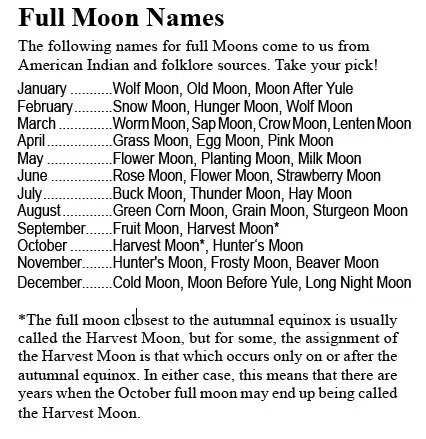
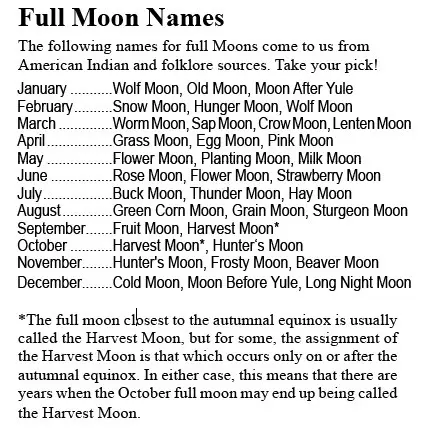
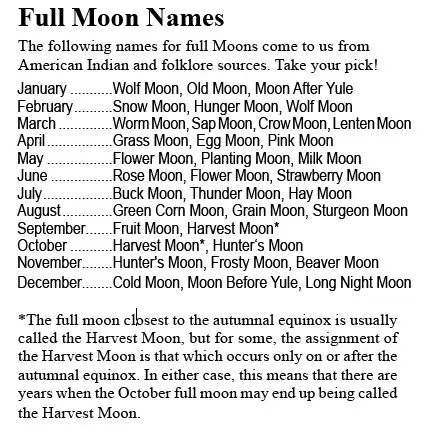
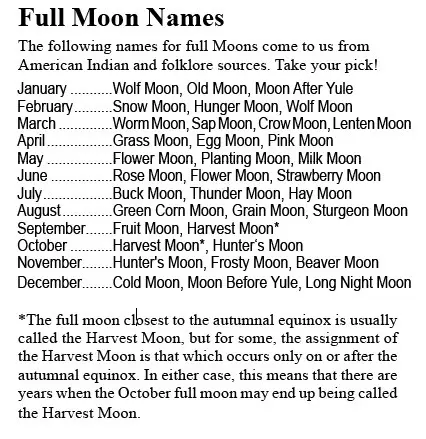
To understand the depth of this system, one must examine the specific moons that mark the turning of the year, tracking how they reflect both survival and celebration.
Winter Moons: Survival and Endurance
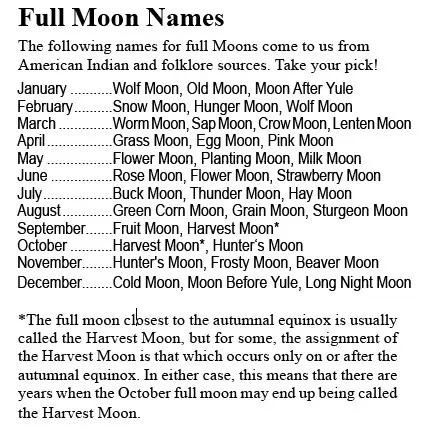
- January – Wolf Moon: Named for the eerie, echoing howls of hungry wolf packs in the dead of winter. Alternative Native names, such as the Severe Moon or Center Moon, highlight the brutal reality of midwinter survival.
- February – Snow Moon / Hunger Moon: Marking the peak intensity of winter. While some northern tribes designated this the Hunger Moon due to depleted food stores, others called it the Bear Moon to mark the birth of bear cubs. The Ojibwe often named it after the sucker fish, a crucial late-winter food source.
Spring Moons: Renewal and Growth
- March – Worm Moon: Named for the softening earth that coaxes earthworm casts back to the surface, signaling the return of robins. Northern tribes often knew this as the Full Crow Moon, while others favored Snow Crust Moon or Sap and Sugar Moon.
- April – Pink Moon: Named for the vibrant wash of wild ground phlox (Phlox subulata) blooming across North America. The Ojibwe traditionally tracked this as the maple sap boiling moon, while other nations used monikers like Breaking Ice Moon and The Moon of the Red Grass Appearing.
Summer Moons: Abundance and Activity
- May – Flower Moon: Celebrating the explosive resurgence of flora and aligning with the critical window for planting corn.
- June – Strawberry Moon: Signalling the ripening of wild strawberries. Coastal tribes frequently called this the Fish Moon due to shad swimming upstream, marking a season of ecological abundance.
- July – Buck Moon / Thunder Moon: Named because male deer (bucks) grow their antlers at full capacity during this month. It is also called the Thunder Moon due to frequent summer squalls.
- August – Sturgeon Moon: Highlighting the peak of the sturgeon fishing season around the Great Lakes. For the Anishinaabe, this is Manoomini-giizis—the vital moon marking the harvest of wild rice.
Autumn Moons: Harvest and Preparation
- September – Harvest Moon: The full moon closest to the autumnal equinox, signaling the gathering of chief agricultural staples like corn, pumpkins, squash, beans, and wild rice.
- October – Hunter’s Moon: Historically the optimal month for hunting, as game animals spent the summer fattening up, and deforested fields left prey with fewer places to hide.
- November – Beaver Moon: Signifying the period when beavers actively prepare their lodges for winter, or historically, when trappers set beaver pelts before the swamps froze solid.
- December – Cold Moon: Marking the arrival of deep snows, long nights, and challenging winter conditions, sometimes referred to as the Long Night Moon.
Official Responses and Cultural Perspectives
In recent years, cultural institutions, Indigenous leaders, and environmental scientists have increasingly emphasized the importance of recognizing the true origins of these lunar monikers.
Tribal historic preservation officers and linguistic revitalization programs across the United States and Canada have pushed back against the sanitized, monolithic presentation of moon names in mainstream media. Representatives from the Anishinaabeg nation emphasize that these names are not static artifacts to be printed on novelty calendars, but rather components of a living, breathing language and worldview.
"When people casually use these names without understanding the ecological context or the specific tribal nations they came from, it strips away their soul," notes a cultural liaison from the Great Lakes Inter-Tribal Council. "These names are teachings. They remind us of our responsibilities to the land, to the fish, to the rice beds, and to the changing seasons."
Furthermore, environmental scientists point out that traditional ecological knowledge (TEK) embedded within lunar calendars offers invaluable data for modern climate researchers. As global warming disrupts historical frost dates, animal migrations, and plant blooms, Indigenous lunar calendars serve as baseline data sets demonstrating how ecosystems historically responded to seasonal shifts.
Implications: The Living Tradition and Modern Relevance
The persistence of Indigenous lunar calendars carries profound implications for how contemporary society interacts with the natural world.
- Reconnecting with Environmental Cues: Modern urban populations are largely detached from natural cycles, relying on artificial lighting and climate control. Re-engaging with traditional moon names encourages a mindful observation of local flora, fauna, and weather patterns.
- Addressing Climate Change: As traditional ecological indicators shift due to anthropogenic climate change, many Native communities are actively adapting their lunar practices. This proves that Indigenous science was never rigid; it is inherently adaptive, resilient, and responsive to environmental feedback.
- Cultural Respect and Decolonization: True appreciation of these traditions requires moving beyond mere consumption. Educators, nature enthusiasts, and almanac publishers are increasingly encouraged to explicitly credit specific tribal origins and support local Indigenous language revitalization efforts.
As the Anishinaabe continue to utilize Gookomisinaan dibik-giiziso-mazina’igan (their traditional lunar calendar) in daily life, they offer a powerful counter-narrative to the relentless pace of the Gregorian solar calendar.
Ultimately, the full moon names overhead are far more than poetic relics of the past. They represent a sophisticated, enduring archive of human observation—a luminous bridge connecting the modern stargazer to the deep, resonant wisdom of the Indigenous peoples who first mapped the heavens and the earth.