MELBOURNE — For centuries, the popular imagination has painted ancient Rome in broad, thunderous strokes of marble, blood, and gold. It is a civilization frequently defined by the martial swagger of its legions, the lethal theater of the Colosseum, and the absolute autocracy of the Caesars. Yet, beneath the grand architectural arches and the glittering panoply of conquest lies a quieter, more intimate history—one of domestic altars, whispered prayers, profound grief, and the ordinary rhythms of daily life.
A rare and breathtaking window into this lesser-seen antiquity is currently open at the Melbourne Museum. Featuring more than 180 rare antiquities dating from the first to third centuries CE, ROME: Empire, Power, People is a Melbourne-exclusive exhibition drawing directly from the prestigious collections of the Museo Nazionale Romano and the Museo Archeologico Nazionale di Firenze. Crucially, a significant portion of the artifacts on display have never before traveled outside of Italy.
Organized into five distinct thematic zones—Ambition, Life, Luxury, The Divine, and Eternity—the exhibition delivers a masterclass in museum curation, balancing scholarly rigor with atmospheric theatricality. Reviewed through the lens of modern pagan scholarship and spiritual care by writer and practitioner Cosette Paneque, the exhibition offers contemporary audiences a profound engagement with the lived religion, anxieties, and sacred practices of people who walked the empire two millennia ago.
Main Facts: A Landmark Cultural Exchange
The logistics of ROME: Empire, Power, People represent a major triumph for Museums Victoria and international cultural preservation. Transporting over 180 fragile, irreplaceable historical objects across hemispheres requires meticulous planning, state-of-the-art climate control, and diplomatic cooperation between Australian cultural institutions and the Italian Ministry of Culture.
- Exhibition Venue: Melbourne Museum (11 Nicholson Street, Carlton, Victoria).
- Closing Date: Sunday, October 25, 2026.
- Curatorial Sources: The Museo Nazionale Romano and the Museo Archeologico Nazionale di Firenze.
- Scope: Artifacts spanning the 1st through 3rd centuries CE, including fine-grained white marble busts, intricate gold jewelry, domestic frescoes, lead curse tablets, marble sundials featuring zodiac symbols, and domestic household bronzes.
- Pricing & Access: General admission tickets—bundled with standard museum entry—range from $15 for children to $38.50 for flexible adult entry, with dedicated concessions and member discounts available.
Chronology and Structural Journey: Through the Five Galleries
The exhibition is strategically laid out to take visitors on a chronological and thematic pilgrimage, beginning with the sweeping ambitions of the state and slowly narrowing down to the personal, domestic, and spiritual realities of the individual.
1. Ambition: The Architecture of Power
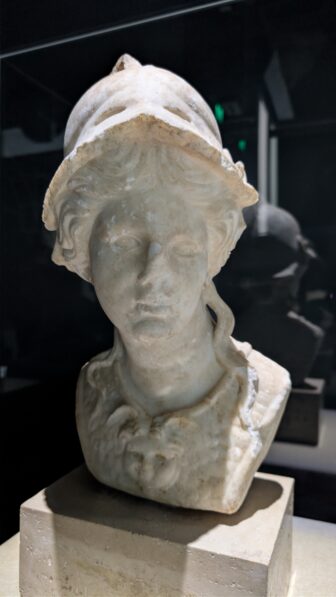
The journey commences in familiar territory. Visitors are greeted by the shadow of the assassination of Julius Caesar, monumental marble portraits of emperors, and visages of the women who wielded immense influence behind the scenes of imperial politics. This gallery sets the foundational tone, showcasing Rome as a civilization fixated on spectacle, dominance, and the monumentalization of authority.
2. Life: The Bureaucracy and Breath of the Common Citizen
Moving away from the halls of power, the second gallery introduces the pulse of ordinary Roman society. Far from the battlefield, everyday citizens left behind humble markers of existence.
- A modest bronze plaque, originally bolted to a cart, records an administrative exemption granted to the Vestal Virgin Calpurnia Praetextata from paying transport tolls—a tiny bureaucratic mercy highlighting the intersection of civic life and rigorous religious obligation.
- Funerary plaques line the walls, commemorating individuals not by military rank or political office, but by their trades: weavers, sausage makers, and laborers who desired posterity to remember their daily toil.
- To bridge the sensory gap, the gallery features a recreation of a Roman bathhouse, utilizing dappled blue illumination, ambient soundscapes, and the organic aromas of lavender, rosemary, and oregano to evoke the steam and herbal treatments of antiquity.
3. Luxury: Domestic Splendor and Patrician Comforts
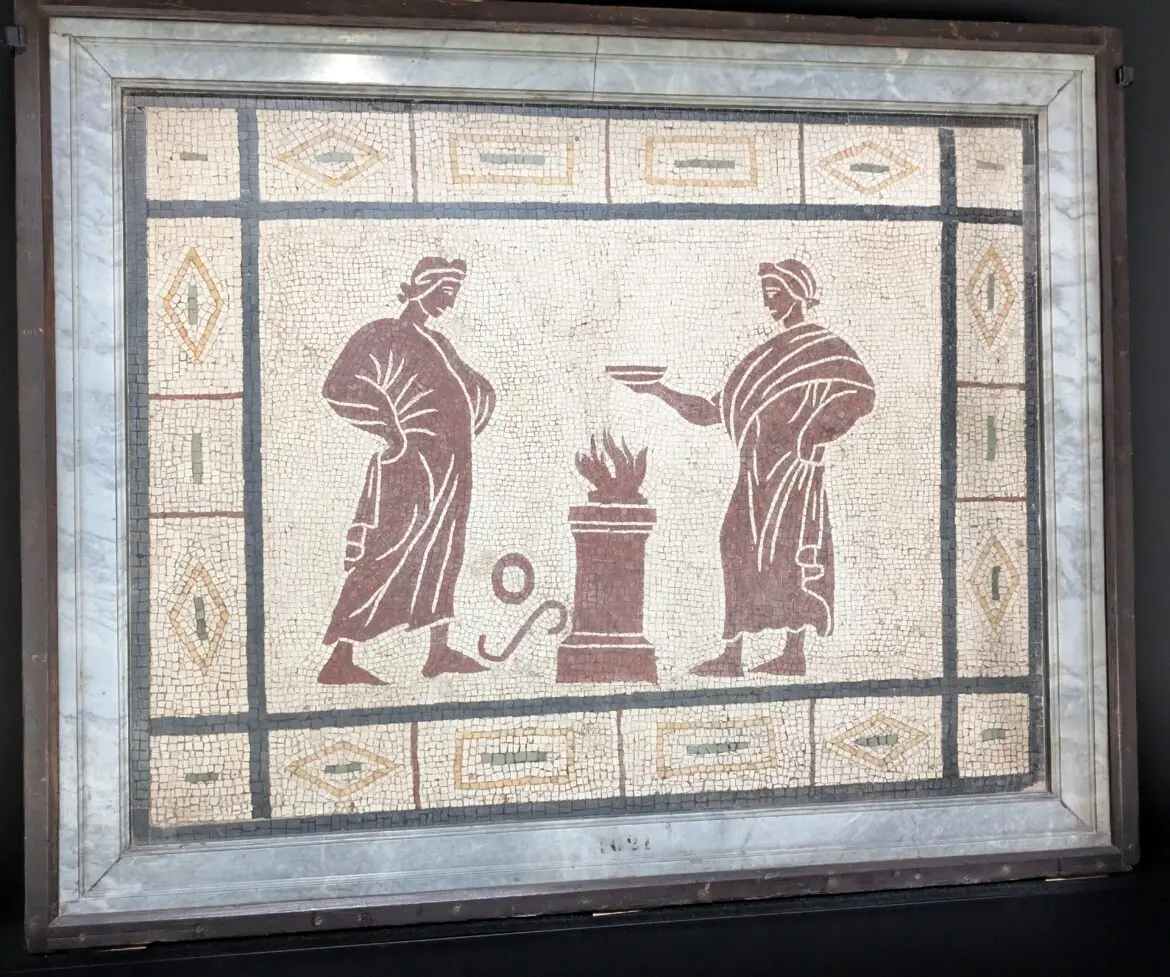
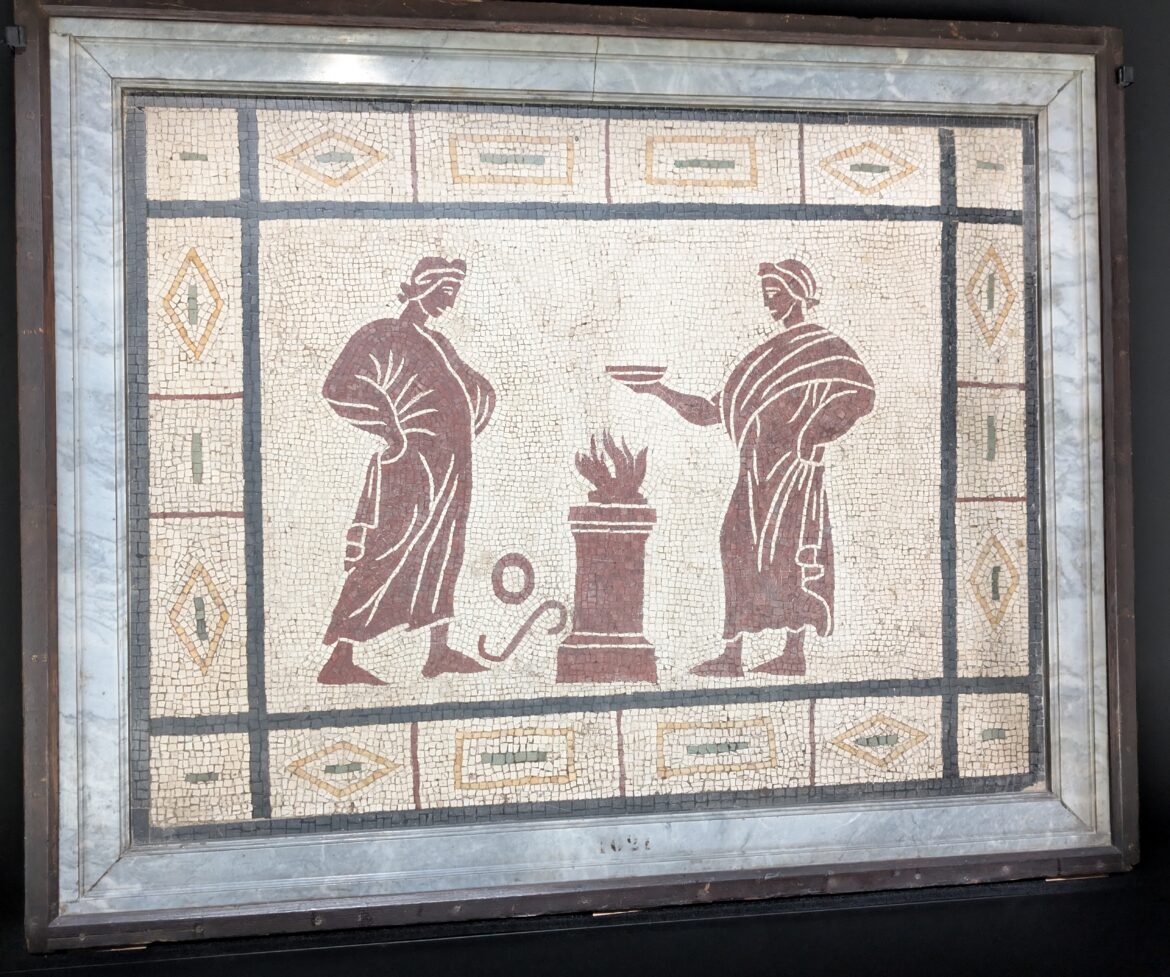
The luxury gallery steps inside the opulent villas of the patrician class. Here, visitors encounter glittering displays of jewelry, intricate mosaics, delicate frescoes, oil lamps, and household tableware. The room’s centerpiece is a meticulously reconstructed Roman banquet scene: dining couches arranged in the traditional triclinium layout around a low table, backed by vibrant garden murals and hyper-realistic plaster representations of food.

4. The Divine: The Strange, Sacred, and Unseen
Shifting dramatically from the warmth of the luxury suite, the Divine gallery plunges visitors into an austere, contemplative atmosphere. The walls are painted black and illuminated exclusively by geometric white lighting fixtures, creating a stark, almost clinical environment that forces a solemn reckoning with ancient religious experience.
At the center stand statues of Dionysus and an anonymous priestess, elevated on a glowing platform against a backdrop of painted sacrificial scenes, while suspended wireframe structures suggest phantom architecture. Here, the exhibition confronts the stranger, more mystical currents of Roman paganism:
- Domestic Devotion: Small household bronzes depict deities like Eros, Diana, Mercury, and veiled sacrificants, demonstrating how Romans maintained intimate relationships with their gods within household shrines (lararia) rather than confining worship to monumental public temples.
- Mystery Cults: A bronze hand amulet terminating in a ram’s head points directly to the mystery cults of Jupiter Dolichenus and Sabazius, while simultaneously forming the benedictio latina—a gesture of blessing later co-opted by Christian ritual traditions.
- The Human Edge of Malice: Providing a startling contrast to divine benevolence, a lead curse tablet targeted at a romantic rival named Malchio and Rufas is methodically inscribed. The curse works its way through the victim’s physical anatomy—eyes, hands, teeth, and bones—cursing each part individually. Compounded by grammatical errors that suggest the writer’s fury outpaced their Latin, the artifact serves as a visceral, 2,000-year-old testament to raw, human emotion. Once inscribed, such tablets were routinely pierced with nails and cast into tombs, wells, or temples.
5. Eternity: Memory, Grief, and the Afterlife
The exhibition concludes by confronting mortality. Romans held diverse and evolving views on the afterlife, prioritizing continuity and remembrance over rigid dogmatic uniformity. Family rituals and public epitaphs ensured the dead remained active members of the community.
The emotional centerpiece of this final space is a fresco salvaged from an underground family tomb built by Octavius Felix. Dedicated to his six-year-old daughter, Octavia Paulina, the artwork depicts children playing and gathering roses under the watchful guidance of Hermes as psychopomp (guide of souls). It is a hauntingly tender artifact, transforming paralyzing grief into an eternal, verdant garden.

Supporting Data and Curation Insights
Museums Victoria has emphasized the scholarly weight of the loans secured for this exhibition. Bringing artifacts directly from Rome and Florence allows Australian researchers and the public to interact with material culture that bypasses standard textbook generalizations.
- Artifact Diversity: Encompassing over 180 pieces, the exhibition spans sculptural masterworks, epigraphic evidence (inscriptions), numismatics, household implements, and funerary art.
- Material Culture: The integration of organic sensory elements—such as the botanical scents in the bathhouse reconstruction and the architectural lighting in the Divine gallery—reflects a modern museum trend toward multi-sensory storytelling, heavily praised by cultural critics and accessibility advocates alike.
- Geographic exclusivity: As the sole Australian venue for this specific collection, Melbourne Museum has anticipated substantial interstate tourism throughout its run.
Official Responses and Scholarly Perspectives
Museum directors and cultural commentators have lauded the exhibition for its ability to humanize an empire frequently sterilized by Hollywood tropes and classical distance.
Dr. Elizabeth Richmond, a classical historian unconnected to the curation team, noted: "Exhibitions of Roman art often fall into the trap of celebrating the state apparatus—the generals and the emperors. By shifting focus toward domestic shrines, curse tablets, and trade-specific epitaphs, this exhibition restores agency and voice to the silent majority of the ancient world."
From a spiritual and contemporary pagan perspective, reviewers like Cosette Paneque have highlighted the emotional resonance of encountering ancient devotional practices firsthand. Standing before household bronzes and mystery cult amulets bridges a millennia-old gap, reminding modern practitioners that the yearning for divine connection, protection, and meaning-seeking is an enduring human constant.
Implications: Confronting the Shadows of Empire
Despite widespread critical acclaim for its artistic and curatorial achievements, ROME: Empire, Power, People also invites important critical conversations regarding the darker foundations of Roman civilization.
A notable point of discussion among critics is the exhibition’s handling of chattel slavery—the economic and social engine that made Roman luxury, monumental architecture, and patrician leisure possible. Within the Life gallery, a single marble sarcophagus depicts Roman soldiers leading bound prisoners before a victorious commander. Accompanying this is a concise label noting that war captives were routinely executed, enslaved, or occasionally manumitted.
Cultural critics have pointed out that while accurate, a solitary label struggles to bear the vast historical weight of an institution that permeated every layer of Roman society, from the domestic households producing funerary monuments to the construction of the very bathhouses and villas celebrated in adjacent rooms.
Nevertheless, the exhibition succeeds in its primary mandate: it challenges visitors to look beyond the marble facade of imperial propaganda. Whether a visitor arrives seeking the bombastic spectacle of gladiatorial combat and imperial ambition, or the quiet, flickering candle of domestic devotion and ancient grief, ROME: Empire, Power, People offers an unforgettable communion with the past—one that will linger in Melbourne long after the final artifacts are packed and returned to Italy.