







Main Facts
In an era dominated by mass production, automated assembly lines, and disposable interior trends, Türkiye-based Regen Studio represents a counter-cultural movement toward intentionality, permanence, and deeply rooted craftsmanship. Operating as both an independent design practice and an exclusive furniture brand, Regen Studio bridges the often-distant worlds of structural architecture and bespoke object design.
The studio does not manufacture at scale. Instead, every piece of furniture is made to order by a tight-knit collective of skilled local artisans in Türkiye, ensuring that no two items are entirely identical. Defined by an architectural approach to spatial harmony, the brand’s portfolio is inherently collectible in the truest sense of the word: made once, made well, and engineered to last across generations.
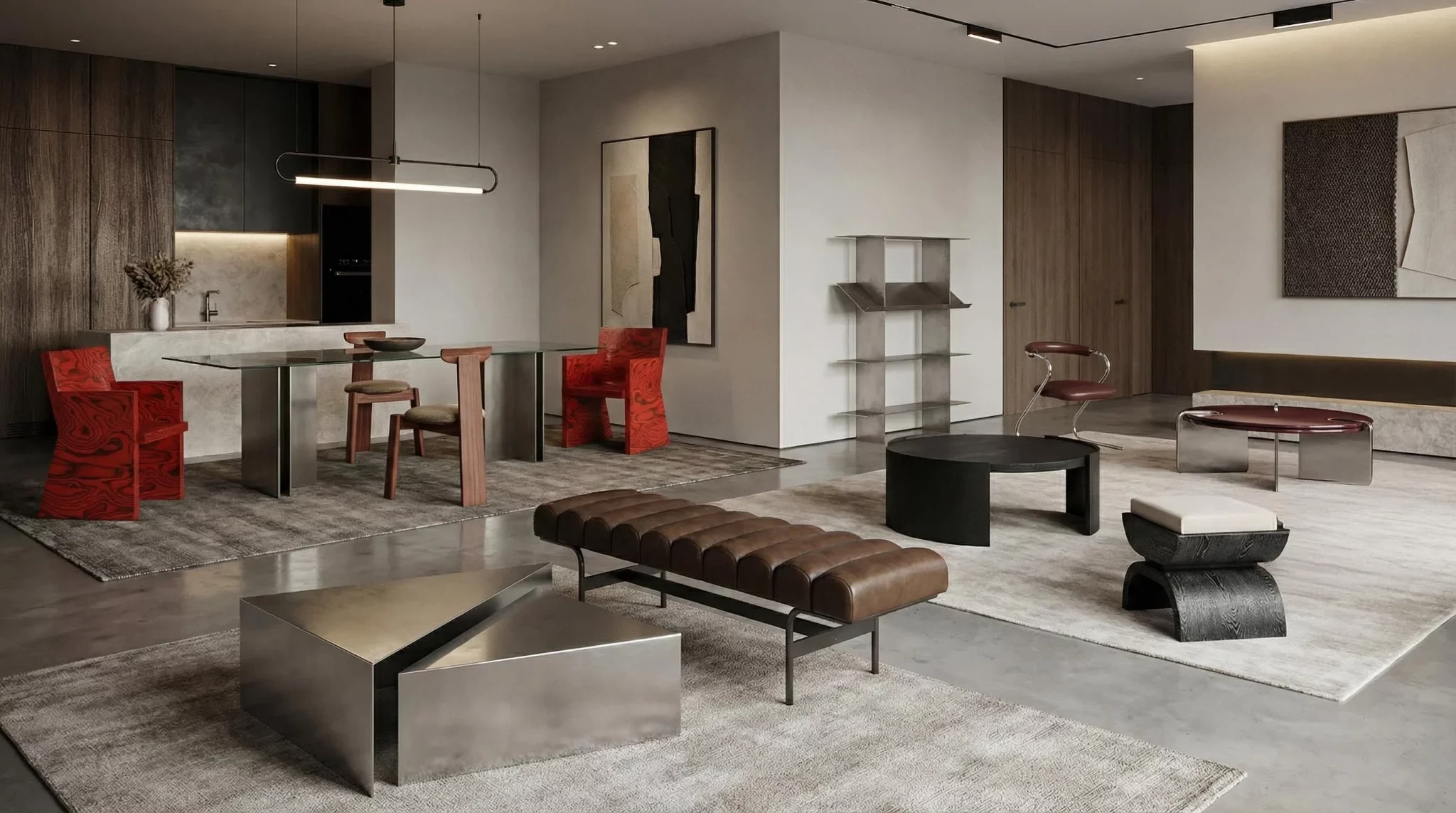
At the heart of the brand’s current collection is the striking Kira Chair, a masterclass in material honesty and sculptural restraint. Constructed from rich root veneer and finished with a bold red polish, the chair measures 88 × 56 × 63 cm and functions as a microcosm of the studio’s broader design philosophy. It is fully customizable in its polish colors, hand-built to order, and delivered globally within a two-to-four-week window. Rather than shouting for attention through fleeting gimmicks, Regen Studio’s pieces command presence through proportion, silhouette, and an uncompromising dedication to traditional handcraft.
Chronology: The Evolution of an Architectural Vision
The Genesis: From Spatial Solutions to a Unified Aesthetic
Regen Studio did not begin with a traditional corporate launch, a venture capital pitch, or a grand commercial unveiling. It began organically, born out of a recurring pattern.
Years prior to the brand’s official inception, its founder—trained as an architect—was deeply immersed in spatial design projects for private clients. Within the scope of these architectural assignments, specific spatial problems routinely demanded bespoke solutions. If a nook required a seating arrangement that adhered strictly to irregular dimensions, or if a dining room called for a table that echoed the structural rhythms of the building’s load-bearing columns, the founder designed it from scratch.
Over time, however, these individual problem-solving exercises began to accumulate a shared logic. Across vastly different projects, a singular sensibility kept reappearing. The proportions felt cut from the same cloth; the material choices honored a unified rhythm; the atmosphere generated by these custom objects spoke a distinct, recognizable dialect. Eventually, this creative continuity became impossible to ignore. The studio emerged simply from the decision to give that persistent identity a name and a permanent home.

Liberation from the Client Brief
Once formalized, Regen Studio carved out a distinct lane by stepping away from the constraints of traditional client briefs. While the studio’s architectural roots remained firmly intact, the formation of the brand allowed the founder to pursue an independent design language. Free from the specific demands of external commissioners, the studio could follow its own material inquiries, explore archaic craftsmanship, and test the boundaries of form without commercial compromise.
Supporting Data & The Maker’s Philosophy
The Architectural Blueprint of Furniture
To understand Regen Studio, one must understand that its founder does not view furniture design as a discipline separate from architecture. In this practice, a chair or a table is merely an extension of the same spatial thinking that governs a physical building.
When conceptualizing an object, the studio approaches it through fundamental architectural questions:
- Proportion: How does the physical mass of the object relate to the human scale and the surrounding envelope of the room?
- Spatial Relationships: How does the piece alter the circulation, sightlines, and negative space within an interior?
- Atmospheric Resonance: How does the object hold or release the mood of a room?
These abstract questions are systematically answered through tangible, tactile mediums—principally wood, metal, color, and texture.
Mid-Century Modernism Meets Forgotten Techniques
Aesthetically, Regen Studio draws heavily from the foundational tenets of mid-century modern design. The brand shares that movement’s reverence for organic forms, absolute functional clarity, and an honest, timeless use of raw materials.
However, the studio’s scope extends far beyond historical pastiche. Regen is equally fascinated by what has been deliberately left behind by modern industrialization: specialized techniques, artisanal hand-tools, and material treatments that were once ubiquitous in Mediterranean and Anatolian craftsmanship but were systematically sidelined by mass production.

The goal here is never hollow nostalgia. Instead, the studio engages in a process of radical reinterpretation. Familiar, historical materials are reimagined through a sleek, contemporary design lens, establishing a living, breathing dialogue between the past and the present rather than forcing a choice between the two.
The Iterative Process and the Power of Constraint
Every object created by Regen Studio follows a rigorous, deeply intentional workflow:
- Contextual Analysis: The process always begins with context. Where will this piece live? What psychological and physical atmosphere must it support? Architectural thinking takes precedence before any physical form is sketched.
- Material Exploration: Textures, finishes, and material combinations are tested. The studio seeks a delicate equilibrium, ensuring every piece possesses both a commanding physical presence and quiet subtlety.
- Iterative Making: The design is continuously refined through drawing, physical prototyping, and workshop collaboration. Craftsmanship is never treated as a final, superficial finishing step; rather, the hands of the artisan shape the character of the object from its inception.
Crucially, Regen Studio embraces constraints as an essential driver of creativity. Many of the brand’s most iconic pieces were originally forged under intense real-world pressures—tight delivery timelines, spatial limitations, and material scarcity within complex architectural sites. Far from dampening creativity, these boundaries acted as a crucible for precision, pushing the studio toward more thoughtful, exact, and enduring solutions.
Official Insights & The Flagship Object: The Kira Chair
To experience the philosophy of Regen Studio in physical form, one need look no further than its flagship piece: The Kira Chair.
The Kira Chair serves as the clearest articulation of the brand’s ethos. Built upon a robust wood veneer construction featuring a striking root veneer surface, the chair is finished in a bold, unapologetic red polish. Its silhouette draws immediate visual attention, yet it accomplishes this without theatricality or loudness. It is confident, highly sculptural, and entirely self-contained.
When asked about the chair, representatives from the studio describe it simply as a piece that "confidently expresses its own style." While accurate, that description understates the profound restraint embedded in its design. The Kira Chair does not scream for validation in a crowded showroom; it simply refuses to be ignored.

Specifications and Personalization
- Dimensions: 88 cm (Height) × 56 cm (Width) × 63 cm (Depth)
- Materials: Root veneer, premium wood veneer construction, hand-mixed polish
- Customization: Fully customizable polish colors tailored to interior schemes
- Production Origin: Handcrafted by local artisans in Türkiye
- Fulfillment: Made to order; standard delivery window of 2 to 4 weeks
With dimensions that echo architectural scale, the Kira Chair was explicitly designed for a fully realized room rather than a flat product catalogue. It is the type of heirloom object that quietly and steadily shapes the atmosphere of its environment. In the words of the studio, a piece from Regen is designed to become "a mirror of the person who lives with it"—reflecting their taste for permanence, depth, and uncompromising quality.
Implications for the Future of Design
The rise of Regen Studio carries significant implications for the broader contemporary design and architecture industries. As consumers grow increasingly fatigued by hyper-commercialized, fast-furniture cycles and algorithm-driven aesthetic homogeneity, brands that champion regional artisanship, provenance, and architectural integrity are stepping into the spotlight.
By tying modern furniture design directly back to architectural theory and localized handcraft, Regen proves that luxury is no longer defined by brand prestige or mass availability. Instead, true luxury lies in narrative continuity, material honesty, and the preservation of endangered artisanal techniques. As the studio continues to evolve from its roots in Türkiye onto the global stage, it offers a blueprint for how independent designers can honor history while forging an entirely modern, enduring path forward.