









By Health & Wellness Desk
Published: September 2026
Main Facts: Understanding the Bunion Epidemic
Bunions—clinically known as hallux valgus—have quietly emerged as a widespread public health concern, impacting approximately one in three adults. Characterized as painful bony deformities that develop gradually at the base of the big toe, bunions occur when the big toe slowly drifts outward toward the smaller toes. This mechanical malalignment causes the joint (the first metatarsal head) to protrude outward, creating a visible and often excruciating bump.
Beyond aesthetics, bunions alter natural gait mechanics, placing abnormal stress on the forefoot. According to expert insights shared by physical therapist Duke Pan, while targeted at-home exercises and early interventions cannot magically reverse an advanced, rigid bony deformity, they play a vital role. Consistent foot-control training can significantly improve big-toe alignment, enhance overall foot stability, redistribute pressure, relieve chronic symptoms, and support post-surgical rehabilitation.
Chronology and Evolution of Modern Foot Health
To understand how bunions became so prevalent, health experts look at the intersection of human evolutionary biomechanics and modern lifestyle habits.
- Prehistoric Foot Mechanics: Historically, humans walked on natural surfaces with unrestricted foot movement, allowing the intrinsic muscles of the feet to maintain robust arches and proper toe spread.
- The Rise of Restrictive Footwear (Mid-20th Century): As urbanization accelerated, soft earth was replaced by unyielding concrete, and traditional footwear gave way to fashion-forward designs. Narrow toe boxes and elevated heels became standard, fundamentally altering how body weight is absorbed and distributed across the foot.
- The Modern Foot Health Crisis: Recent public health data emphasizes that foot pain is severely neglected. By the time individuals reach age 50, roughly half of all Americans experience significant, chronic foot pain. Modern habits—specifically confining growing feet in narrow, restrictive shoes and pounding them against hard, artificial surfaces—have created a compounding crisis of faulty foot mechanics.
- Current Clinical Perspectives (2026): Contemporary physical therapy and orthopedic literature increasingly emphasize conservative management. Rather than rushing straight to invasive procedures for mild cases, specialists now advocate for early screening, targeted intrinsic muscle conditioning, and the adoption of functionally sound footwear.
Supporting Data and Anatomical Insights
The structural mechanics behind hallux valgus involve a complex interplay of genetics, joint laxity, and external physics. Medical literature outlines several key data points and anatomical truths regarding the condition:
- Prevalence of Contributing Conditions: Flat feet (pes planus)—defined as the loss of the medial longitudinal arch combined with hindfoot valgus—affect an estimated 5% to 14% of the adult population. This structural collapse alters how weight travels through the foot, placing undue shearing forces directly onto the big-toe joint.
- The Physics of High Heels: High heels and narrow, pointed toe boxes force the forefoot into a compressed wedge. This dramatically shifts the body’s center of gravity forward, overloading the ball of the foot and forcing the big toe to absorb disproportionate loads during the final push-off phase of a normal walking cycle.
- Hereditary Factors: Genetics play a massive predictive role. Individuals with a family history of joint hypermobility, narrow foot structures, or structural weaknesses often develop bunions earlier in life and with significantly less external provocation (such as minimal heel-wearing).
- Clinical Presentation: As the medial metatarsal head becomes prominent and the proximal phalanges angle laterally, patients frequently experience localized redness, bursitis, skin thickening, and overlapping of the first and second toes. This friction and structural deviation make everyday ambulation increasingly painful.
Official Responses and Expert Recommendations
Medical professionals, physical therapists, and podiatrists stress that a proactive, multi-disciplinary approach is essential for managing bunions before they progress to irreversible stages.
The Physical Therapist’s Perspective: Three Foot-Control Exercises
Duke Pan emphasizes that because foot muscles are intrinsically small, patients must practice patience. Benefits accumulate gradually through mindful, consistent engagement rather than brute force. Pan recommends three foundational at-home exercises to improve foot control while the big-toe joint remains flexible:
- Toe Separation Training:
- How to perform: Support your body weight primarily on your heels while slightly lifting your toes. Spread all five toes as wide apart as possible. Keeping them spread, slowly press all five toes back down into the ground.
- The benefit: You should feel a gentle muscle activation along the inner side of the big toe and the inner arch. Hold for 10 seconds, relax, and repeat. This trains the inner arch muscles to pull the big toe back toward a neutral alignment.
- Arch Training (Short Foot Exercise):
- How to perform: Spread all five toes and press them firmly onto the floor. Next, lift all five toes together to an equal height—taking care not to let the big toe hyper-extend higher than the others. As the toes rise, consciously contract the muscles of the inner arch without fully relaxing the foot. Lower the toes back down while maintaining arch tension.
- The benefit: Builds foundational stability in the midfoot, helping to combat collapsed arches and improper weight-bearing lines.
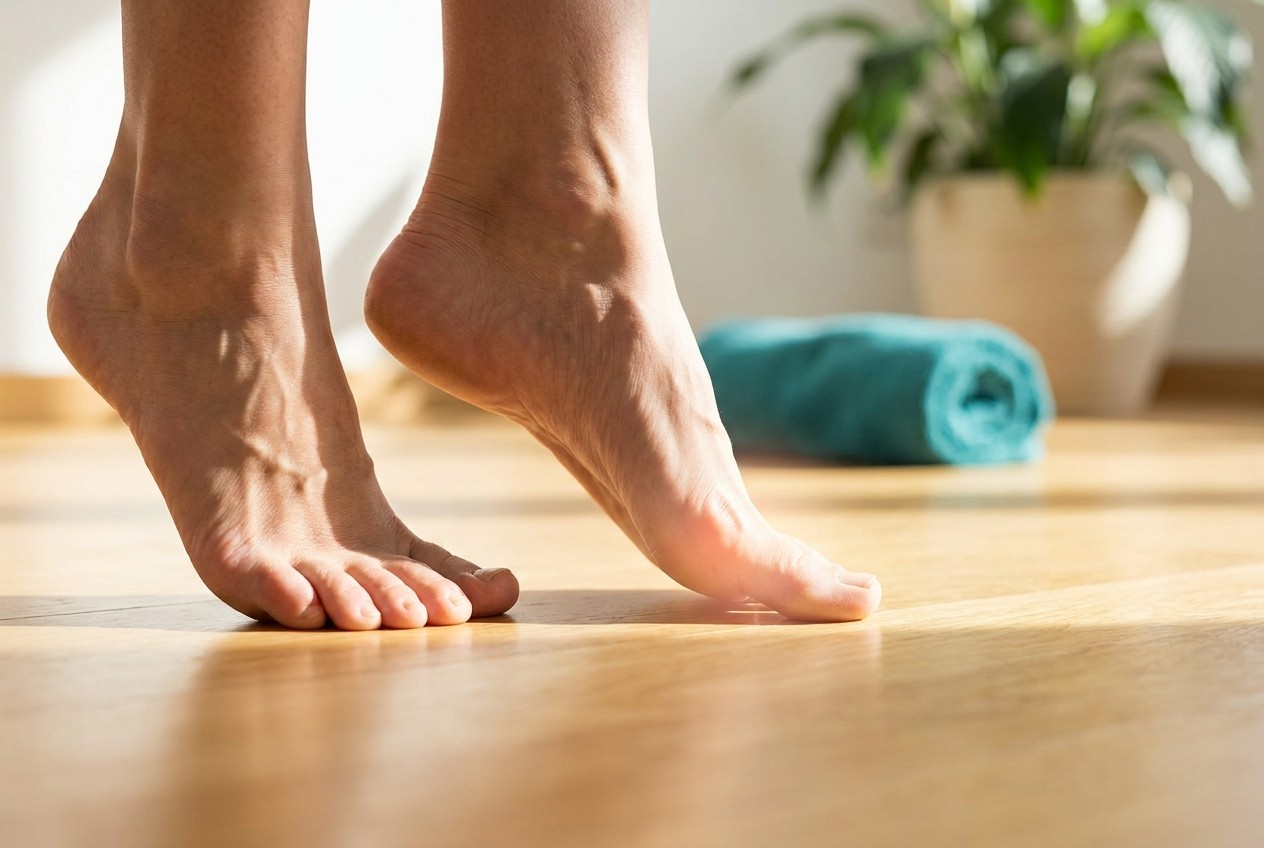
- Calf Raise Training (Neutral Weight Distribution):
- How to perform: Stand with both feet flat on the ground. Slowly rise onto the balls of your feet, consciously shifting your center of gravity so that pressure rests evenly between your second and third toes, avoiding the temptation to roll all your weight onto the big toe. Ensure your ankles do not tilt inward (pronate) or outward (supinate) as you elevate.
- The benefit: Re-trains the lower kinetic chain to distribute force evenly, preventing the big toe from taking on destructive isolated loads.
Orthopedic and Podiatric Guidelines
Experts note that exercise should be paired with proper supportive measures. Clinical evaluations are strongly advised for individuals noticing early enlargement, persistent pain, or progressive deformity.
Furthermore, footwear functionality is paramount. As clinical educators note, true orthopedic or functional footwear is defined not by its appearance, but by its adaptability—ranging from deep heel cups designed to absorb shock, to wide toe boxes that give toes room to spread, to custom orthotics that successfully redistribute plantar pressures.
Implications for Public Health and Daily Life
The societal and personal implications of untreated bunions extend far beyond minor foot discomfort.
1. Altered Kinetic Chains and Secondary Pain
Because the human body is an interconnected kinetic chain, an unstable foundation at the foot inevitably ripples upward. When a person alters their gait to avoid bunion pain, it frequently triggers secondary compensatory stress in the ankles, knees, hips, and lower back. Restoring foot strength and balancing walking patterns is therefore a critical component of whole-body musculoskeletal health.
2. The Shift Toward Conservative Care
With modern healthcare leaning heavily into preventative medicine, physical therapy protocols for foot deformities are gaining mainstream validation. Systematic reviews indicate that combining targeted intrinsic strengthening exercises with supportive interventions—such as toe spacers, therapeutic taping, or custom orthotics—can modestly improve joint alignment and significantly reduce pain in mild-to-moderate cases.
3. Redefining Footwear Culture
Public health advocates argue that greater awareness is needed regarding shoe design. As data points to half of all adults over 50 suffering from foot pain, consumer demand is slowly shifting toward footwear that honors natural foot anatomy—prioritizing wide toe boxes and flat, flexible soles over narrow, restrictive fashion statements.
When to Seek Professional Intervention
While at-home foot control exercises are transformative for early-stage hallux valgus, patients must recognize their limits. Individuals experiencing persistent, debilitating pain, rapidly advancing deformities, numbness, open wounds, difficulty walking, or those managing systemic conditions like diabetes must seek immediate professional evaluation. Advanced bunions may ultimately require specialized orthotics, padding, rigorous physical therapy regimens, or surgical intervention to restore mobility and quality of life.