








Long before digital notifications blinked on smartphones or standardized Gregorian calendars dictated the rhythm of daily life, humanity looked upward to navigate the passage of time. Across North America, Indigenous peoples relied upon a sophisticated, symbiotic timekeeping system that fused lunar cycles with the subtle shifts of the natural world. Far more than poetic descriptors, names like the Wolf Moon, Strawberry Moon, and Beaver Moon represent a living archive of ecological observation, tribal survival strategies, and ancestral heritage.
Today, while mainstream society relies on a rigid solar calendar, the traditional lunar names preserved by Indigenous communities—and later adapted by European settlers—continue to captivate stargazers and nature enthusiasts. Understanding these names requires a journey through time, a recognition of tribal diversity, and an appreciation for a scientific and cultural framework developed over millennia.
Main Facts: The Intersection of Astronomy and Indigenous Ecology
At its core, the traditional naming of full moons is an exercise in applied environmental science. Indigenous groups across North America did not view the cosmos as separate from the earthly biosphere; rather, celestial movements were intimately connected to the behavior of animals, the blossoming of plants, and changing weather patterns.
In Anishinaabe tradition, Nookomis Dibik-Giizis (Grandmother Moon) is regarded as a primary teacher. Unlike the fixed, 30- or 31-day months of the Julian and Gregorian systems, traditional lunar calendars fluctuate. Depending on the nation, a year might comprise 12 or 13 moons, sometimes divided into four seasons, and other times into five. This flexibility allowed communities to adapt their timekeeping directly to their local environments.
The most widely recognized full moon nomenclature in contemporary popular culture stems primarily from the Algonquian language family. Stretching historically from New England to Lake Superior, Algonquian-speaking peoples—most notably the Ojibwe (Chippewa)—built a vast trading, harvesting, and cultural network governed by the lunar cycle. Their activities, from the spring harvest of maple syrup to the autumn gathering of wild rice (manoomin), were timed precisely to the phases of Grandmother Moon.
Chronology and Adaptation: From Tribal Wisdom to Colonial Settlement
The historical timeline of full moon names is marked by cross-cultural exchange, adaptation, and preservation.
Pre-Colonial Era: Sophisticated Indigenous Timekeeping
For thousands of years before European contact, sovereign Indigenous nations maintained distinct calendars tailored to their specific geographic regions. A moon signifying the running of sucker fish in the Great Lakes basin held a different urgency and timing than a moon marking the coastal migration of shad. These names were passed down orally through generations, woven into creation stories, and reinforced through seasonal survival practices.
The Colonial Era: Blending Worlds
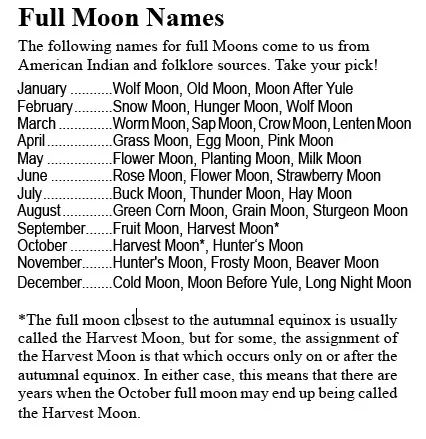
Upon arriving in North America, European settlers faced a radically unfamiliar environment. Early colonists relied heavily on the ecological knowledge of Native American tribes to survive harsh winters and locate fertile agricultural grounds. Settlers adopted many Indigenous moon names while simultaneously introducing terms rooted in Celtic and Old English folklore. For instance, the January "Wolf Moon" likely carries Old English and European roots—born from the eerie sound of hungry winter wolves—while other European traditions contributed terms like the "Mead Moon" for July or the "Barley Moon" for September.
This cultural synthesis created a hybrid naming convention. Over the centuries, almanacs—most notably The Old Farmer’s Almanac, which began publishing these names in the late 1700s—cemented these terms into popular American consciousness.
Chronological Journey Through the Twelve Moons
The cycle of the year, viewed through the lens of traditional lunar observation, offers a profound narrative of survival, renewal, abundance, and preparation.

Winter Moons: Survival and Endurance
- January (Wolf Moon / Severe Moon / Center Moon): Marking the deep freeze of midwinter, this moon reflects the stark realities of survival. While European-influenced naming points to the howling of hungry wolves, indigenous names underscore the severity of the season.
- February (Snow Moon / Hunger Moon / Bear Moon): February represents winter’s peak intensity. The Ojibwe traditionally named this moon after the sucker fish, a vital late-winter food source, while other nations noted the birth of bear cubs or the scarcity of rations.
Spring Moons: Renewal and Growth
- March (Worm Moon / Crow Moon / Sap Moon): As temperatures rise, the ground softens, earthworm casts reappear, and the cawing of crows signals the final retreat of winter. In northern latitudes, this moon is synonymous with the running of maple sap.
- April (Pink Moon / Breaking Ice Moon): Named for the early-spring blooming of wild ground phlox across North America, April’s moon also marks spring thaws, breaking river ice, and the emergence of fresh green grass.
Summer Moons: Abundance and Activity
- May (Flower Moon): Spring reaches its botanical climax in May, a period dedicated to blossoming flora and the critical window for planting staple crops like corn.
- June (Strawberry Moon): Marking the ripening and gathering of wild strawberries, June offers a seasonal feast provided by nature. Coastal tribes frequently called this the Fish Moon as migratory fish pushed upstream.
- July (Buck Moon / Thunder Moon): Named for the velvet-covered antlers growing at full force on male deer, July is equally defined by frequent, powerful summer thunderstorms.
- August (Sturgeon Moon / Manoomini-giizis): For Great Lakes tribes, August marks the peak of the sturgeon catch and the sacred, ritual-laden harvest of wild rice, known to the Anishinaabe as Manoomini-giizis.
Autumn Moons: Harvest and Preparation
- September (Harvest Moon): Closest to the autumnal equinox, this moon illuminates the gathering of major agricultural staples, including corn, pumpkins, squash, beans, and wild rice.
- October (Hunter’s Moon): With fields cleared of crops and deciduous trees dropping their leaves, game animals fattened from summer foraging are exposed, making this the optimal month for hunting.
- November (Beaver Moon): Signifying the period when beavers actively construct winter dams—or when trappers historically set final pelting traps before swamps froze solid.
- December (Cold Moon / Long Night Moon): As winter solstice approaches, bringing the longest nights and heaviest snows, hunting becomes perilous, evoking the hardships of deep winter.
Supporting Data and Regional Diversity
To assume there is a single, monolithic "Native American moon calendar" is a historical misconception. With 576 federally recognized tribes in the United States alone—along with First Nations communities across Canada—the diversity of lunar nomenclature is vast.
Climate and geography dictated distinct naming paradigms:
- Southeastern Ontario vs. North Dakota: Anishinaabe bands living in the Great Lakes region experienced drastically different ecological triggers than tribes inhabiting the northern plains or the eastern seaboard. Consequently, moon names varied to reflect local realities.
- Linguistic Families: Beyond the Algonquian nations, language groups such as Iroquoian, Siouan, and Athabaskan maintained their own sophisticated astronomical and ecological lexicons.
- Calendar Structures: While most contemporary societies operate exclusively on the 365-day Gregorian solar calendar, traditional timekeeping among groups like the Anishinaabeg endures via Gookomisinaan dibik-giiziso-mazina’igan—a living lunar calendar.
Official Responses and Perspectives on Cultural Preservation
In recent years, historians, environmental scientists, and tribal elders have emphasized the importance of context, respect, and accuracy when utilizing traditional moon names.
Cultural preservationists note that while commercialized almanacs and digital weather apps have successfully kept these names in the public eye, they often strip the names of their profound cultural contexts. Indigenous scholars urge the public to view these names not merely as quirky trivia for stargazers, but as intellectual property born of sophisticated, long-term ecological stewardship.
Furthermore, climate change has introduced new complexities to traditional timekeeping. As global weather patterns shift, unseasonably warm winters, erratic spring thaws, and altered migration patterns affect the very natural phenomena—such as maple sap runs or animal migrations—that inspired the moon names in the first place. Despite these disruptions, many Indigenous communities continue to adapt their lunar practices, proving that these calendars are dynamic, resilient systems rather than static relics of the past.
Implications for Modern Society
Reconnecting with the heritage of full moon names offers modern society valuable insights into environmental mindfulness. In an era dominated by screens and hyper-urbanization, tracking the lunar cycle provides an accessible gateway to ecological literacy.
By understanding the historical origins of these names, contemporary nature enthusiasts can:
- Foster Environmental Awareness: Observing the moon encourages a deeper mindfulness of local seasonal shifts, animal behaviors, and plant life cycles.
- Honor Indigenous Knowledge: Acknowledging the roots of these names serves as an act of cultural respect, highlighting the profound scientific contributions of Indigenous peoples.
- Decelerate Time: Tuning into natural rhythms offers a psychological counterweight to the relentless speed of modern digital schedules.
Conclusion
The full moon names we encounter today are far more than poetic titles used to embellish weather reports or calendar pages. They are monuments of human observation, encapsulating centuries of ecological wisdom, spiritual reverence, and practical survival strategies developed by Indigenous peoples across North America.
As we look up at the night sky to witness the next full moon, we participate in an ancient human ritual. By understanding the rich cultural heritage behind these lunar cycles—and honoring the specific tribal communities who first mapped them—we bridge the gap between the cosmos above and the living, breathing Earth below.
When exploring traditional moon names, observers are encouraged to look beyond generalized lists, acknowledge their Indigenous origins, and research the specific tribal stewards of the land they inhabit.