








Main Facts
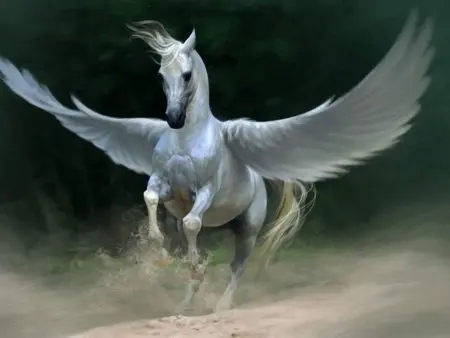
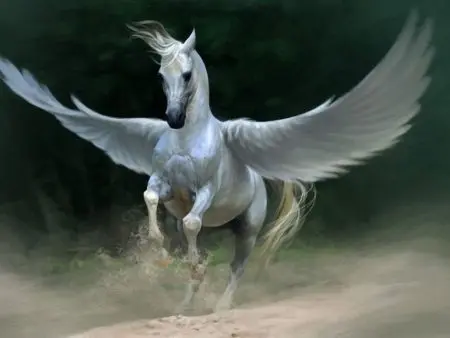
Pegasus—known in classical Greek as Πήγasos (Pēgasos) and in Latin as Pegasus—stands as one of the most enduring and universally recognized symbols in Western mythology. Classically depicted as a magnificent, snow-white stallion gifted with broad, feathered wings, this legendary creature occupies a unique space between the terrestrial and the divine.
According to ancient Greek mythography, Pegasus was sired by Poseidon, the Olympian god of the sea, and was born from the neck of the Gorgon Medusa. This miraculous birth occurred at the exact moment the hero Perseus decapitated the serpentine-haired monster. Rather than emerging as a helpless foal, Pegasus sprang fully formed into existence alongside his brother, Chrysaor, a warrior whose name translates to "he who bears a golden sword."
While classical depictions consistently present Pegasus as a solitary, pure white entity, modern fantasy literature and media have significantly expanded the creature’s visual lexicon. Contemporary depictions frequently introduce herds of pegasi (the plural form), varied coat colors, horned variants (often overlapping with the unicorn mythos), and stylized, lion-like or feathered tails. Despite these imaginative expansions, the foundational core of the Pegasus narrative remains anchored in ancient heroic tales of divine favor, untamed freedom, and mortal ambition.
Chronology
The timeline of Pegasus spans from his miraculous, violent genesis in antiquity to his enduring afterlife in modern pop culture, literature, and cinematic adaptations.
- The Mythological Genesis: Pegasus is born from the severed neck of Medusa, following her defeat by the hero Perseus. Because Medusa perished during his birth, classical mythology separates the immediate timeline of Pegasus’s birth from his later encounters with Perseus—contrary to liberties often taken in modern cinema, such as the 1981 and 2010 film adaptations of Clash of the Titans.
- The Taming at the Fountain of Pirene: Wild and fiercely independent, Pegasus roams the earth until he pauses to drink from the sacred spring of Pirene on the citadel of Corinth. Guided by the goddess Athena, the hero Bellerophon manages to capture the winged beast using a divine golden bridle.
- The Epic Campaigns of Bellerophon: Bound to Bellerophon, Pegasus plays a pivotal role in several legendary victories. The most notable is the defeat of the Chimera—a monstrous, fire-breathing hybrid of a lion, goat, and serpent—whom Bellerophon attacks from the safety of the skies aboard the winged stallion.
- The Fall from Olympus: Emboldened by his triumphs, Bellerophon attempts to ride Pegasus all the way to Mount Olympus to join the ranks of the gods. Angered by this mortal hubris, Zeus sends a stinging gadfly to torment Pegasus. The startled horse bucks, throwing Bellerophon back down to earth, while Pegasus is welcomed onto Olympus to carry thunderbolts for Zeus.
- The Creation of Hippocrene: In an earlier terrestrial exploit, a stampede of Pegasus’s hooves upon Mount Helicon causes a spring to burst forth. Known as Hippocrene, this sacred spring is later celebrated in classical tradition as the primary source of poetic inspiration for the Muses.
- Modern Era & Cinematic Revival: Pegasus transitions from ancient oral traditions and classical texts into Renaissance art, heraldry, and eventually modern fantasy. Twentieth and twenty-first-century films—ranging from Disney’s Hercules (1997) to the Clash of the Titans franchise—reintroduce the mythical stallion to global audiences, cementing his status as a cornerstone of fantasy lore.
Supporting Data
To fully understand the cultural footprint of Pegasus, it is helpful to examine the linguistic, literary, and symbolic data points associated with the myth:
- Etymological Roots: Scholars suggest the name Pegasus may derive from the Luwian word Pigassa, meaning "lightning," or from the Greek root pēgē, meaning "spring" or "water source," directly correlating with his association with water-producing hoofprints like Hippocrene.
- Kinship Data:
- Father: Poseidon (God of the Sea, Earthquakes, and Horses).
- Mother: Medusa (Gorgon mortal-turned-monster).
- Siblings: Chrysaor (Golden-sword-bearing warrior).
- Key Artifacts & Associations:
- The Golden Bridle: The sole instrument capable of controlling Pegasus, gifted by Athena.
- Mount Helicon: The site of the Hippocrene spring, linking the horse directly to literature, music, and the arts.
- Symbolic Classifications: Across historical analysis, Pegasus is categorized under four primary symbolic pillars:
- Inspiration and Creativity (connection to poetry and the Muses).
- Heroism and Victory (conquest of the Chimera).
- Transcendence and Freedom (flight above earthly limitations).
- Nobility and Purity (the classic unblemished white stallion archetype).
Official Responses and Scholarly Interpretations
Classicists, historians, and mythologists have long analyzed the Pegasus legend, viewing the creature not merely as a fantastic beast, but as a profound psychological and cultural construct.
Classical historian Dr. Elena Vance notes that the taming of Pegasus represents a foundational motif in ancient Greek thought: the domestication of wild, chaotic natural forces by human intellect aided by divine grace. "The golden bridle given by Athena is critical," Vance explains. "It signifies that raw, god-given talent or untamed nature—represented by Pegasus—cannot be mastered by brute force alone. It requires divine wisdom, strategy, and patience."

Furthermore, literary analysts point to the myth of Bellerophon’s fall as an early theological warning against hubris (excessive pride). Scholars from the Mythological Research Institute emphasize that Pegasus serves as a moral boundary marker in Greek literature. While the horse is permitted to ascend to Olympus because of his divine heritage and innocent nature, the mortal who attempts to bridge the gap between humanity and divinity is cast down. In this context, Pegasus acts both as an instrument of divine justice and a symbol of aspirations that outstrip mortal limitations.
Modern cultural critics also observe how the imagery of Pegasus has been co-opted across centuries. From the heraldry of European noble houses signifying speed and nobility, to corporate logos representing high-flying technological ambition, institutions consistently leverage the psychological weight of the Pegasus myth to project authority, speed, and creative vision.
Implications
The enduring legacy of Pegasus carries profound implications for how modern society interacts with ancient mythologies, creative inspiration, and the ethics of human ambition.
In the modern creative landscape, Pegasus remains the ultimate archetype for artistic breakthrough. The phrase "riding Pegasus" or drawing inspiration from the Hippocrene spring continues to resonate with writers, poets, and visual artists who seek to transcend the mundane constraints of reality. The creature’s evolution from a terrifying byproduct of a Gorgon’s execution into a noble, celestial steed demonstrates the fluid nature of mythology, showing how ancient cultures adapted stories to reflect evolving moral and aesthetic values.
Moreover, the cautionary tale embedded in the myth—exemplified by Bellerophon’s tragic fall—retains sharp relevance in an era of rapid technological and scientific expansion. As humanity continuously pushes the boundaries of exploration, artificial intelligence, and aerospace engineering, the ancient archetype of the winged horse serves as an enduring metaphor for the fine line between inspired achievement and destructive hubris.
Ultimately, Pegasus transcends his origins as a figment of ancient Greek folklore. Whether galloping across the starry night sky as a constellation or inspiring modern fantasy artists, the winged stallion endures because he mirrors humanity’s deepest yearnings: the desire to break free from gravity, to achieve greatness, and to touch the divine through the power of imagination.