









By Global Mythology & Culture Desk
Published: October 2023
1. Main Facts: Anatomy, Origins, and Misconceptions
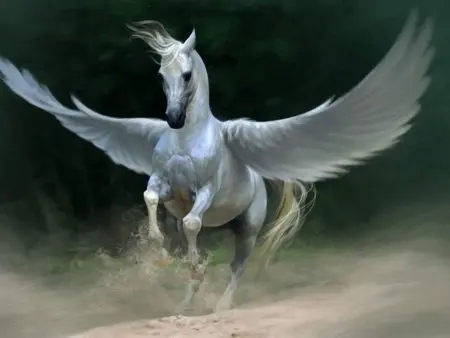
In the vast pantheon of Greek mythology, few creatures capture the human imagination quite like Pegasus (Greek: Πήγασος, Págasos; Latin: Pegasus, Pegasos). Classically depicted as a magnificent, pure white stallion endowed with sweeping, feathered wings, Pegasus has transcended his ancient Hellenic origins to become a universal symbol of freedom, imagination, and divine grace. However, a deep dive into the historical texts reveals a complex tapestry of parentage, extraordinary physical attributes, and modern cinematic misconceptions that often blur the line between ancient fact and Hollywood fantasy.
According to classical mythology, Pegasus is the divine offspring of Poseidon, the formidable Olympian god of the sea. His mother is none other than the Gorgon Medusa. The circumstances of his birth are among the most dramatic in classical lore: rather than being born through traditional means, Pegasus—along with his brother, Chrysaor—sprang forth from the neck of Medusa when the hero Perseus decapitated her using a polished, reflective shield and winged sandals.
This familial lineage frequently surprises modern audiences, largely due to adaptations like the classic 1981 fantasy film Clash of the Titans. In the cinematic retelling, Perseus and Pegasus form an immediate and lifelong bond early in the narrative. Mythologically speaking, however, this pairing is chronologically inaccurate; Medusa perished at the exact moment of Pegasus’s birth, meaning mother and foal never coexisted in a traditional maternal relationship. Nevertheless, cinematic portrayals have cemented the majestic winged horse into the popular consciousness.
Furthermore, Pegasus was not an only child. Born simultaneously from Medusa was Chrysaor. Unlike his equine brother, Chrysaor is traditionally depicted in anthropomorphic terms as a human warrior. While ancient texts provide sparse details regarding his exploits, his name translates poetically to "he who bears a golden sword," and he is remembered in myth as a warrior of immense courage.
In contemporary fantasy media, the rigid image of the solitary white stallion has evolved significantly. Modern creators frequently depict vast herds of pegasi (pegasi being the plural form) boasting diverse color palettes—ranging from midnight black to dappled greys and golden roans—often supplemented by mythical mutations such as spiraled horns or leonine tails. Yet, the timeless archetype remains rooted in the snow-white image immortalized by ancient Greek artisans.
2. Chronology: From Mythical Genesis to Modern Media
To fully understand the cultural footprint of Pegasus, historians and mythologists trace a distinct chronological arc from ancient religious rituals to twenty-first-century digital media.
- The Heroic Age (Classical Antiquity): Born from the blood of Medusa, the wild and untamable Pegasus roamed the earth, frequenting sacred springs such as Hippocrene on Mount Helicon—said to have been created by a strike of the stallion’s hoof. For a time, the beast resisted all human mastery.
- The Age of Bellerophon: The mortal hero Bellerophon, aided by the goddess Athena, captured Pegasus at the Pirene fountain using a magical golden bridle. Together, the pair achieved legendary feats, most notably defeating the fire-breathing Chimera. However, Bellerophon’s hubris eventually led to his downfall when he attempted to fly to Mount Olympus; Zeus, angered by the mortal’s arrogance, sent a gadfly to sting Pegasus, causing the horse to buck and cast Bellerophon back to earth. Pegasus, however, continued his ascent to the celestial realm, where he spent his remaining days carrying the thunderbolts of Zeus.
- The Renaissance and Enlightenment: During the European Renaissance, Pegasus experienced a massive resurgence in classical humanism, frequently utilized in allegories of poetic inspiration, divine revelation, and the soaring intellect of man.
- The 20th and 21st Centuries: The modern era transformed Pegasus from an object of literary reverence into a pop-culture staple. From Ray Harryhausen’s stop-motion animation in the 1981 Clash of the Titans (and its 2010 remake) to appearances in modern fantasy literature like Rick Riordan’s Percy Jackson series, Pegasus has cemented his status as a permanent fixture of global fantasy culture.
3. Supporting Data: The Anatomy and Adaptations of the Winged Stallion
To understand the physical characteristics and cultural variations associated with Pegasus, researchers often categorize historical texts alongside modern entertainment metrics. The table below outlines the evolution of Pegasus attributes across eras:
| Attribute | Classical Greek Tradition | Modern Fantasy & Cinematic Portrayal |
|---|---|---|
| Coat Color | Strictly pure white. | Varies: black, grey, piebald, golden, and patterned. |
| Anatomical Additions | Equine body with large feathered avian wings. | Often includes horns (Alicorns), lion tails, or bat-like wings. |
| Temperament | Wild, untamable, divine, and fiercely independent. | Often domesticated, deeply loyal companion animals. |
| Primary Association | Divine mount of Zeus / Creator of Hippocrene. | General symbol of fantasy, freedom, and flight. |
The Mechanics of Mythological Flight
While modern science struggles to rationalize how a horse-sized mammal could achieve aerodynamic lift with feathered wings, ancient Greek mythologists sidestepped physical limitations by attributing Pegasus’s flight to his divine parentage. As a child of Poseidon and a creature favored by the Olympian gods, Pegasus was bound neither by gravity nor mortal physiology, operating instead as a conduit of divine will.

4. Symbolism: The Multi-Faceted Legacy of Pegasus
Beyond his physical prowess, Pegasus carries a rich, complex tapestry of symbolic meaning that has resonated across civilizations for millennia.
Inspiration and Creativity
Perhaps the most enduring symbolic association of Pegasus is his connection to the arts, poetry, and intellectual inspiration. According to Greek legend, when Pegasus struck the earth with his hoof on Mount Helicon, the sacred spring of Hippocrene burst forth. Drinking from this spring was believed to bestow the gift of poetic inspiration upon mortals. Consequently, writers, painters, and musicians throughout history have invoked Pegasus as a muse, representing the moment human consciousness transcends earthly bounds to tap into the divine wellspring of creativity.
Heroism and Victory
In the tales of Bellerophon, Pegasus serves as the ultimate instrument of heroic triumph. His defeat of the monstrous Chimera—a fire-breathing hybrid of lion, goat, and serpent—solidified the winged horse as a badge of courage, tactical superiority, and the triumph of light over dark, order over chaos. In military heraldry and national insignia throughout modern history, winged horses are frequently employed to represent airborne supremacy and victorious military campaigns.
Transcendence and Freedom
Unbridled and soaring through the clouds, Pegasus is the ultimate emblem of personal freedom and spiritual transcendence. The image of a horse—traditionally a symbol of earthly power, labor, and movement—augmented with the wings of a bird represents humanity’s eternal desire to overcome physical limitations, break free from societal or earthly constraints, and explore the unknown.
Nobility and Purity
Traditionally depicted as a radiant, snow-white stallion, Pegasus embodies nobility, grace, and moral purity. Unlike the chaotic, destructive monsters of Greek myth (such as his mother Medusa or the serpentine foes he faced), Pegasus was viewed as a noble, righteous beast that served justice and aided virtuous mortals, provided they approached him with respect and divine favor.
5. Powers and Abilities in Lore
While flight is the most universally recognized trait of Pegasus, classical mythology and subsequent folklore attribute a diverse array of supernatural powers to the majestic creature:
- Divine Speed and Agility: Pegasus was said to move through the air with the speed of a thunderbolt, capable of crossing vast distances between the mortal realm and Mount Olympus in mere moments.
- The Spring-Maker (Gerokinesis): By striking the ground with his hooves, Pegasus possessed the unique ability to manifest water springs. The most famous of these, Hippocrene, became a place of pilgrimage for poets seeking divine creativity.
- Immunity to Mortal Weapons: As a creature of divine blood born from a mythological deity and a Gorgon, Pegasus was impervious to ordinary mortal harm, sharing in the resilience of the gods.
- Celestial Navigation: Following his mortal exploits, Zeus elevated Pegasus to the heavens as a constellation (Pegasus). In this celestial form, he was believed to guide travelers and sailors across the night sky, operating as an eternal compass of the cosmos.
6. Implications: The Modern Relevance of Ancient Myth
Why does a winged horse from ancient Greek folklore continue to capture the imaginations of millions in the twenty-first century? The implications extend far beyond academic mythology. In an increasingly digitized and fast-paced world, creatures like Pegasus serve as psychological touchstones for human aspiration.
As technology allows humanity to conquer the skies—and eventually the stars—the ancient archetype of the winged horse remains deeply relevant. It bridges the gap between the natural world (the horse) and human technological/spiritual ambition (the wings). Whether utilized in corporate branding to signify speed and innovation, or in fantasy literature to inspire young readers to look beyond the horizon, Pegasus endures because he represents the best of human potential: the courage to dream, the drive to create, and the desire to fly unbound.