








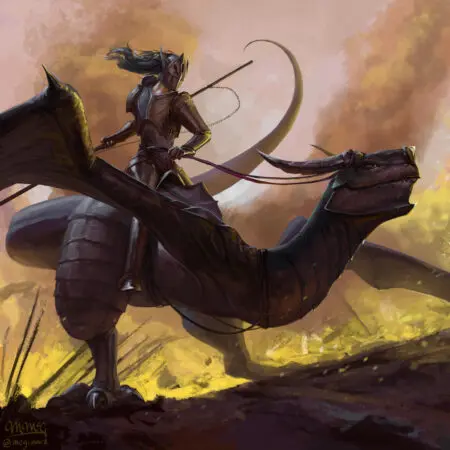
LONDON — In the vast pantheon of mythical beasts, few creatures occupy as fascinating a gray area between historical folklore and modern fantasy as the wyvern. Often colloquially mistaken for a standard fire-breathing dragon, the wyvern is a distinct entity with a rich, albeit dark, lineage rooted deeply in Anglo-Saxon culture, medieval demonology, and alchemical philosophy.
While pop culture frequently flattens fantastical reptiles into a single category, cryptid historians and medievalists emphasize that understanding the wyvern requires looking past the classical four-legged, multi-winged dragon archetype. From ancient celestial anxieties regarding falling meteorites to its role as a heraldic symbol of conquest and raw power, the wyvern’s story is a compelling chapter in the history of human imagination.
Main Facts: Anatomy, Taxonomy, and Distinction from Dragons
To understand the wyvern, one must first dismantle common misconceptions. While both belong to the broad mythical family of scaled, winged reptilian terrors, their anatomical blueprints diverge significantly.
- Limb Structure: The classic European dragon possesses four legs in addition to a separate pair of wings (often emerging from the back). In contrast, the wyvern is distinctly bipedal. Its anatomical design mirrors that of bats or birds, where the wings are derived entirely from the forelimbs. This grants the creature a predatory stance and allows its wings to double as dexterous, hand-like appendages capable of clasping when folded.
- Facial and Defensive Features: Wyverns feature powerful, beak-like jaws essential for capturing and transporting prey. Unlike their grander cousins, which rely heavily on massive jaws and overwhelming size, wyverns are armed with eagle-like talons and a deadly, barbed stinger at the tip of their tail.
- Size and Behavior: Generally smaller than classic dragons—earning them the historic moniker of "dragonets" in England—wyverns are significantly bolder. They exhibit a far less timid disposition toward humans and terrestrial animals alike, often engaging in fierce territorial disputes.
Like dragons, wyverns maintain a notorious affinity for collecting valuables. However, true to their "lesser" status in folklore, their subterranean lairs—typically found in deep, protected woodland caverns—are messy treasure troves. Unlike the discriminating gold-pilers of high fantasy, a wyvern’s hoard is just as likely to contain useless rubbish, shiny trinkets, and bone debris as it is precious metals.
Chronology: The Evolution of the Wyvern Through the Ages
The historical trajectory of the wyvern spans millennia, evolving from ancient sky-worship and localized superstitions to medieval ecclesiastical warnings and modern heraldry.

1. Anglo-Saxon Roots and Celestial Serpents
The linguistic lineage of the wyvern traces back to the Anglo-Saxon word wivere, which translates directly to "serpent" or "worm." Early Old Saxon oral traditions did not initially picture these creatures as terrestrial beasts, but rather as fiery anomalies falling from the sky.
Ancient Germanic and Saxon lore spoke of fire-monsters or glowing "worms" streaking across the night sky, only to burrow deep into the earth, never to emerge again. Modern folklorists suggest these ancient accounts were humanity’s earliest attempts to rationalize the terrifying phenomenon of meteorites crashing into the earth, with the "treasure" guarded by the subterranean monster being the rare, iron-rich space rocks themselves.
2. The Medieval Era and the Black Death
During the Middle Ages, as ecclesiastical authorities cataloged the natural and supernatural world through heavily moralized bestiaries, the wyvern’s reputation took a sinister turn. Christian scholars adopted the creature as a living allegory of Satan, weaponizing its imagery to preach against sin, war, and pestilence.
Most alarmingly, medieval superstition blamed the wyvern for spreading the plague. In an era where populations across Europe were decimated by successive waves of disease—culminating in the horrors of the Black Death—attributing the invisible, airborne vector of death to a fierce, serpentine beast provided a tangible, albeit terrifying, explanation for an otherwise incomprehensible tragedy.
3. Alchemical Transmutation and Renaissance Observations
Alchemists of the medieval and Renaissance periods utilized the wyvern in their complex, coded iconography. Within alchemical texts, the wyvern represented matter in its most primal, base, and volatile state. The alchemist was frequently depicted as a noble knight locked in mortal combat with the beast—symbolizing the arduous process of breaking down raw elements and purifying them into spiritual or literal gold.

By the Renaissance, encounters with the creature had transitioned from popular fear to speculative natural philosophy. Notably, polymath Leonardo da Vinci documented a detailed observation of an encounter between a lion and a wyvern. While modern historians debate whether da Vinci actually witnessed the event firsthand or merely sketched it as a theoretical exercise in animal combat, it highlights the creature’s lingering presence in the European consciousness during the 15th and 16th centuries.
Supporting Data: Habitat, Demographics, and Historical Decline
Historical records indicate that wyverns were once relatively common across the heavily forested regions of Europe, with high concentrations reported in the British Isles. However, their bold disposition and direct competition with expanding human settlements led to a dramatic population collapse.
- Habitat Preference: Wyverns favored dense woodlands, jagged cliffs, and deep caverns—environments that offered both concealment and a steady supply of large terrestrial game.
- The Toll of Human Expansion: As medieval weaponry advanced—transitioning from rudimentary spears and longbows to firearms and heavy siege equipment—and as human populations cleared forests for agriculture, wyvern habitats shrank drastically.
- Modern Cryptid Status: Today, mainstream science categorizes the wyvern strictly as a product of myth and cultural evolution. However, cryptozoologists and enthusiasts occasionally point to the vast, relatively undisturbed wildernesses of Eastern Europe and the remote mountain ranges of Russia as potential, albeit highly improbable, final refuges where a dwindling population might theoretically have eluded human detection.
Implications: Heraldry, Culture, and the Psychology of Myth
While physical wyverns faded from the European landscape centuries ago, their cultural footprint remains remarkably robust, most visibly preserved in the intricate rules of heraldry.
The Language of Heraldry
In the realm of coats-of-arms, banners, and shields, the wyvern evolved into a powerful emblem. Unlike the benevolent or neutral connotations sometimes assigned to dragons in Eastern traditions, European heraldry strictly utilized the wyvern to signify:
- War and Conquest: A testament to the creature’s aggressive, frontline nature.
- Envy and Pestilence: Echoes of its medieval association with moral corruption.
- Might and Strength: A fierce deterrent meant to intimidate rivals on the battlefield.
Families and noble houses across England, Germany, and France proudly bore the wyvern on their crests, projecting an image of unyielding defense and martial supremacy.

Psychological and Cultural Legacy
The endurance of the wyvern underscores a profound human psychological need to externalize danger and mystery. What began as an ancient effort to explain falling stars and devastating plagues eventually transformed into a sophisticated metaphor for internal struggle—as seen in alchemy—and a symbol of lineage and power in heraldry.
Today, the wyvern thrives anew in global fantasy literature, role-playing games, and modern media. By drawing a sharp line between the bipedal, stinger-tailed wyvern and the traditional four-legged dragon, contemporary world-builders continue to honor the rich, distinct folkloric heritage of a creature that has terrified and inspired humanity for over a thousand years.