









Main Facts
The era when domestic critical infrastructure could rely on geographic isolation and conventional security measures for protection has officially ended. Driven by the rapid proliferation of low-cost guidance systems, open-source engineering know-how, and commercial manufacturing technology, the global landscape of warfare has fundamentally shifted. Advanced drone technology—once the exclusive domain of heavily funded nation-states—is now readily accessible to lone actors, small criminal cells, and non-state entities.
This democratization of destruction has rendered above-ground industrial assets, including power grids, oil refineries, water treatment plants, and data centers, acutely vulnerable. Unlike traditional military targets protected by sophisticated air-defense networks, civilian critical infrastructure sits largely in the open. Publicly available satellite imagery and government databases map these facilities down to their precise single points of failure.
Compounding the physical exposure is a severe economic asymmetry: defensive measures often require multimillion-dollar missile systems or complex electronic jamming apparatuses to neutralize aerial threats that cost mere thousands of dollars to manufacture and deploy. Security experts warn that national security establishments in the West continue to underestimate the immediacy of this threat, creating a perilous gap between recognized vulnerabilities and actionable domestic defense policies.
Chronology of Escalation: From Battlefield Innovation to Global Vulnerability
The integration of unmanned aerial vehicles (UAVs) into modern conflict zones and domestic incidents marks a rapid, continuous escalation over the past decade:
- Pre-2020 (The Hobbyist Era): Commercial drones are primarily utilized as consumer electronics and aerial photography tools. Security frameworks view them largely as nuisances rather than strategic vectors for kinetic attacks.
- 2019 (The Wake-Up Call): Precision strikes utilizing low-cost aerial drones target critical oil infrastructure, specifically hitting Saudi Aramco processing facilities at Abqaiq and Khurais. This event demonstrates to military analysts worldwide that commercial-off-the-shelf components can bypass multi-billion-dollar defense shields.
- 2021–2023 (The Acceleration in Ukraine): The ongoing conflict in Ukraine acts as a massive accelerator for drone warfare. Both state militaries rapidly deploy first-person-view (FPV) kamikaze drones, AI-enabled targeting algorithms, and large-scale aerial swarms. Notable incidents involve hundreds of UAVs launched simultaneously across multiple regional sectors, overwhelming traditional radar and interceptor batteries.
- 2023–2024 (International Incidents and Domestic Breaches):
- Middle East Theaters: Broad deployment of Iranian-designed drones against regional targets strains sophisticated air-defense systems in Israel and the Gulf states, highlighting the severe cost imbalances of intercepting massed UAV attacks.
- European Airport Disruptions: Unidentified drone swarms force the complete, emergency shutdowns of major European transport hubs, including international airports in Brussels and Liege, paralyzing regional transit.
- U.S. Military Installations: Mysterious drone swarms breach restricted airspace at sensitive domestic military facilities, including Barksdale Air Force Base in Louisiana, home to strategic nuclear-capable B-52 bombers.
- 2024–Present (Industrial and Financial Adaptations Abroad): Foreign governments begin taking aggressive defensive postures. Russia authorizes state banks to operate anti-drone systems and permits the temporary seizure of inadequately protected commercial infrastructure to harden national supply chains against aerial sabotage.
Supporting Data and Economic Asymmetry
The fundamental challenge of modern drone defense lies not just in interception capabilities, but in basic economic arithmetic. The cost-to-benefit ratio heavily favors the attacker, creating an unsustainable fiscal burden for defenders.
- Cost Disparities: A rudimentary, commercially available drone outfitted with an explosive payload can be assembled or purchased for a few thousand dollars. By contrast, conventional military interception missiles (such as those used in Patriot or Iron Dome batteries) routinely cost between $1 million and $4 million per unit.
- Volume Metrics: Defense operations in the Middle East have documented instances where regional coalitions intercepted upwards of 1,500 incoming projectiles—including coordinated waves of loitering munitions—in single defensive engagements. The sheer volume places immense mechanical and economic pressure on even the most advanced radar and missile inventories.
- Infrastructure Concentration: In the United States, critical supply chains rely heavily on concentrated nodes. For instance, temporary outages at single regional facilities, such as the Joliet refinery incident, immediately trigger regional diesel shortages and sudden price spikes across the broader fuel supply chain. Replicating targeted disruptions across a dozen critical nodes simultaneously would induce catastrophic cascading failures throughout the national economy.
- Global R&D Integration: Advanced research institutions, including DARPA, have developed extensive portfolios ranging from slow, low-flying micro air vehicles to hypersonic stealth platforms like the Falcon HTV-2, designed to travel at speeds exceeding Mach 20. Concurrently, adversarial states have integrated artificial intelligence into seeker heads, enabling autonomous target recognition that renders traditional radio-frequency signal jamming obsolete.
Official Responses and Regulatory Blind Spots
Intelligence and law enforcement agencies have increasingly acknowledged the reality of the domestic aerial threat, yet institutional policy changes have lagged behind operational dangers.
The Federal Bureau of Investigation (FBI) has issued public advisories noting that low-cost commercial drones pose a significant and escalating threat to U.S. domestic security. These warnings explicitly state that readily available UAVs possess the capability to inflict lethal harm on personnel and cause debilitating structural damage to critical infrastructure facilities.
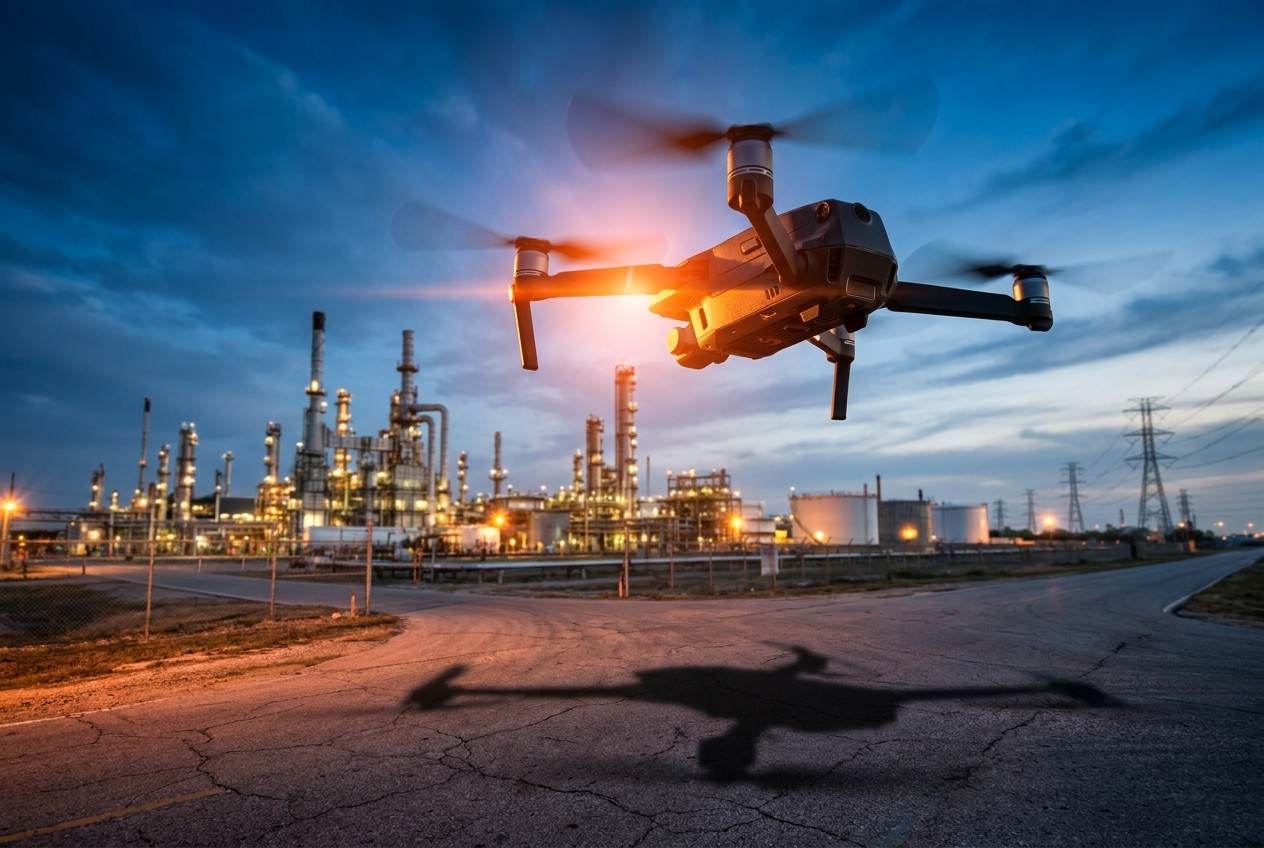
Despite these acknowledgments, federal strategies for safeguarding sprawling industrial footprints remain largely inadequate. Traditional physical security measures—such as perimeter fencing, barbed wire, and stationary armed guards—are structurally incapable of securing hundreds of square miles of interconnected pipelines, electrical substations, and telecommunication hubs.
Internationally, governments are beginning to bridge the gap between civil enterprise and national defense. Russia’s legislative shift allowing financial institutions to deploy active anti-drone countermeasures and empowering the state to commandeer vulnerable private infrastructure illustrates a growing global consensus: traditional civil-military divides are obsolete in the face of distributed aerial threats. In contrast, Western regulatory frameworks remain mired in jurisdictional disputes between aviation authorities (such as the Federal Aviation Administration), local law enforcement, and federal security agencies, creating dangerous bureaucratic blind spots in domestic airspace protection.
Implications for National Security and Civil Preparedness
The democratization of advanced weaponry demands a complete philosophical overhaul of national defense, shifting away from centralized protection models toward decentralized resilience.
The Obsolescence of Centralized Defense
The historical assumption that a centralized military apparatus and a handful of federal agencies can maintain an impermeable shield over an entire continental landmass is no longer viable. When a non-state actor can launch an autonomous, AI-guided drone from a remote location to neutralize an electrical substation or a municipal water pump, the speed of an attack far outstrips the response time of centralized law enforcement.
The Shift Toward Distributed Resilience
National security analysts increasingly argue that future stability depends on structural redundancy and localized preparedness rather than perimeter defense alone. Because securing every mile of pipeline or every commercial data center is physically and economically impossible, the focus must shift to hardening the grid through modular design, localized microgrids, and rapid-replacement capabilities.
Civil Preparedness and Self-Reliance
As institutional vulnerabilities become more apparent, security paradigms are trickling down to the individual and community levels. Experts emphasize that long-term resilience requires proactive measures:
- Energy Independence: Utilizing off-grid power systems, such as solar arrays with localized battery storage, to maintain baseline functionality during prolonged infrastructure outages.
- Resource Stockpiling: Maintaining emergency reserves of potable water, non-perishable food supplies, and essential medical goods.
- Community Networks: Establishing localized communication and mutual-aid networks to ensure community survival independently of municipal services during a crisis.
Ultimately, the convergence of cheap autonomous systems, geopolitical instability, and highly exposed domestic infrastructure means that the question facing modern society is no longer if coordinated drone disruptions will test national resilience, but when.