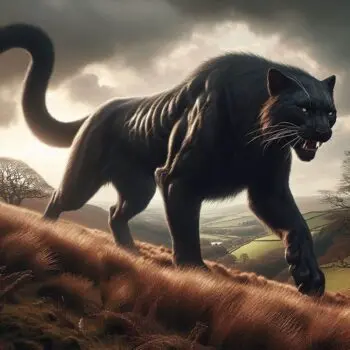
EXMOOR, England — For more than half a century, the windswept, rugged expanse of Exmoor—stretching across the picturesque counties of Somerset and Devon in southwest England—has harbored a chilling secret. Beneath the brooding skies and amid the sprawling heather and gorse, something massive, dark, and predatory is said to roam.
Known colloquially as the Beast of Exmoor, this phantom feline has captivated the public imagination, terrified local farming communities, and baffled cryptozoologists and wildlife experts alike. Described by terrified eyewitnesses as an oversized, panther-like predator capable of devastating livestock, the creature remains one of Britain’s most famous and elusive modern cryptids.
Despite decades of sporadic investigations, military interventions, and countless reported sightings, definitive proof of the beast’s existence remains frustratingly out of reach. Yet, the legend persists, weaving a dark thread through the cultural and rural fabric of the British countryside.
Main Facts: Anatomy of a Phantom Predator
To understand the legend of the Beast of Exmoor, one must first examine the striking consistency of the descriptions provided by those who claim to have encountered it.
Physical Characteristics
The creature is almost universally described as a large, cat-like predator bearing a striking resemblance to a panther, cougar, or puma. Key physical attributes reported by eyewitnesses include:
- Size: Often estimated to be between five and eight feet in length from nose to tail tip, standing significantly taller than a domestic dog and possessing a muscular, powerful build.
- Coloration: Predominantly coal-black or dark grey, though occasional reports describe tawny or sandy-brown fur reminiscent of a North American mountain lion.
- Behavior: Observers frequently note the creature’s stealthy, low-to-the-ground hunting posture, cat-like gait, and an astonishing athletic ability—such as leaping over six-foot stone walls with effortless grace.
The Epicenter of the Mystery
The primary stage for these encounters is the Exmoor National Park, a protected area characterized by high moorland, deep wooded valleys, and isolated farms. The rugged terrain provides ideal cover for a large, secretive animal. However, the shadow of the beast stretches heavily over nearby communities, most notably South Molton in Devonshire, which has long considered itself the epicenter of the phenomenon.
Chronology: A History of Fear and Sightings
The modern legend of the Beast of Exmoor did not emerge overnight; rather, it has been built upon decades of mounting tension between local residents and an unseen predator.
The 1970s: The First Whispers
While occasional rumors of strange, large cats in the British countryside date back to the early 20th century, the specific legend of the Beast of Exmoor began to crystallize in the late 1970s. Farmers in rural Somerset began reporting unusual livestock losses, accompanied by massive paw prints left in muddy fields and eerie, unidentifiable growls echoing across the moors at night. At the time, these reports were largely dismissed by urban newspapers as rural folklore or the exaggerated tales of imaginative locals.
1983: The South Molton Massacre
The turning point for the legend came in 1983, a year that cemented the Beast of Exmoor in British media headlines. Over a period of just two and a half months, a single farmer near South Molton, Devonshire, suffered the catastrophic loss of more than 100 sheep.
The nature of the kills horrified the local community. Unlike attacks by domestic dogs—which tend to chase, maul, and leave livestock injured—these sheep were found dead with distinct, precise puncture wounds to the neck, indicative of a professional strangulation or suffocation technique utilized by large feline apex predators. The sheer scale and precision of the slaughter sparked panic and drew national attention to the quiet countryside.
The 1990s to Present: Ongoing Encounters and Media Focus
Throughout the 1990s and into the 21st century, sightings continued to accumulate. Dog walkers, motorists, and campers reported locking eyes with a massive black cat crossing country lanes or vanishing into the dense bracken.
In 2006, the mystery reached international television audiences when the popular documentary series MonsterQuest investigated the claims, bringing high-tech tracking equipment, thermal imaging, and expert analysis to the remote valleys of Exmoor in an unsuccessful bid to capture definitive proof. Despite changing decades and shifting cultural landscapes, reports of the beast have never truly ceased.
Supporting Data: Examining the Evidence
The debate surrounding the Beast of Exmoor essentially boils down to a conflict between hard scientific skepticism and a compelling body of circumstantial, anecdotal, and physical evidence.
Livestock Autopsies and Predation Patterns
Agricultural experts and veterinarians who examined the carcasses of sheep lost during peak periods of the panic noted unusual wound patterns. While some kills could be attributed to foxes or domestic dogs operating in packs, a significant percentage exhibited traits consistent with feline predation—specifically, clean incisions and crushed windpipes. Furthermore, the immense leaping ability required to clear Exmoor’s traditional stone boundary walls points toward an athletic, large-bodied mammal rather than standard farm predators.
Physical Traces: Hair, Scat, and Casts
Over the decades, investigators have recovered tufts of coarse black hair snagged on barbed wire fences and deep, four-toed paw prints pressed into riverbanks. While some samples have been sent for forensic testing, results have frequently been inconclusive—either degraded by weather, identified as belonging to large domestic dogs or deer, or, in rare instances, displaying mitochondrial DNA markers that tantalizingly failed to rule out exotic cat species.
The Biological Impossibility vs. The Exotic Pet Trade
Skeptics and zoologists often point out a fundamental biological hurdle: a single animal cannot survive indefinitely without breeding, and a population of large cats would surely leave undeniable traces—such as definitive roadkill, clear scat, or high-resolution photographic evidence.
However, context is crucial. In 1976, the UK government passed the Dangerous Wild Animals Act, which placed stringent restrictions and heavy licensing fees on the private ownership of exotic pets, such as pumas, panthers, and leopards. Prior to this legislation, it was entirely legal and fashionable for eccentric aristocrats and exotic animal enthusiasts to keep such creatures. A widely accepted theory among cryptozoologists is that rather than face hefty fines or surrendering their pets, some owners illegally released their dangerous animals into the wild countryside of Exmoor and surrounding counties. While an individual exotic cat would have a natural lifespan of 12 to 15 years, the ongoing nature of the sightings suggests either a surviving breeding population or successive generations of feral big cats adapted to the British wilderness.
Official Responses: Government and Law Enforcement Intervention
The persistence of the Beast of Exmoor forced local authorities and national agencies to take the reports seriously, leading to unprecedented official actions.
The Military Deployment of 1983
The panic following the 1983 South Molton sheep massacres reached such a fever pitch that local politicians and agricultural unions successfully petitioned the government for assistance. In an extraordinary move, the Ministry of Agriculture, Fisheries and Food (MAFF) deployed a squad of Royal Marines to Exmoor.
Armed with high-powered rifles and equipped with night-vision gear, the elite soldiers were tasked with tracking, hunting, and neutralizing the beast to protect local livestock and restore public safety. Despite combing the rugged terrain for days, utilizing tactical sweeps and surveillance, the Marines returned empty-handed. They reported finding no trace of the creature, though local farmers maintained that the beast simply possessed an uncanny ability to evade detection in its native habitat.
Police and Local Council Stances
Over the years, local police forces have received hundreds of 999 calls regarding large cat sightings. While officers have occasionally been dispatched to investigate credible reports near schools or populated areas, official police statements typically emphasize caution, reminding the public that while exotic animal releases historically occurred, concrete proof of a dangerous predator roaming Exmoor remains elusive. Natural England and local park authorities maintain a stance of open-minded skepticism, encouraging the public to report unusual wildlife encounters while attributing most unsubstantiated sightings to misidentified domestic cats, large dogs, or deer.
Implications: Folklore, Tourism, and the British Wilderness
Whether the Beast of Exmoor is a flesh-and-blood apex predator, a collection of misidentified domestic animals, or a modern myth born from rural isolation, its cultural and economic footprint is undeniable.
The Economics of Cryptid Tourism
In the villages surrounding Exmoor, the beast has transformed from a source of terror into a unique tourist draw. Local pubs, bed-and-breakfasts, and gift shops embrace the legend, offering "Beast of Exmoor" themed ales, souvenirs, and guided cryptozoological tours of the moors. For a region heavily reliant on rural tourism, the mystique of the phantom cat adds an adventurous, gothic allure that attracts travelers eager to experience the untamed wildness of the British landscape.
The Psychology of the Unknown
Beyond commerce, the enduring fascination with the Beast of Exmoor highlights humanity’s deep-seated relationship with the wild unknown. In an increasingly mapped, urbanized, and digitized world, the idea that untamed, mysterious forces still lurk just beyond the edge of the paved road provides a thrilling counter-narrative to modern domesticity. The moors of Somerset and Devon retain an ancient, atmospheric majesty, and the ghost of a giant cat stalking the heather serves as a reminder that nature cannot entirely be tamed or explained.
As long as the mists roll over the valleys of Exmoor and farmers tend their flocks under the watchful gaze of the hills, the legend of the beast will endure—a captivating phantom slipping effortlessly between reality and folklore.