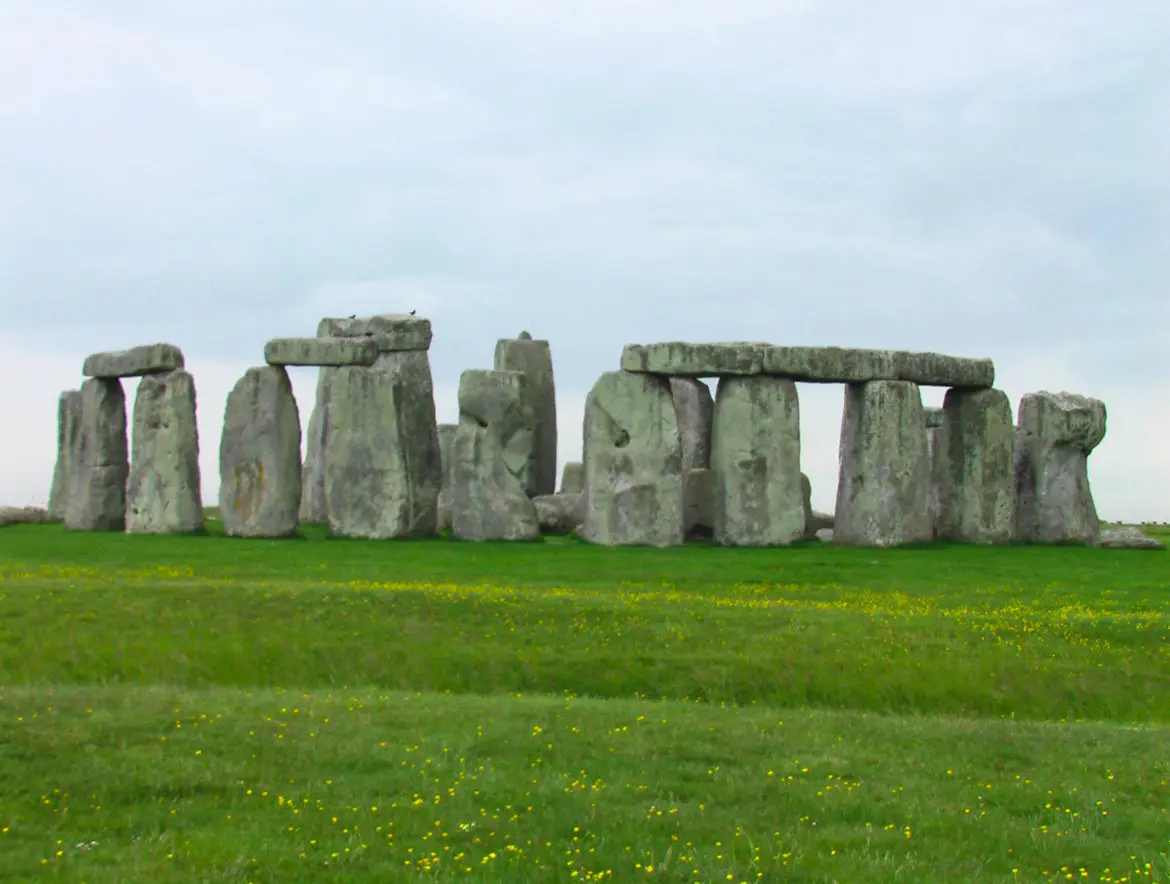
DEVIZES, England — For more than two centuries, a celebrated Early Bronze Age burial discovered just a few miles from the mystical monoliths of Stonehenge was understood by generations of historians to belong to a powerful male artisan and spiritual leader. Today, that foundational narrative has crumbled under the lens of modern science.
Recent ancient DNA profiling has definitively overturned two hundred years of archaeological assumptions, revealing that the individual interred with rare goldworking tools and items of profound ritual significance was, in fact, a woman.
The revelation centers on the Upton Lovell “shaman,” a 4,000-year-old skeleton unearthed in Wiltshire, England, between 1801 and 1802. Long romanticized as a patriarchal figure of prehistoric industry and magic, the skeleton’s biological reidentification forces a sweeping reassessment of gender roles, status, and specialized labor during the British Early Bronze Age. Far from being a passive participant in a male-dominated society, this ancient artisan was a master of high-prestige technology—what modern researchers describe as the "space science of its day."
Main Facts: Shattering Prehistoric Stereotypes
The breakthrough stems from a collaborative initiative with the Francis Crick Institute’s exhibition, We Go Way Back, which explores how cutting-edge genetic mapping is reshaping contemporary understanding of the archaeological record. Genetic material extracted from the 4,000-year-old remains revealed that the individual possessed Beaker-associated ancestry and was biologically female.
Standing approximately 5 feet 4 inches (1.63 m) tall, the woman lived and worked in the vibrant, rapidly evolving landscape of Stonehenge during a period when metallurgy was revolutionizing human civilization. Osteological examination of her remains reveals arthritis in her right wrist—a physical signature that, while not uniquely diagnostic of a single trade, points to years of intense, repetitive manual labor consistent with master-level craft production.
The burial site itself yielded an extraordinary cache of grave goods that set the individual apart as someone of supreme importance within her community:
A touchstone: Used meticulously to test the purity of precious metals.
Specialized stone tools: Interpreted as burnishers and scribes utilized for fine metalwork.
Fossilized sea-sponge cups: Small vessels likely used to hold adhesives, fluxes, or specialized pigments.
A finely polished stone and a greenstone battle axe: Imported from Cornwall, the latter thought to have functioned as a heavy-duty metalworking hammer rather than a traditional weapon of war.
Microscopic residue analysis of these artifacts has successfully detected trace amounts of gold, firmly grounding the archaeological interpretation that this grave belonged to an elite, accomplished craft specialist rather than merely a symbolic figurehead.
Chronology: From 19th-Century Discovery to 21st-Century Science
To understand how a female master craftsperson was misidentified as a male shaman for generations, one must trace the historical timeline of the Upton Lovell barrow discovery and the evolution of archaeological theory.
1801–1802: The Antiquarian Excavation
The site was originally opened during the winter of 1801–1802 by pioneering archaeologist William Cunnington, who worked alongside the wealthy antiquarian Sir Richard Colt Hoare. The pair were engaged in systematic excavations of the numerous round barrows dotting the Wiltshire landscape—investigations that would eventually be published in Ancient Wiltshire, a foundational text of British prehistoric archaeology.
Beneath a chalk-cut grave under a round barrow, Cunnington uncovered the primary burial of the metalworker, laid extended on her back. Directly above her lay a secondary burial placed in a crouched, "sitting posture." While Cunnington kept relatively careful notes for his era, modern record-keeping standards were non-existent; critically, no precise stratigraphic plan or map of the grave goods survived, complicating later efforts to reconstruct the exact spatial arrangement of the artifacts.
1962: The Birth of the "Shaman"
For more than 150 years, the exact social role of the Upton Lovell individual remained open to interpretation. That changed in 1962, when prominent archaeologist Stuart Piggott coined the evocative moniker the "Upton Lovell Shaman."
Piggott compared the elaborate burial costume, unusual assemblage, and foreign stones to Mesolithic burials in northern Europe that had been traditionally interpreted as belonging to spiritual intermediaries or shamans. The label instantly captured the public imagination, transforming a silent Bronze Age artisan into an iconic, mystical figure of prehistoric Britain—and quietly locking in the implicit assumption that the occupant was male.
2026: Genetic Realities Overturn Assumptions
Two centuries after Cunnington first breached the barrow, advances in ancient DNA extraction and microscopic artifact analysis have rewritten the narrative. By integrating the genetic data generated by the Francis Crick Institute with modern re-examinations of the grave goods, researchers have stripped away centuries of cultural projection to reveal the biological reality of the Upton Lovell craftswoman.
Supporting Data: The Technology and Status of Early Bronze Age Metallurgy
The reclassification of the Upton Lovell burial highlights the immense cultural value placed on metallurgy during the Early Bronze Age. In a world transitioning from stone tools to gleaming copper, bronze, and gold, the ability to transform dull ores and dull stones into brilliant, imperishable metals must have seemed nothing short of alchemical.
Archaeologists have long recognized that early metalworkers occupied a privileged, liminal space in society. They held specialized knowledge—pyrotechnology—that granted them immense economic and social leverage. The variety and condition of the tools found in the Upton Lovell grave indicate that this woman was not a novice, but a practitioner at the very height of her powers.
Furthermore, the presence of nonlocal items—such as the Cornish greenstone axe—underscores the expansive trade networks active in Britain during the second millennium BCE. The community she belonged to valued her expertise deeply enough to ensure that her extensive, specialized toolkit was entombed with her to accompany her into the afterlife.
Official Responses: Historians and Archaeologists Respond
The scientific community has embraced the finding as a masterclass in how modern technology can correct historical biases.
David Dawson, Director of the Wiltshire Museum—where the skeletal remains and grave goods are currently housed—expressed astonishment at the depth of the revelation:
"It shows the depth of understanding of her craft. The people she left behind wanted her to take her toolkit into the afterlife… It completely tears up previous assumptions. It’s a fantastic revelation of the position of women in society. We’re so used to the assumption that men do everything—men are the leaders, men are the metalworkers. Here we have smoking gun evidence of a female metalworker. And metalworking was the space science of its day."
Prominent classicist Professor Mary Beard, whose work intersects with the We Go Way Back exhibition, emphasized the broader psychological and methodological implications of the discovery for historical studies:
"So often we have assigned the sex of an ancient skeleton partly on the basis of our own assumptions about sex and gender roles—if it is buried with a sword, it’s male; with a necklace, it’s female. As with the Upton Lovell shaman, DNA analysis can help us correct those assumptions and think harder about the roles of men and women in the deep past—and perhaps also in our own world."
Implications: Re-evaluating Gender, Power, and the Past
The rewriting of the Upton Lovell burial’s history carries profound implications far beyond the borders of Wiltshire. It serves as a stark warning against projecting modern or Victorian patriarchal frameworks onto prehistoric societies.
For generations, nineteenth-century biases dictated that high-status technological innovation and spiritual leadership were strictly the domain of men. When archaeologists encountered rich graves containing tools, weapons, or items of power, default assumptions frequently leaned toward male occupancy. Even as modern archaeology grew more cautious regarding terms like "shaman"—noting that there is no direct evidence the Upton Lovell woman performed formal religious rites—the underlying assumption of male identity remained largely unchallenged until the advent of archaeogenetics.
By proving that a woman could hold the most technologically advanced and high-status craft position of her era, the discovery invites a sweeping reassessment of female agency throughout European prehistory. It forces museums, educators, and researchers to audit how they present ancient peoples to the public, ensuring that historical narratives are driven by empirical data rather than inherited cultural prejudices.
Two hundred years after William Cunnington first turned the soil of a Wiltshire barrow, the Upton Lovell craftswoman has finally stepped out of the shadow of assumptions—reclaiming her rightful place as one of the preeminent technological pioneers of Bronze Age Britain.