By Scott Cooney
Published via Green Living Ideas
Main Facts
For decades, the environmental movement has rallied around a familiar, bite-sized piece of eco-advice: want to save the planet? Try shaving two minutes off your daily shower.
On paper, the math seems straightforward. If you use a traditional, low-efficiency showerhead that dispenses 2.5 gallons of water per minute, shortening your daily routine by 120 seconds saves 5 gallons of water a day. Multiply that across a 365-day year, and you arrive at a total savings of 1,825 gallons.
It is advice repeated by municipal water boards, eco-bloggers, and well-meaning environmentalists worldwide. Yet, a closer examination of modern resource consumption reveals a stark reality: focusing strictly on household bathroom habits is the equivalent of trying to empty the ocean with a teaspoon. When evaluated against the backdrop of industrial and agricultural resource allocation, the water footprint of everyday goods—most notably the global food supply chain—dwarfs domestic consumption habits.

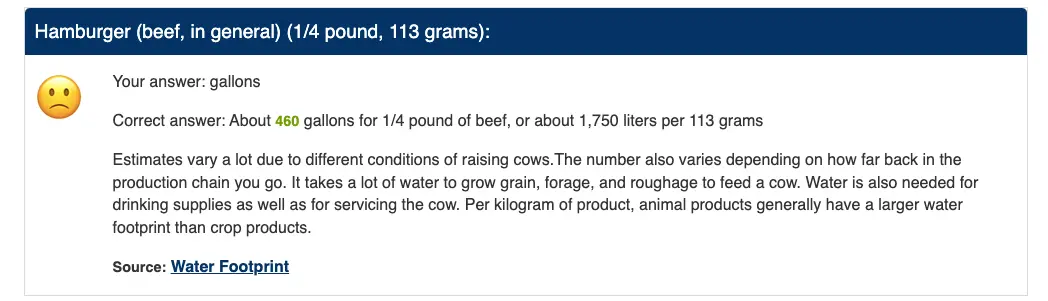
According to data compiled by the United States Geological Survey (USGS), the water required to produce common dietary staples, such as beef and poultry, eclipses household conservation metrics. Most consumers grossly underestimate this invisible, or "virtual," water footprint. For instance, just a single quarter-pound of beef requires approximately 460 gallons of water to produce—scaling up to a staggering 1,840 gallons for a full pound.
Put simply: eating a single pound of beef consumes more water than cutting two minutes off your daily shower for an entire year. To match the water footprint of that single pound of beef using a traditional 2.5-gallon-per-minute showerhead, an individual would need to take a continuous shower lasting over 12 hours.
This dramatic disparity forces a fundamental re-evaluation of how society approaches sustainability. If environmentalism feels like a series of punishing daily sacrifices—such as freezing through shortened showers—adoption rates will remain low. By shifting focus toward high-impact, low-friction behavioral adjustments, particularly regarding diet, consumers can achieve exponential conservation gains without feeling like they are sacrificing their quality of life.
Chronology
The evolution of modern water conservation messaging follows a distinct historical trajectory, shifting from broad industrial oversight to hyper-focused individual behavioral tweaks before circling back to systemic, systemic consumption patterns.

- The Late 20th Century (The Rise of Domestic Efficiency): Following the environmental awakenings of the 1970s and the establishment of agencies like the Environmental Protection Agency (EPA), conservation messaging primarily targeted heavy industry and municipal infrastructure. However, as suburban expansion boomed, attention shifted toward residential water use. Campaigns began targeting lawn irrigation, leaky faucets, and indoor plumbing fixtures.
- The 1990s and Early 2000s (The Institutionalization of Bathroom Conservation): This era saw the introduction of the EPA’s WaterSense program and a standardization of low-flow fixtures. During this period, the cultural trope of the "shorter shower" became codified as a cornerstone of personal environmental responsibility. Schools, public service announcements, and green living guides universally adopted the narrative that personal discipline in the bathroom was the primary metric of a green lifestyle.
- The 2010s (The Awakening to "Virtual Water"): As global trade expanded and data analytics improved, hydrologists and environmental scientists began calculating the "virtual water" or "water footprint" of manufactured goods and agricultural products. Pioneering work by organizations like the USGS and academic institutions began publishing comprehensive metrics illustrating that the vast majority of human water consumption was invisible—trapped inside the supply chains of food, textiles, and energy production.
- The Present Day (The Paradigm Shift): Contemporary environmental communication, championed by sustainability advocates and researchers, is actively working to dismantle the myth that household bathroom habits are the ultimate battleground for water conservation. By leveraging public awareness tools like the USGS food impacts water calculator, modern advocates are steering public discourse away from low-yield domestic sacrifices and toward high-impact dietary and consumer choices.
Supporting Data
To truly understand the scale of water consumption, one must look past the visible water running down household drains and examine the hidden hydrologic costs of global agriculture. Water footprint accounting divides usage into three categories: blue water (surface and groundwater), green water (rainwater stored in the soil), and grey water (freshwater required to dilute pollutants). Agriculture dominates the consumption of all three.
The USGS food impacts water calculator provides eye-opening metrics that starkly contrast with domestic conservation efforts:
- Beef Production: Requires approximately 1,840 gallons of water per pound. This is driven primarily by the massive amounts of water needed to irrigate feed crops (such as corn and alfalfa) over the multi-year lifespan of cattle, in addition to drinking water and processing needs.
- Poultry and Pork: While significantly more water-efficient than beef, chicken and pork still demand hundreds of gallons of water per pound, largely tied to feed production.
- Comparative Domestic Metrics:
- Standard Showerhead Flow Rate: 2.5 gallons per minute.
- Water Saved by Shaving 2 Minutes Off a Daily Shower for One Year: 1,825 gallons.
- Water Required for One Pound of Beef: ~1,840 gallons.
- Equivalent Shower Time for One Pound of Beef: 736 minutes (or 12.26 hours) of continuous showering under a standard 2.5 gpm fixture.
These figures illustrate a profound mathematical imbalance. While fixing a leaky toilet or taking a shorter shower yields tangible, feel-good local water savings, these actions pale in comparison to the structural water demands of the global food system. A consumer who dutifully shaves minutes off their shower every day for a year can completely wipe out those savings by consuming a single weekend’s worth of traditional burgers.
Official Responses
Environmental agencies, agricultural bodies, and sustainability experts have responded to these revelations with a mix of structural policy adjustments and shifting educational frameworks.

Historically, municipal water authorities leaned heavily on restriction-based policies during droughts—asking residents to limit lawn watering, wash cars less frequently, and, yes, take shorter showers. These measures are easy to legislate and enforce via local ordinances, making them politically attractive during short-term water crises.
However, federal scientific bodies like the USGS have taken a more educational approach, providing interactive digital tools that empower consumers to visualize their entire resource footprint. By deploying calculators that quantify the hidden water costs of food, agencies are implicitly acknowledging that public messaging must evolve beyond simplistic bathroom tips.
Corporate sustainability consultants and industry leaders note that while consumer education is vital, systemic change must occur at the agricultural production level. Innovations in drip irrigation, precision agriculture, alternative livestock feed formulations, and regenerative farming practices are being championed as the true paths forward for agricultural water stewardship. Rather than simply telling consumers to eat less meat, progressive food tech sectors are investing heavily in plant-based alternatives and cellular agriculture—products designed to drastically reduce the virtual water footprint of human diets while preserving the culinary experiences consumers enjoy.
Implications
The realization that dietary choices outweigh domestic bathroom habits in the realm of water conservation carries profound implications for policy, culture, and individual action.

First, it challenges the prevailing "sacrifice narrative" of the environmental movement. For decades, green living has often been marketed as an exercise in asceticism—giving up comforts, enduring cold or short showers, and generally accepting a lower quality of life to appease Mother Nature. This narrative is not only psychologically exhausting; it is deeply inefficient. When individuals are asked to make daily, annoying sacrifices that yield negligible macro-level results (like saving 1,825 gallons a year through regimented showering), burnout is inevitable.
Conversely, focusing on high-impact, low-friction adjustments—such as incorporating plant-based meals into one’s weekly routine or choosing sustainably sourced proteins—offers a psychological reframe. Eating delicious plant-based foods or modifying dietary habits does not inherently feel like a sacrifice if framed around health, culinary exploration, and effortless systemic impact.
Second, these findings underscore the urgent need for structural agricultural reform. Because agriculture accounts for the vast majority of freshwater consumption, true planetary resilience will not be achieved by tweaking residential plumbing codes alone. Policymakers must incentivize water-efficient farming techniques, modernize aging irrigation infrastructure, and price water resources accurately to reflect their true scarcity.
Ultimately, the shift in perspective from shower timers to food calculators marks a maturing environmental movement. It is a transition away from superficial gestures and toward data-driven, high-leverage solutions that protect global water resources without requiring humanity to live in a state of perpetual, uncomfortable self-denial.