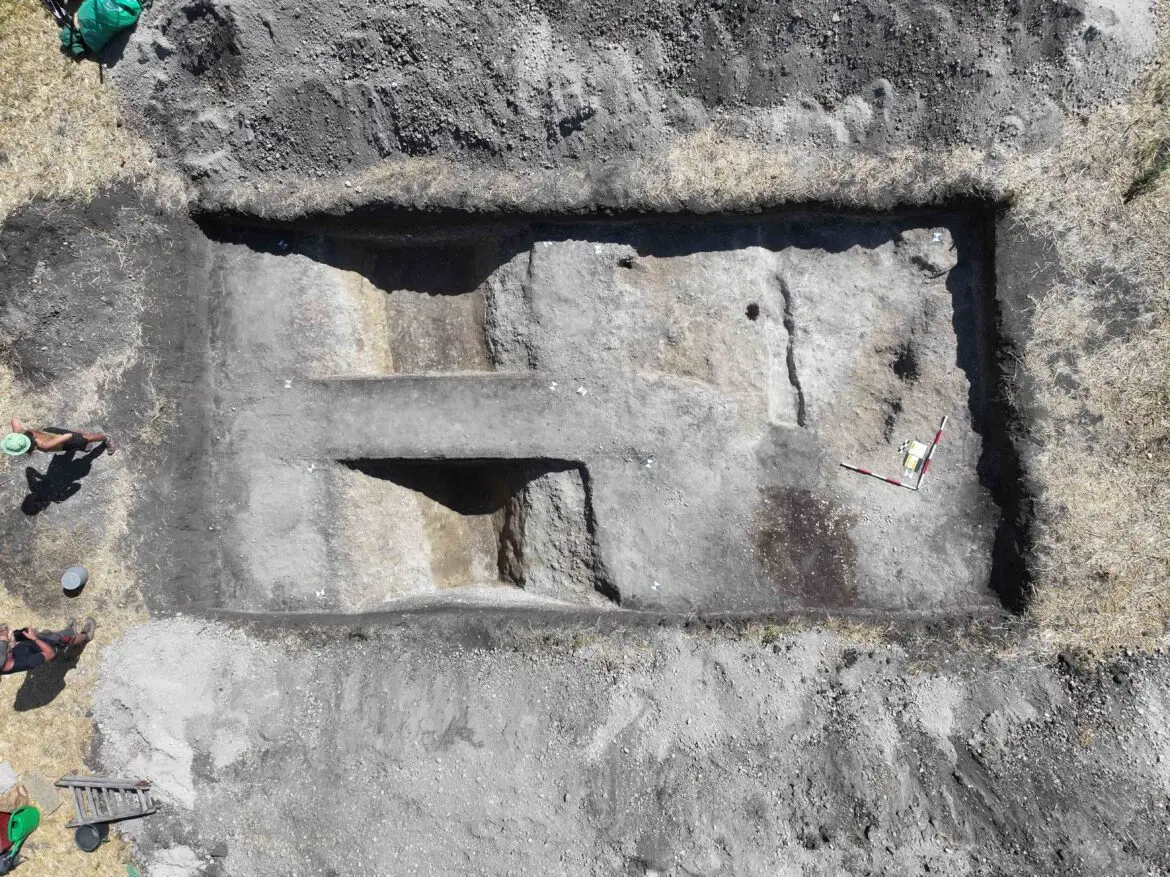
CHLEBY, Czech Republic — Deep in the fertile agricultural heartland of Central Europe, an international team of archaeologists has brought to light a monumental prehistoric sanctuary that challenges long-held assumptions about early human engineering, astronomy, and ritual. Located near the modern-day village of Chleby in the Nymburk District, the site consists of a colossal circular enclosure dating back approximately 6,500 years.
Advanced 3D modeling, geospatial surveys, and radiometric dating have revealed that the enclosure’s dozen carefully planned entrances were aligned with celestial events, specifically tracking the movements of the Sun and the Moon. Built during the Neolithic period, this sophisticated ritual landscape predates the oldest major phases of Stonehenge in England by more than a millennium.
The discovery provides startling new evidence that early farming communities in Central Europe possessed an advanced, highly specialized understanding of celestial mechanics. Long before the rise of the great civilizations of the ancient Near East, these Neolithic people were transforming their observations of the cosmos into grand, earth-wrought architecture.
Main Facts: Architecture and Celestial Geometry
The sheer scale of the Chleby enclosure immediately sets it apart from contemporary settlements in the region. Measuring a staggering 230 meters (approximately 755 feet) in diameter, the nearly circular monument is defined by a massive perimeter ditch that once plunged more than 2.5 meters (8 feet) deep into the earth.
What has electrified the archaeological community, however, is not just the size of the earthwork, but the deliberate, calculated placement of its 12 irregularly spaced gateways. Rather than serving as random points of entry or defense, these gaps in the perimeter ditch form an intricate geometric system designed to frame specific celestial phenomena.
According to the research team, led by archaeologists from the University of West Bohemia (UWB), the site features two primary observation points that anchor the entire complex:
- The Solstitial Axis: One perspective links the sunrise at the summer solstice directly with the sunset at the winter solstice.
- The Lunar Cycle: The second alignment tracks the extreme positions of the Moon as it rises and sets along the horizon throughout its complex, roughly 18-year cycle.
For early agrarian societies, these alignments were far from academic. They were matters of survival and spiritual order. The connection between sunrise and the summer solstice symbolized beginnings, growth, and the onset of the agricultural season, while sunset at the winter solstice represented endings, dormancy, and the turning of the year. By mapping these cycles into the physical geography of their sanctuary, the builders of Chleby inscribed the rhythm of the cosmos onto the landscape they farmed.
Chronology: From Sacred Sanctuary to Ordinary Earth
The life cycle of the Chleby monument spans millennia, revealing a trajectory that differs significantly from other famous megalithic structures like Stonehenge. While British monuments often experienced centuries of renewed use, adaptation, and sacred continuity, Chleby tells a story of rise, transformation, and eventual secularization.
The Neolithic Foundation (c. 4500 BCE)
The sanctuary was constructed during the Neolithic period by early farming communities. It served as a vital regional center for communal gatherings, astronomical observation, and ritual activities. During this foundational phase, monumental gateways were likely decorated with sacred symbols, including the horns and skulls of sacrificed bulls.
The Bronze Age Shift (Únětice Culture)
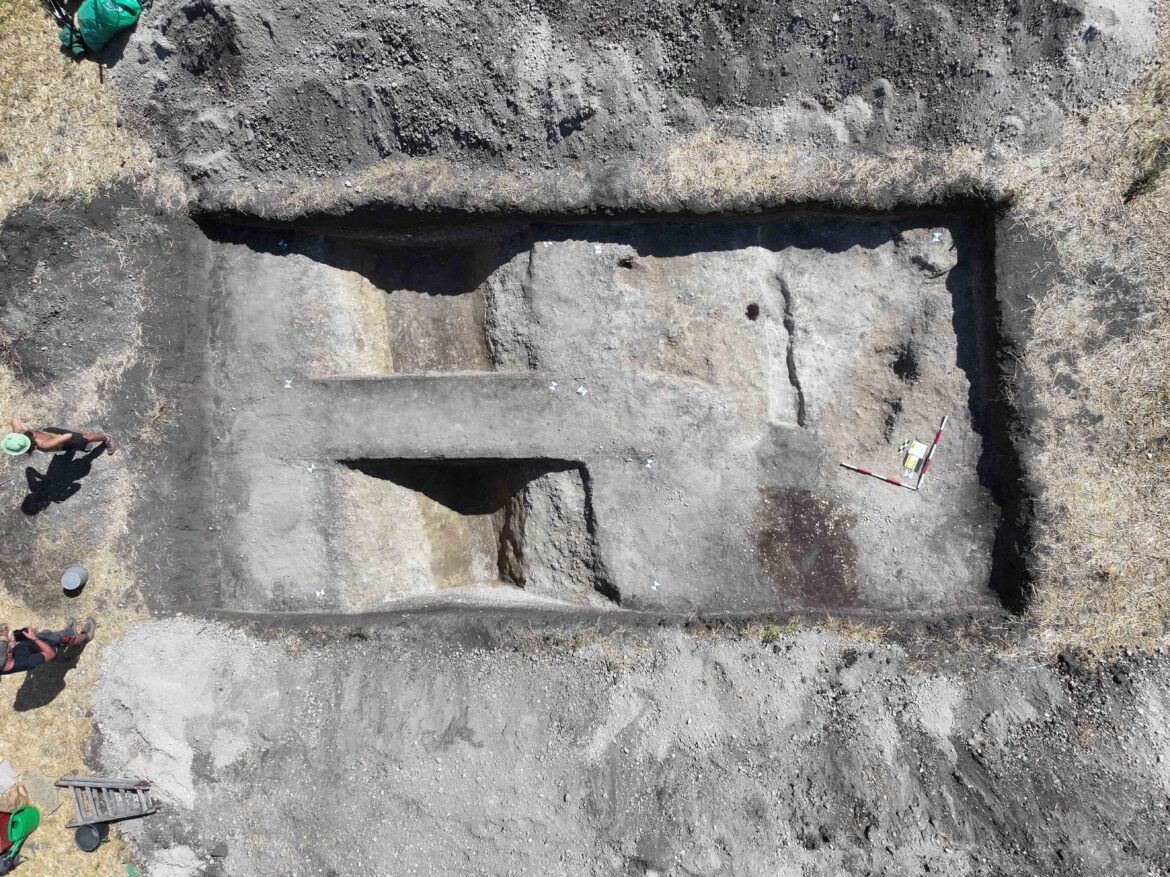
As centuries passed, the immediate ritual function of the enclosure evolved. Excavations at the site have uncovered a collective Bronze Age burial associated with the Únětice culture. This sepulcher contained the remains of approximately 18 individuals, deposited gradually over an extended period. This suggests that while the site may have lost its active day-to-day use as a solar-lunar observatory, it retained a lingering ancestral and sacred gravity, becoming a final resting place for the community’s honored dead.
The Iron Age Abandonment and Settlement
By the Iron Age, the sanctuary had completely shed its sacred identity. The monumental significance that once drew communities from across the region vanished. The deep perimeter ditches were systematically and gradually filled in, and an ordinary, utilitarian settlement was established directly over the sacred ground of the former sanctuary. Nature and human practicality paved over the prehistoric observatory, hiding its secrets beneath the plowzone for thousands of years until modern remote-sensing technology brought them to light.
Supporting Data and Methodology
Unlocking a site buried beneath millennia of agricultural activity and landscape changes required a multi-disciplinary approach combining high-tech surveying with traditional excavation techniques.
Researchers utilized high-resolution aerial photography, ground-penetrating radar, and meticulous three-dimensional spatial modeling to map the subterranean contours of the 230-meter-wide ditch and its 12 gateways. Radiometric dating of organic materials recovered from the bottom of the enclosure’s ditches provided the secure chronology placing the site more than 1,000 years prior to Stonehenge’s main construction phases.
Furthermore, the research team is currently expanding its analysis into the realm of soil chemistry. Led by Jan Fišer of the University of Hradec Králové, scientists are extracting core samples from both the interior of the enclosure and the surrounding landscape to trace chemical signatures left behind by ancient human behavior.

Because organic matter, food preparation, animal fats, and human waste leave distinct chemical footprints—such as elevated levels of phosphorus and nitrogen—soil chemistry can reveal invisible history. These analyses aim to pinpoint where specific community feasts, sacrificial slaughter, ritual processing, or mortuary rites took place, painting a richer picture of how the monument was utilized in daily and ceremonial life.
Official Responses and Expert Insights
The excavation and its provocative findings have drawn praise and analysis from leading European prehistorians, who emphasize the uniqueness of the Chleby discovery within Central European archaeology.
"Circular enclosures are completely unknown in our region for this period, which already makes the site exceptional," stated Petr Krištuf of the Department of Archaeology at the Faculty of Arts of the University of West Bohemia, who is leading the research project. "But when we began to analyze the positioning of the entrances in detail, it became clear that their arrangement was not random. Their geometry creates a system that made it possible to observe the most significant moments of the solar and lunar cycles."
Krištuf draws a direct philosophical line between the Czech site and its more famous British counterpart, noting that both share a foundational preoccupation with solstitial alignments. "For prehistoric farming communities, the connection between sunrise and the summer solstice symbolized a beginning, while sunset and the winter solstice represented an ending. The same principle can be seen along Stonehenge’s main axis. We can now see that the sanctuary at Chleby was designed similarly. Still, more than a thousand years earlier, as we have established from the dating of organic material."
The ritual life of the enclosure is further illuminated by the discovery of bovine remains within the perimeter ditches, particularly clustered around the monumental gateways. Jan Turek, an archaeologist from Charles University, underscores the religious significance of these finds.
"We assume that they may originally have decorated monumental gateways leading into the enclosure," Turek explained. "The cult of the bull was an important religious symbol among the first farming communities and is known from many parts of prehistoric Europe."
While cattle clearly held profound symbolic and economic value for these Neolithic societies, the exact theological meaning behind their placement at the gateways remains a subject of ongoing debate among specialists.

Implications: Rethinking European Prehistory
The identification of the Chleby sanctuary as a sophisticated solar and lunar observatory carries profound implications for our understanding of Neolithic Europe. For decades, popular imagination has tended to attribute monumental, astronomically aligned stone and earth architecture primarily to Atlantic and Western European cultures, such as those responsible for Stonehenge or the megaliths of Carnac in France.
Chleby shatters this geographical bias. It demonstrates that Central European farming cultures possessed the social cohesion, mathematical intuition, and architectural ambition necessary to orchestrate monumental landscape projects on par with anything found elsewhere on the continent—and they did so a millennium earlier than previously assumed.
The site redefines the relationship between early humans and their environment. The builders of Chleby did not merely adapt to the rhythms of nature; they codified them into monumental sacred architecture. By binding the movements of the sun, moon, and seasons to the earthly architecture of ditches, gateways, and bovine sacrifice, they created a permanent meeting place between the mortal world and the cosmic order.
As the research team at the University of West Bohemia, Charles University, and the University of Hradec Králové continues their chemical, archaeological, and spatial analyses, Chleby promises to yield even more secrets. What is already clear, however, is that this windswept corner of the Czech Republic holds the key to a forgotten chapter of human ingenuity—a time when the first farmers of Central Europe looked up at the stars and decided to build their universe into the earth.