










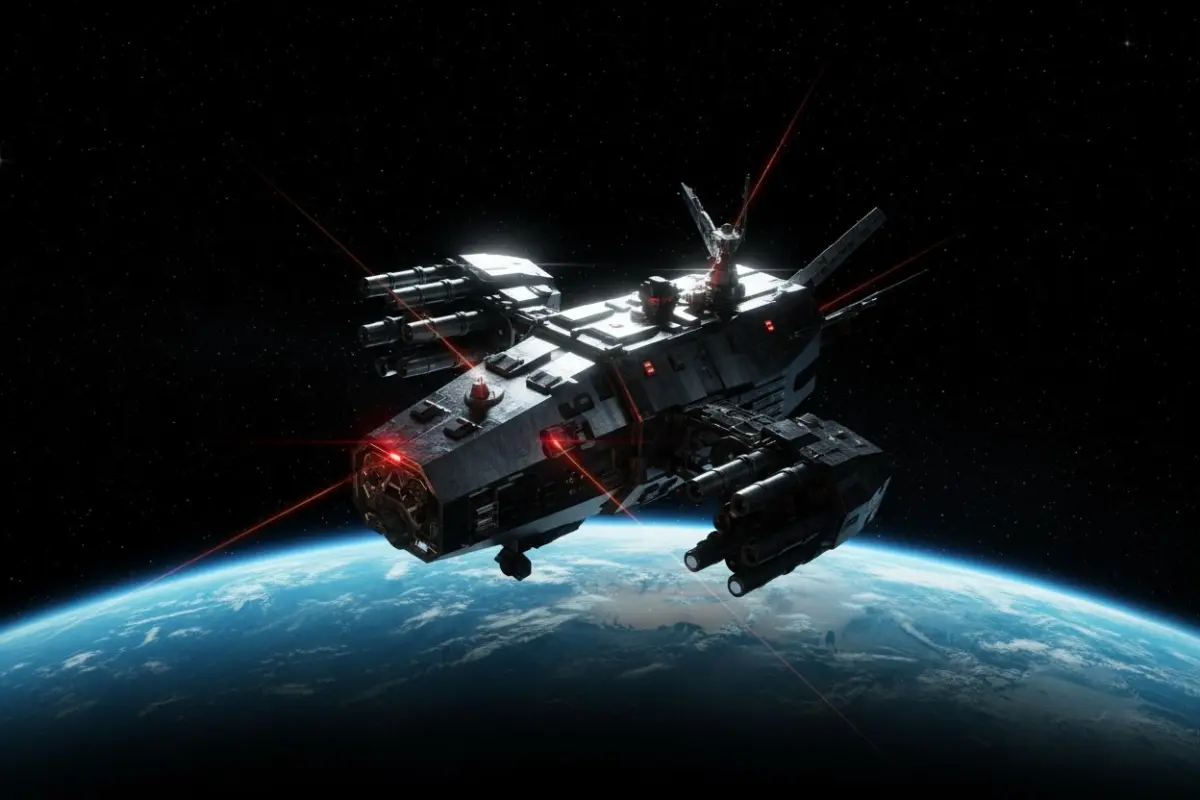
WASHINGTON — In a historic policy shift that marks a major escalation in modern military strategy, the U.S. Department of War confirmed on September 14, 2026, that the United States has successfully deployed active weapon systems into Earth’s orbit.
The announcement, delivered by Secretary of the Air Force Troy Meink during a keynote address at the Air & Space Forces Association’s 2026 Air, Space & Cyber Conference in Washington, represents the first time Washington has publicly acknowledged placing defensive or offensive armaments into space. Meink stated unequivocally that the U.S. Space Force "now has on-orbit space control weapons capable of defending the joint force against hostile adversary action."
While military leadership insists the platforms are strictly defensive and designed to safeguard vital national and allied space infrastructure, the revelation has immediately drawn fierce international condemnation, renewed warnings of a runaway orbital arms race, and intense scrutiny from arms control advocates worldwide.
Main Facts: What the Pentagon Confirmed
The disclosure brings into the open what defense analysts and intelligence agencies have suspected for years: that the architecture of modern warfare has officially expanded beyond the stratosphere.
According to statements released by the Pentagon and elaborated upon by senior defense officials, the core parameters of the deployment include:
- The Capability: The newly acknowledged payloads are classified as "space control weapons." Their primary objective is to protect American and allied satellites from foreign interference, physical tampering, or kinetic destruction by hostile nations.
- The Operating Force: The systems are under the direct operational command of the U.S. Space Force, whose Guardians are tasked with managing the orbital domain just as traditional branches manage land, sea, air, and cyberspace.
- Operational Seecurity (OPSEC): Citing strict national security protocols, Secretary Meink declined to specify the exact number of weapons deployed, their precise technical specifications, the orbits they occupy, or whether they have undergone live-fire testing in space. Pentagon officials emphasized that additional operational data would only be released "at an appropriate time."
- Preceding Context: The public confirmation follows years of rhetorical posturing and incremental policy changes. For over a decade, senior military commanders have warned that space is no longer a peaceful scientific sanctuary, but a congested, contested "warfighting domain" vulnerable to foreign counter-space technologies.
Chronology of Space Militarization: From Sanctuary to Battlefield
The journey from the post-Cold War era of peaceful satellite exploration to the 2026 orbital weapons deployment spans decades of escalating technological competition.
The Post-Cold War and Treaty Era (1967–2000s)
For decades, military activities in space were tightly bound by the 1967 Outer Space Treaty. Ratified by the United States, the Soviet Union (now Russia), and China, the treaty fundamentally banned the placement of weapons of mass destruction (WMDs) in orbit. However, because the text did not explicitly prohibit conventional weapons, lasers, or electronic jamming systems, a legal gray area persisted. During the Reagan administration, the pursuit of strategic defense initiatives—such as the Strategic Defense Initiative (SDI)—signaled an early U.S. intent to leverage technological superiority in the high ground of space, prompting Soviet leadership in 1984 to urge immediate negotiations for a comprehensive ban on anti-satellite (ASAT) technologies.
The Shift to "Contested Space" (2020–2024)
As adversaries developed sophisticated counter-space capabilities, U.S. rhetoric shifted dramatically. In 2020, then-Defense Secretary Mark Esper openly accused China and Russia of "weaponizing" space, alleging that both nations operated maneuverable "killer satellites" and directed-energy weapons capable of blinding or disabling American assets.
The establishment of the U.S. Space Force in December 2019 formalized the military’s structural focus on the domain. By the mid-2020s, the Pentagon scrambled to acquire terrestrial and space-based tools to defend its orbital network, introducing systems like the Meadowlands satellite jammer and Remote Modular Terminal units designed to disrupt enemy spacecraft remotely.
The 2025–2026 Threshold
Tensions escalated sharply when Gen. Chance Saltzman, Chief of the U.S. Space Force, warned in 2025 that Beijing had amassed a military satellite fleet numbering in the hundreds, heavily dedicated to the surveillance and tracking of U.S. forces. Simultaneously, the Space Force deployed prototype payloads capable of detecting when American spacecraft were actively being targeted or tracked by foreign adversaries.
The trajectory culminated on September 14, 2026, when Secretary Meink lifted the veil of ambiguity, formally confirming that active orbital weapons are now operational.
Supporting Data and Technological Ecosystem
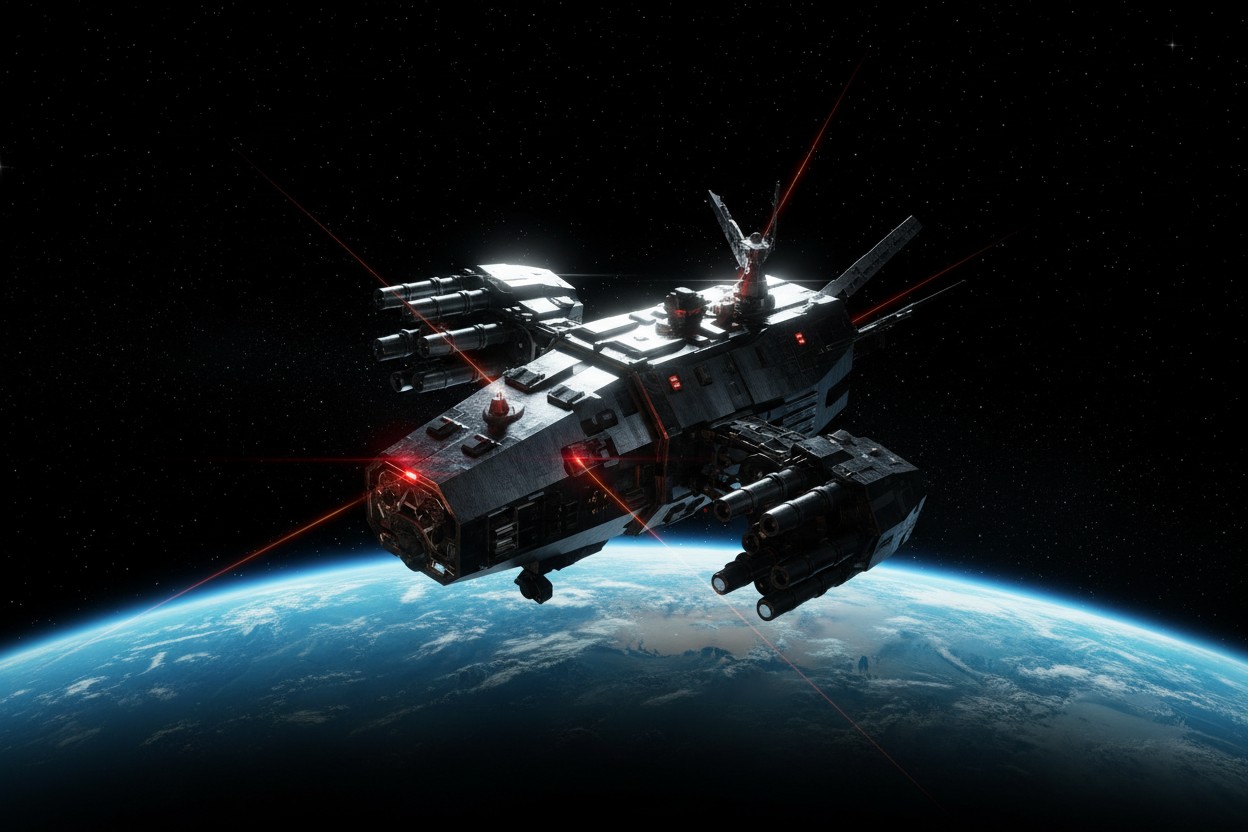
The newly confirmed orbital weapons do not exist in a vacuum; they are part of a sprawling, multi-layered technological ecosystem designed to establish absolute space dominance.
The Threat Matrix
Pentagon briefings over the past several years have highlighted the acute vulnerability of Western space assets. Modern global economies, financial markets, GPS navigation, and military command-and-control networks rely entirely on a stable constellation of low-Earth orbit (LEO), medium-Earth orbit (MEO), and geosynchronous (GEO) satellites.
Gen. Douglas Schiess, Chief of Space Operations, noted that adversaries have increasingly tested the limits of international norms through co-orbital inspections, cyber intrusions against ground stations, and ground-based laser dazzling. The deployment of U.S. space control weapons is viewed by military planners as a necessary deterrent—a "credible, acknowledged" means of imposing costs on any adversary that attempts to blind or cripple the joint force by attacking its digital backbone in orbit.
Complementary Capabilities
Beyond the newly confirmed orbital armaments, the U.S. military has rapidly expanded its broader space warfare toolkit:
- The Meadowlands System: A transportable, ground-based satellite communication jammer designed to temporarily disrupt adversary transmissions without creating orbital debris.
- Proximity Operations Payloads: Sensors capable of identifying and tracking aggressive satellite maneuvers in real-time.
- Global Expansion: Other nations are mirroring these developments. Israel’s Defense Ministry, for instance, has incorporated offensive space capabilities—including space-based lasers capable of neutralizing threats—into its multi-year budgetary framework.
Official Responses and Geopolitical Fallout
The Pentagon’s historic disclosure has triggered sharp reactions across international capitals, dividing policymakers, defense contractors, and arms control advocates.
Domestic Reaction
Within the United States, reactions broke along familiar political and institutional lines. Members of the congressional armed services committees acknowledged that they had been briefed on aspects of the deployment behind closed doors, but several lawmakers immediately called for heightened transparency and rigorous oversight regarding the rules of engagement for orbital combat.
Conversely, independent analysts and alternative media outlets sharply criticized the timing and nature of the disclosure. Critics argued that formalizing weaponized orbits shatters the last remaining illusion of arms control restraint, effectively greenlighting an unconstrained military buildup above the atmosphere.
International Condemnation
Abroad, the response was swift and predictable.
- Moscow: Kremlin spokesman Dmitry Peskov condemned the move, stating unequivocally that Russia opposes the deployment of any weapons systems in Earth’s orbit. Military experts on Russian state media, such as Alexei Leonkov, claimed that the U.S. deployment—echoing concepts from historical missile defense initiatives—turns space into an active theater of war and paves the way for American laser and kinetic missile systems in orbit.
- Beijing: While official, detailed statements from the Chinese Foreign Ministry were pending at the time of reporting, state-aligned media and international wire services reported that Beijing views the move as a profound threat to strategic stability, warning that Washington is actively accelerating an arms race in the final frontier.
- International Allies: European partners expressed cautious concern. While acknowledging the growing threat landscape posed by Russian and Chinese counter-space advancements, allied diplomats warned that the lack of international transparency regarding orbital weapons risks triggering accidental escalations or catastrophic debris cascades.
Implications for the Future of Global Security
The confirmation that the U.S. military has placed weapons in Earth’s orbit fundamentally alters the strategic calculus of international security. Several long-term implications loom large over the future of geopolitics:
- The Death of Space Sanctuary: For decades, international diplomats hoped to preserve space exclusively for scientific research, telecommunications, and earth observation. September 14, 2026, marks the formal burial of that ideal. Space is now officially a militarized operational theater.
- The Kessler Syndrome Risk: The introduction of offensive and defensive kinetic systems into orbit exponentially increases the risk of the Kessler Syndrome—a catastrophic scenario where a single collision between space weapons and satellites triggers a chain reaction of shrapnel, rendering entire orbital bands unusable for generations.
- The Absence of Guardrails: With no modern arms control framework governing conventional or directed-energy space weapons, the major spacefaring powers—the United States, China, and Russia—are entering an era of unbridled technological competition. Without transparency, miscalculations during orbital close approaches could easily spark terrestrial conflict.
As the international community digests the Pentagon’s paradigm-shifting announcement, attention now turns toward upcoming diplomatic forums and closed-door congressional hearings. Whether the deployment of these space control weapons will successfully deter foreign aggression or ultimately catalyze the very orbital arms race experts have long feared remains one of the defining security questions of the 21st century.