By the Maritime History and Folklore Desk
Published: October 2023
Main Facts: The Anatomy of a Legend
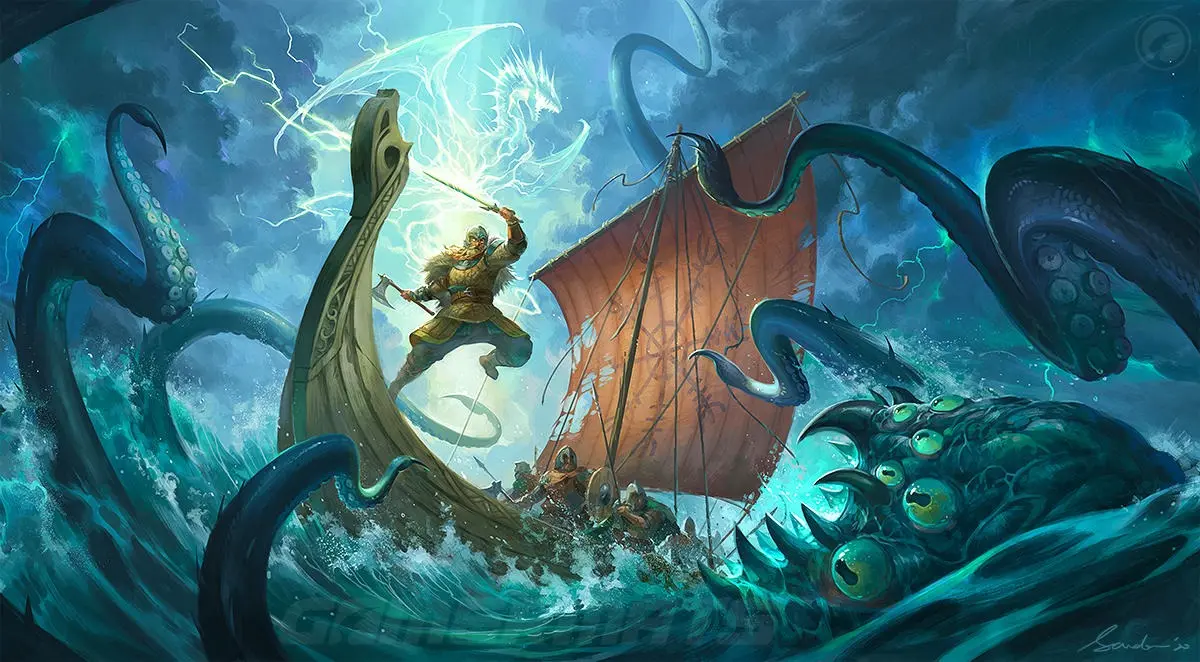
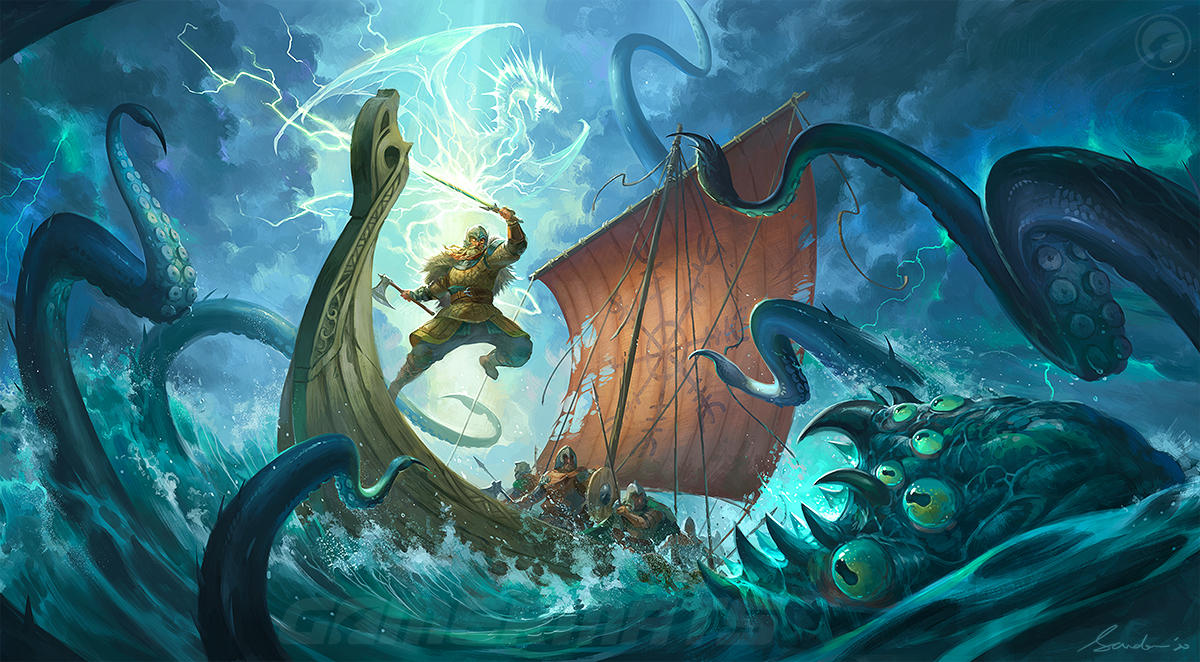
For centuries, the mere mention of the Kraken was enough to strike terror into the hearts of hardened sailors. Hailing from the rich oral traditions and maritime folklore of Scandinavia—particularly Norway and Iceland—the Kraken is perhaps history’s most formidable mythical sea monster. Described variously as a colossal squid, an octopus-like leviathan, or an island-sized crab, this creature of the deep was conjured by ancient mariners to explain the terrifying, unpredictable perils of the open ocean.
Unlike sirens or mermaids, which relied on enchantment to lure victims, the Kraken was pure, unadulterated physical destruction. According to traditional accounts, the beast did not merely attack ships; it obliterated them. It could drag entire vessels into the pitch-black abyss, shatter wooden hulls with sweeping tentacles, or create massive, swirling whirlpools simply by submerging beneath the waves.
While modern science has relegated the Kraken to the realm of fantasy, its origins are deeply rooted in the very real, terrifying encounters early fishermen and traders had with the uncharted depths of the North Atlantic. Today, the legend persists not just as a cautionary tale of nautical folklore, but as a cultural touchstone that continues to inspire literature, cinema, and marine cryptozoology.
Chronology: A History of Sightings and Literary Evolution
The evolution of the Kraken from regional superstition to globally recognized myth spans over a millennium. Its historical timeline reveals how imagination, fear, and sparse scientific observations intertwined to build a legend.
1. The Norse Sagas (13th Century)
Though oral traditions stretch back much further, the earliest written references to colossal sea beasts akin to the Kraken appear in old Norse literature. The Örvar-Odds saga, an Icelandic tale from the 13th century, describes two monstrous creatures in the Greenland Sea: the Hafgufa (sea mist) and Lyngbakr (heather-back). The Hafgufa was said to swallow entire whales, ships, and men, matching behaviors later attributed directly to the Kraken.
2. Bishop Pontoppidan’s Definitive Account (1752)
The definitive codification of the Kraken occurred in the 18th century. Erik Pontoppidan, the Bishop of Bergen and a fellow of the Royal Academy of Sciences in Copenhagen, published his Natural History of Norway in 1752. Pontoppidan provided the most detailed descriptions of the beast to date, officially naming it "Kraken" (derived from the Norwegian definite form krake, denoting an unhealthy animal or something twisted). Pontoppidan meticulously detailed its island-like proportions, its method of creating deadly whirlpools, and its reliance on excreting a thick, darkening fluid that muddied the surrounding sea to catch fish.
3. The Scientific Skepticism and Reclassification (19th Century)
As the Age of Sail gave way to the Age of Steam—and empirical science began to dominate maritime exploration—reports of the Kraken began to wane. By the mid-to-late 19th century, naturalists sought rational explanations for the ancient myths. The discovery of giant squids (Architeuthis dux) washed ashore in places like Newfoundland and Denmark provided a vital missing link. Scientists realized that sailors’ tall tales of multi-armed titans were likely exaggerated encounters with real, elusive deep-sea cephalopods.

Supporting Data: Dimensions of the Beast
Because the Kraken belongs to the realm of folklore, its reported size and capabilities were never bound by the laws of biology. However, historical accounts consistently emphasize its staggering proportions:
- Mass and Scale: In Pontoppidan’s accounts, the Kraken’s back was said to be a mile and a half in circumference. Sailors frequently mistook the creature’s carapace or dorsal surface for an uncharted island, anchoring their ships to it—only to realize their mistake when the "island" began to sink back into the freezing water.
- The Tentacles: Historical illustrations and texts describe limbs thick enough to encircle a three-masted warship, capable of pinning down the vessel’s masts and rendering its crew completely helpless.
- The Whirlpool Effect: The displacement of water caused by a creature of such massive volume diving or surfacing was said to generate a vortex powerful enough to drag nearby ships down with it, ensuring no survivors remained to tell the tale.
In contrast, the real-world biological counterpart—the Giant Squid—is impressive in its own right, though far less catastrophic. Growing up to 43 feet (13 meters) in length and weighing nearly a metric ton, the giant squid possesses eyes the size of dinner plates and long, barbed tentacles. While a giant squid poses zero threat to a modern cargo ship, it is easy to imagine how an unexpected encounter with one in a dense fog centuries ago could birth a terrifying legend.
Official Responses: From Church Authorities to Naturalists
In the era before modern oceanography, authorities took the threat of sea monsters seriously. Church officials, scholars, and naval captains recorded encounters with the Kraken as undeniable facts of the natural world.
- Ecclesiastical and Academic Validation: Bishop Pontoppidan was not an uneducated superstitious peasant; he was a respected scholar and clergyman. His inclusion of the Kraken in a scientific survey of Norway’s natural history lent the creature immense credibility across Europe during the Enlightenment.
- Early Naval Logbooks: Numerous 17th- and 18th-century sea captains included references to sudden, unexplained maritime disasters in their official logs. While many vessels were undoubtedly lost to severe storms, rogue waves, or uncharted reefs, the lack of wreckage often led crews to blame the invisible, indiscriminate wrath of the Kraken.
- The Linnaean Classification: Even Carl Linnaeus, the father of modern taxonomy, included the Kraken in the first edition of his landmark Systema Naturae (1735) under the scientific name Microcosmus marinus, though he wisely dropped it in later editions as a lack of physical evidence prompted scientific skepticism.
Implications: Why the Kraken Endures Today
The legacy of the Kraken extends far beyond historical curiosity. It serves as a profound psychological mirror reflecting humanity’s enduring fear of the unknown.

1. The Psychological Impact of the Ocean
To pre-modern civilizations, the ocean was an alien, hostile environment. While the land could be mapped, cleared, and conquered, the sea remained a shifting abyss hiding unfathomable mysteries. The Kraken served as a personification of this existential dread—a reminder that human beings are fragile visitors in a domain ruled by primordial forces.
2. Pop Culture and Modern Mythology
Today, the Kraken has transitioned safely from a maritime terror to a beloved pop culture icon. It features prominently in blockbuster franchises (Pirates of the Caribbean, Clash of the Titans), video games, and literature. Furthermore, the name is proudly adopted by modern sports teams (such as the Seattle Kraken NHL franchise) and aerospace engineering firms developing autonomous underwater vehicles, symbolizing immense power, depth, and agility.
3. The Quest for Real-World Cryptids
The story of the Kraken offers a fascinating lesson in the intersection of myth and science. It reminds us that behind many ancient legends lies a kernel of truth. Just as the coelacanth and the giant squid once seemed like impossible myths before being discovered, modern marine biologists continue to explore the deep ocean trenches—knowing full well that we understand less about the bottom of our own planet than we do about the surface of the moon.
As long as the deep blue holds secrets, the shadow of the Kraken will continue to loom large in the human imagination.