









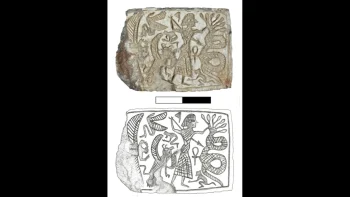
JERUSALEM — Archaeological research into a tiny, centuries-old artifact discovered in the Southern Levant has yielded profound insights for historians of ancient religion and mythology. The object—a meticulously carved stone seal dating back approximately 2,800 years to the Iron Age—depicts a dramatic and violent confrontation between a heroic figure and a terrifying multi-headed serpent.
Far from being a mere decorative trinket, international epigraphers and Near Eastern archaeologists suggest this artifact serves as a critical missing link. It visually bridges the gap between ancient Canaanite, Israelite, and Mesopotamian dragon-slaying traditions and the later, highly influential monster-combat motifs found in Classical Greek mythology and Biblical literature.
Main Facts
The artifact at the center of this discovery is an Iron Age stamp seal, measuring just a few centimeters across, yet carrying immense symbolic weight. Recovered during archaeological excavations in Israel and subjected to advanced imaging analyses, the seal portrays a narrative scene deeply embedded in the collective consciousness of the ancient Near East: order battling chaos, personified by a heroic champion confronting a multi-headed serpent.
- The Artifact: An Iron Age II stamp seal carved from semi-precious stone, featuring intricate micro-relief engraving.
- The Imagery: A human or divine hero locked in mortal combat with a serpentine entity possessing seven distinct heads.
- Chronology: Dated to approximately the 8th century BCE (roughly 2,800 years ago), placing it squarely in the Iron Age II period of the Southern Levant.
- Significance: The artifact provides tangible archaeological corroboration for oral and textual traditions concerning cosmic sea-serpents—motifs well-documented in Ugaritic texts, the Hebrew Bible, and later Greek epics such as the labors of Heracles.
According to researchers, the iconography on the seal mirrors the ancient Near Eastern preoccupation with the Chaoskampf—the cosmic struggle between a creator deity or cultural hero and a primordial sea monster, often represented as a dragon or multi-headed serpent.
Chronology of the Discovery and Research
To understand the weight of this find, researchers trace a long timeline of mythic transmission and modern archaeological recovery spanning millennia.
Phase 1: The Iron Age Milieu (c. 800–700 BCE)
During the Iron Age II, the Levant was a cultural and political crossroads. Empires such as Assyria and Egypt vied for dominance, while local kingdoms—including the Israelites, Judahites, Phoenicians, and Philistines—exchanged goods, technologies, and religious ideas. It was within this hyper-connected artistic and ideological environment that the craftsman of the stamp seal lived and worked, utilizing stylistic conventions borrowed from both Mesopotamia and Egypt to depict a locally resonant myth.
Phase 2: Excavation and Initial Cataloging (Late 20th to Early 21st Century)
The seal was recovered from a stratified archaeological context in Israel during authorized excavations. Initially categorized simply as a standard administrative or personal signet ring component typical of the Iron Age, the artifact’s true iconographic value remained underappreciated due to the limitations of naked-eye examination.
Phase 3: Advanced Micro-Imaging and Re-Evaluation (Recent Years)
With the advent of high-resolution reflectance transformation imaging (RTI) and 3D digital microscopy, epigraphers and iconographers were able to examine the minute details carved into the stone. What previously appeared to be abstract decorative banding or floral motifs under standard lighting resolved into the distinct, menacing profiles of multiple serpentine heads rearing up against a central, dominant human figure.
Phase 4: Public Announcement and Scholarly Consensus (2024–Present)
As findings were prepared for publication in archaeological journals, the broader implications of the seal captured the attention of scholars tracking the diffusion of ancient Near Eastern motifs into the Mediterranean basin, setting off a renewed academic dialogue regarding the shared roots of Mediterranean and Near Eastern mythology.
Supporting Data and Context: The Seven-Headed Serpent in Antiquity
The appearance of a seven-headed serpent on an Iron Age artifact from Israel is not an isolated anomaly, but rather part of a rich, pan-Mediterranean tapestry of dragon-slaying lore.
The Ugaritic Precedents
Centuries before the creation of this seal, scribes in the Canaanite city of Ugarit (modern-day Syria) recorded epic poetry on clay tablets. In the Baal Cycle, the storm god Baal battles Yam (the sea) and defeats Lotan—a twisting, fugitive serpent described explicitly as having "seven heads." Linguistic and structural analyses have long linked Ugaritic Lotan to the Biblical Leviathan.
Biblical Parallels
The imagery of the multi-headed chaos monster also permeates the Hebrew Bible, appearing in texts that utilize ancient Near Eastern mythological tropes to communicate theological concepts. Passages in Psalms and Isaiah reference God’s triumph over the sea monsters:
- “You divided the sea by your might; you broke the heads of the sea monsters in the waters.” (Psalm 74:13)
- “On that day the Lord with his hard and great and strong sword will punish Leviathan the fleeing serpent, Leviathan the twisting serpent, and he will kill the dragon that is in the sea.” (Isaiah 27:1)
The Classical Greek Counterpart
The motif of the multi-headed serpent is perhaps most famously immortalized in Greek mythology through the Hydra of Lerna—a serpentine water monster with multiple heads that Heracles had to slay as the second of his Twelve Labors. While classical sources date the codification of Greek myths to the Archaic and Classical periods (c. 700–400 BCE), art historians have long argued for significant Near Eastern influence on Greek artistic motifs during the Orientalizing period (c. 750–650 BCE). This newly analyzed seal provides physical evidence of the visual vocabulary circulating in the Levant precisely when Greek traders and mercenaries were interacting heavily with the Near East.
Official Responses and Academic Perspectives
The unveiling of the seal’s detailed iconography has drawn commentary from leading archaeologists, historians of religion, and biblical scholars.
Dr. Alon Weiner, a Near Eastern archaeologist specializing in Iron Age glyptic art, emphasized the artifact’s role as a physical bridge between text and image:
"For a long time, we have relied almost entirely on textual descriptions—whether from Ugaritic tablets or Biblical verses—to understand how ancient peoples envisioned these cosmic battles. Finding this narrative captured on a portable object like a stamp seal demonstrates that these mythological concepts were not confined to elite literature; they were part of the visual and ideological everyday culture of the Southern Levant."
Meanwhile, Dr. Elena Rostova, a specialist in Classical and Near Eastern comparative mythology, noted the profound implications for understanding cultural diffusion:
"The presence of a seven-headed serpent in Iron Age Israel matches descriptions found centuries later in Greek accounts of the Hydra. It reinforces the thesis that Greek mythmakers did not invent these creatures in a vacuum. They drew from a deep, ancient well of Near Eastern iconography that stretched from Mesopotamia through the Levant and onward to the Aegean."
Museum curators and heritage officials in Israel have also highlighted the importance of safeguarding such artifacts, noting that they illuminate the complex, multicultural fabric of the ancient land bridge connecting Asia, Africa, and Europe.
Broader Implications for History and Theology
The publication and analysis of this 2,800-year-old seal extend far beyond the niche field of glyptic studies, offering deeper reflections on how human societies process fear, order, and heroism.
- The Universal Nature of the Chaoskampf: The recurring motif of the hero defeating the multi-headed beast symbolizes humanity’s perennial desire to impose order upon chaos—whether through taming the wild forces of nature, establishing political stability, or overcoming existential threats.
- Interconnectedness of Ancient Civilizations: The artifact dispels the outdated notion of ancient cultures existing in isolated silos. The seamless blending of Mesopotamian stylistic elements, Levantine mythic themes, and motifs that would later permeate Greek literature underscores a vibrant, highly interactive ancient Mediterranean world.
- Contextualizing Biblical Literature: For biblical historians, the seal offers valuable material context. It proves that the imagery of multi-headed sea serpents utilized by biblical prophets was part of a common cultural currency shared by Israelites and their neighbors, utilized effectively to convey divine power over the chaotic forces of the universe.
As research continues and technological advancements allow for even deeper scrutiny of museum collections worldwide, artifacts like this tiny Iron Age seal remind modern observers that the stories we tell today—about heroes, monsters, and epic battles between good and evil—have ancient, enduring roots stretching back millennia into the dust of the Near East.