










By the Science & Lifestyle Desk
Published: November 2025
Main Facts: The 2026 Celestial Lineup
As stargazers, astronomers, and art enthusiasts look ahead to the coming year, Celestial Products has officially announced its highly anticipated lineup for the 2026 lunar tracking season. Merging scientific precision with aesthetic elegance, the newly released collection offers a comprehensive array of formats designed to bring the beauty of the night sky into everyday spaces.
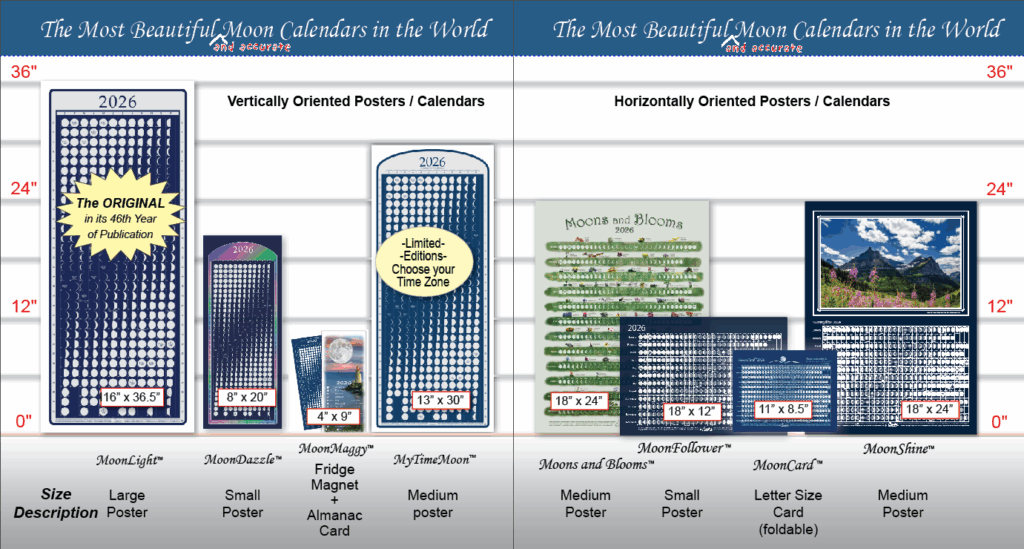
From compact, everyday-carry fridge magnets and greeting cards to statement-making small, medium, and large wall posters, the 2026 catalog caters to a diverse audience. Flagship titles such as MoonLight 2026 and MoonMaggy 2026 lead the current release, anchoring a product line engineered for both amateur stargazers and professional astronomers who demand accurate lunar data.
The company has made its complete digital showcase available through an interactive Adobe InDesign catalog, allowing prospective buyers to browse physical editions seamlessly. Additionally, key items from the 2026 collection have officially launched on major e-commerce platforms, including the dedicated Celestial Products Amazon storefront, alongside direct-order channels for bulk or specialty purchases.

Chronology: The Evolution of Modern Lunar Calendars
The journey from ancient, rudimentary lunar tracking systems to modern, scientifically accurate printed calendars spans millennia, reflecting humanity’s enduring fascination with Earth’s natural satellite.
Ancient Origins and Early Tracking
Long before the advent of printed media, ancient civilizations—including the Babylonians, Chinese, Greeks, and Indigenous peoples across the globe—relied on the changing phases of the Moon to measure time, schedule agricultural planting, and navigate maritime voyages. These early observations laid the groundwork for lunisolar calendars, which attempted to reconcile the roughly 29.5-day synodic month with the solar year.
The Rise of Print Astronomy
With the invention of the printing press in the 15th century, astronomical data began to democratize. Ephemerides—tables giving the positions of astronomical objects in the sky at a given time—gradually transitioned from specialized scholarly texts to accessible almanacs. By the 19th and 20th centuries, visual representations of the Moon’s phases became staples in households, blending practical utility with landscape and celestial art.
The Digital Era and Modern Publishing
In recent decades, the proliferation of digital applications has transformed how people track celestial events. However, physical lunar calendars have experienced a renaissance. Rather than competing with digital screens, publishers like Celestial Products have elevated the medium, combining high-resolution astronomical calculations with museum-grade printing techniques, durable materials, and sophisticated artistic design. The release of the 2026 collection represents the culmination of decades of refinement in balancing rigorous astronomical ephemeris data with contemporary interior design trends.

Supporting Data: Understanding Lunar Tracking and Consumer Demographics
The enduring popularity of physical moon calendars is supported by a growing market demand for tangible, analog tools in an increasingly digital world, alongside steady interest in amateur astronomy.
The Science Behind the Data
Accurate moon calendars require precise mathematical modeling of the Moon’s orbit, which is perturbed by the gravitational influences of both the Sun and the Earth. Key data points meticulously calculated for the 2026 editions include:
- Synodic Month Duration: Averaging approximately 29 days, 12 hours, and 44 minutes.
- Phase Transitions: Exact timing for New Moons, First Quarters, Full Moons, and Third Quarters across multiple global time zones.
- Apogee and Perigee: Tracking the points in the lunar orbit where the Moon is farthest from and closest to Earth, often coinciding with "Supermoon" phenomena.
- Libration and Tilt: Factoring in the subtle wobbles of the Moon that reveal slightly more than 50% of its surface over time.
Market Trends and Product Formats
Consumer interest spans several distinct demographics, reflected in the varied sizing and format strategy deployed by Celestial Products for 2026:
| Product Format | Target Audience / Primary Use Case | Key Features |
|---|---|---|
| Greeting Cards | Casual gift-givers, correspondence enthusiasts | Compact, features notable lunar phases, doubles as a keepsake |
| Fridge Magnets | Daily kitchen utility, casual observers | High-durability gloss finish, quick-reference monthly layouts |
| Small Posters | Dorm rooms, offices, compact spaces | Balanced layout prioritizing visual art and daily phase visibility |
| Medium Wall Posters | Living rooms, classrooms, home observatories | Standardized viewing distance, enhanced typographic clarity |
| Large Wall Posters | Professional observatories, serious astronomers, galleries | Immersive scale, highly detailed ephemeris markings, premium heavy-stock paper |
Official Responses and Creator Insights
The philosophy behind the 2026 collection centers on bridging the gap between hard science and human creativity. Spokespersons and designers behind Celestial Products emphasize that a moon calendar should be more than a mere schedule tracker—it should serve as an inspirational window to the cosmos.
"Our goal has always been to create products that satisfy the rigorous demands of astronomers while captivating those who simply find peace and wonder in looking up at the night sky," notes the editorial team at Celestial Products. "The 2026 collection represents our most visually striking and scientifically precise catalog to date. Whether someone is ordering a quick-reference magnet for their kitchen or a large-format poster for an observatory wall, every item is crafted with uncompromising attention to detail."
Feedback from early retail partners and long-term customers has highlighted the seamless transition between the digital catalog browsing experience and fulfillment options. By expanding their digital footprint through platforms like Amazon while maintaining personalized, direct-order support lines, the publisher ensures that celestial enthusiasts worldwide can easily access the tools they need for the upcoming year.
Implications: The Cultural and Practical Value of the 2026 Collection
The release of the 2026 moon calendar collection carries several broader implications for hobbyists, educators, and the wider wellness and lifestyle communities.
Educational Enrichment
In classrooms and home-schooling environments, physical calendar charts remain invaluable pedagogical tools. By displaying the lunar cycle visibly on a wall or desk, students absorb natural science concepts organically. The precise tracking of eclipses, equinoxes, and moon phases included in the 2026 editions provides educators with reliable visual aids that foster an early appreciation for astrophysics and orbital mechanics.

Mindfulness and the "Slow Living" Movement
In recent years, lunar tracking has experienced a surge in popularity within wellness, gardening, and mindfulness communities. Many individuals use moon phases to structure personal reflection time, set monthly intentions, or align agricultural and horticultural activities (such as biodynamic gardening) with natural rhythms. The tactile nature of a physical wall calendar supports the broader "slow living" movement, encouraging individuals to disconnect from algorithmic feeds and reconnect with natural, cyclical time.
Aesthetic Integration
Modern interior design increasingly favors natural elements and celestial motifs. By ensuring that titles like MoonLight 2026 and MoonMaggy 2026 double as fine art prints, Celestial Products bridges the gap between scientific utility and home decor. The ability to choose from a spectrum of sizes ensures that whether placed on a refrigerator door or framed in a living room, the cosmos remains accessible, beautiful, and mathematically precise throughout the entirety of 2026.