WASHINGTON — Long before the advent of digital push notifications, glowing smartphone screens, and standardized solar calendars, humanity’s primary celestial timekeeper hung silently in the night sky. For millennia, Indigenous peoples across North America looked up at the full moon not merely as a passive astronomical body, but as a dynamic, living calendar.
By tracking the lunar cycle in tandem with subtle ecological shifts—the melting of ice, the blooming of specific wildflowers, the migration of fish, and the behavior of wildlife—Native communities developed sophisticated timekeeping systems. These traditions birthed the familiar full moon names we reference today, transforming cosmic events into vital ecological guides for survival, agriculture, and celebration.
Main Facts: The Intersection of Cosmos and Ecology
At its core, the traditional naming of full moons is an exercise in applied ecological science. Far from being random or purely poetic labels, monikers like the "Wolf Moon," "Strawberry Moon," or "Beaver Moon" served as mnemonic devices. They functioned as operational alerts for Indigenous tribes, signaling when it was time to harvest wild rice, set traps before the deep freeze, or prepare for the leaner months of midwinter.
The foundational nomenclature widely recognized today—particularly in North America—stems primarily from the Algonquian language family. Stretching historically from New England to Lake Superior, Algonquian-speaking groups, most notably the Ojibwe (Chippewa), left an indelible mark on how European settlers and, subsequently, modern almanacs tracked the turning of the year.
However, historians and cultural anthropologists emphasize that these names are not monoliths. With hundreds of distinct federally recognized tribes across the United States and Canada, lunar calendars varied widely. Climate differences between the southeastern forests and the northern Great Plains meant that a seasonal marker in one region bore little resemblance to the realities faced by communities hundreds of miles away.
Furthermore, while popular culture often attributes all traditional moon names exclusively to Native American heritage, the historical record reveals a rich cultural exchange. European settlers brought their own timekeeping traditions—rooted in Celtic and Old English folklore—which eventually blended with Indigenous systems, creating the hybrid lunar lexicon popularized by publications like The Old Farmer’s Almanac since the late 18th century.
Chronology: A Journey Through the 13 Moons
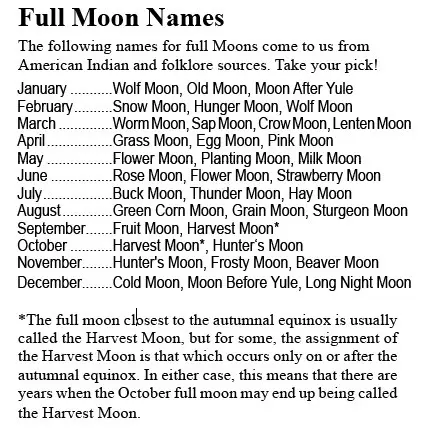
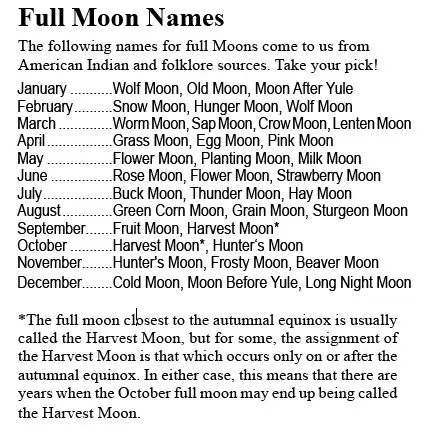
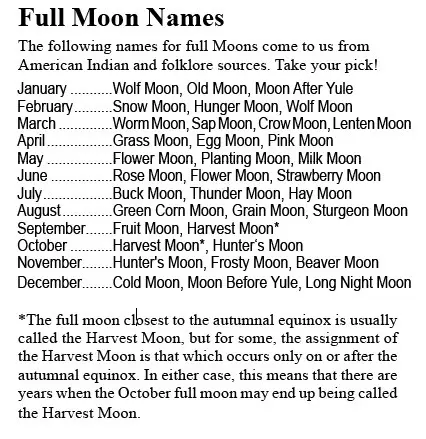
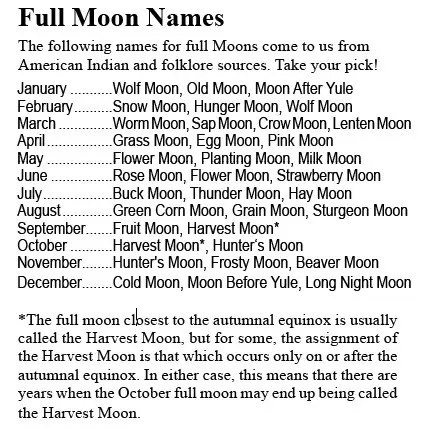
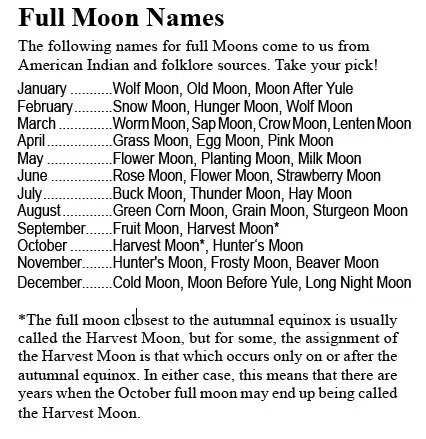
While the Gregorian calendar divides the year into twelve standardized, rigid months, traditional lunar systems often tracked thirteen cycles, aligning closely with the roughly 29.5-day phases of the moon. Below is a seasonal chronology of the traditional moon names, tracking how ancient societies navigated the wheel of the year.
Winter Moons: Survival, Endurance, and the Deep Freeze
- January – Wolf Moon / Severe Moon: The year often opened with the haunting sound of hungry wolves howling outside winter encampments. While European settlers popularized the "Wolf Moon" (drawing on Old English roots), many Native American tribes referred to it as the Severe Moon or Center Moon, acknowledging the brutal peak of winter.
- February – Snow Moon / Hunger Moon: February tested human endurance. Often called the Hungry Moon due to depleted food stores, it was also known by the Ojibwe as the Sucker Fish Moon, recognizing an essential aquatic resource that helped communities survive the final stretch of winter.
Spring Moons: Renewal, Thaw, and the Awakening
- March – Worm Moon / Crow Moon: As the ground softened, the emergence of earthworm casts and the cawing of returning crows signaled the retreat of frost. Northern tribes also tracked the Sap and Sugar Moon, marking the vital seasonal window for harvesting maple syrup.
- April – Pink Moon / Breaking Ice Moon: Named for the wild pink phlox flowers blooming across early spring landscapes, April also brought the sound of cracking river ice and the return of lush, green growth.
- May – Flower Moon / Planting Moon: Spring reached its zenith in May. Moon names from this period universally celebrate floral abundance and serve as a strict calendar reminder for planting critical crops like corn, beans, and squash.
Summer Moons: Abundance, Harvest, and Activity
- June – Strawberry Moon / Fish Moon: June brought the sweet reward of ripe wild strawberries. Coastal tribes similarly tracked the Shad Moon, noting when fish began migrating upstream to spawn.
- July – Buck Moon / Thunder Moon: Male deer grew their new antlers at peak velocity during July, inspiring the Buck Moon moniker. Frequent summer storms also earned it the title of Thunder Moon.
- August – Sturgeon Moon / Wild Rice Moon: For Great Lakes tribes, August was defined by the peak sturgeon catch and, crucially, Manoomini-giizis—the sacred season for harvesting wild rice.
Autumn Moons: Preparation and the Gathering Darkness
- September – Harvest Moon: Closest to the autumnal equinox, this moon illuminated the fields late into the night, allowing farmers to gather the last of the corn, squash, and pumpkins.
- October – Hunter’s Moon: With fields cleared of crops and trees stripped of leaves, game animals stood out clearly, fattened up after a summer of abundance. It was the optimal time for autumn hunting.
- November – Beaver Moon: As swamps began to freeze, beavers worked furiously to fortify their lodges, prompting tribes to set traps for warm winter pelts or simply observe the industrious animals preparing for the cold.
- December – Cold Moon / Long Night Moon: The year closed with the longest nights and deepest snows, plunging communities back into the cycle of endurance and storytelling around the hearth.
Supporting Data: Linguistic and Cultural Diversity
The diversity of lunar tracking systems reflects a profound adaptation to local ecosystems. In Anishinaabe tradition, the moon is known as Nookomis Dibik-Giizis (Grandmother Moon), regarded as a primary teacher and celestial guide rather than an inanimate rock.
Data compiled by cultural historians highlights the following operational differences in historical and modern timekeeping:

- The Season Count: While mainstream society strictly observes four seasons, various Indigenous traditions recognized five distinct seasons, adding specific transitional phases like "freeze-up" or "break-up" to their calendars.
- The Month Count: Lunar years naturally cycle through approximately 12.4 full moons annually. Consequently, some tribes maintained a 12-moon calendar while others incorporated a 13-moon system, periodically adjusting with "blue moons" or intercalary months to keep pace with solar years.
- The Longevity of Publications: Mainstream adoption of these names accelerated dramatically following the American Revolution. The Old Farmer’s Almanac, established in 1792, cemented many of these Algonquian and European-derived names into public consciousness, where they remain standard vernacular today.
Official Responses and Perspectives: Honoring Indigenous Knowledge
In recent years, cultural institutions, scientific bodies, and tribal leaders have placed renewed emphasis on properly contextualizing these lunar names.
Historians and Indigenous scholars stress that while sharing these names broadens public appreciation for nature, it must be done with cultural respect and historical accuracy. Dr. Elizabeth LaPensee (Anishinaabe and Métis), an interdisciplinary scholar and media creator focusing on Indigenous art and culture, notes that traditional calendars are living archives of ecological data.
"When we look at traditional names like Manoomini-giizis (Wild Rice Moon), we aren’t just looking at a poetic title," independent cultural preservationists have argued in educational forums. "We are looking at thousands of years of ecological stewardship, sustainable harvesting practices, and a reciprocal relationship with the land that modern science is only just beginning to validate."
Furthermore, environmental scientists increasingly turn to Indigenous ecological knowledge (IEK) to track climate change impacts. As warming temperatures alter animal migrations, plant budding, and ice-melt timelines, traditional lunar markers serve as baseline data points, highlighting how modern environmental shifts disrupt ancient ecological synchronicity.
Implications: A Living Tradition in a Digital Age
The persistence of full moon names in the 21st century carries profound implications for how modern society relates to the natural world. In an era dominated by artificial lighting, concrete urban landscapes, and hyper-accelerated digital schedules, tracking the phases of the moon offers an accessible, grounding antidote.
For modern nature enthusiasts, stargazers, and urban gardeners, adopting the mindset behind traditional lunar calendars encourages a deeper, more observant relationship with local ecosystems. By paying attention to when local trees bloom, when specific birds migrate, or how weather patterns shift, individuals can step outside of standardized time and tap into natural rhythms.
At the same time, the evolution of these naming systems proves that they were never meant to be rigid museum pieces. Indigenous communities continue to adapt their traditional calendars to meet the challenges of a changing global climate, ensuring that ancestral wisdom remains active and relevant.
Ultimately, looking up at a "Wolf Moon" or a "Strawberry Moon" is more than a nod to folklore. It is an invitation to acknowledge a sophisticated heritage of environmental science—and a reminder that humanity’s deepest anchor is, and always has been, the natural world.