By Scott Cooney
Published in partnership with Green Living Ideas
Main Facts
For decades, environmental advocacy campaigns have relied on a familiar set of behavioral directives to promote personal sustainability. Among the most common pieces of advice offered to eco-conscious consumers is to turn off the tap while brushing teeth, water lawns only at night, and—most persistently—shave two minutes off daily shower times.
While these micro-habits are well-intentioned, they often frame sustainability as a series of daily lifestyle deprivations. Cutting a shower short feels like a sacrifice, a minor discomfort endured for the greater good of planetary health. However, recent analyses of personal resource consumption reveal a profound disconnect between where everyday people focus their conservation efforts and where the vast majority of water is actually consumed.
Data compiled by environmental agencies and the U.S. Geological Survey (USGS) demonstrates that direct household water use—showers, faucets, and toilets—accounts for only a fraction of an individual’s total water footprint. The hidden, indirect water consumption embedded in our daily lifestyle choices, particularly in agriculture and food production, dwarfs domestic usage.

When evaluated through the lens of data, the math tells a striking story: skipping a two-minute reduction in daily shower time pales in comparison to the massive water footprints associated with modern dietary choices, particularly the consumption of animal proteins such as beef and chicken.
Chronology
The evolution of modern water conservation messaging traces back to the environmental movements of the late 20th century, which prioritized visible, direct-use conservation measures.
- 1970s–1990s: Following early municipal water shortages and the rise of the modern environmental movement, public service announcements began targeting direct household habits. Shortening showers and fixing leaky faucets became the bedrock of public conservation campaigns.
- Early 2000s: As academic institutions and governmental bodies began developing lifecycle assessment (LCA) methodologies, researchers started tracking "virtual water"—the total volume of freshwater consumed throughout the supply chain to produce goods and services.
- 2010s: The U.S. Geological Survey (USGS) and international research groups published comprehensive data calculators to help consumers visualize their hidden water footprints. These tools shifted analytical focus away from the bathroom and toward the plate, highlighting the intense resource demands of global industrial agriculture.
- Present Day: Environmental educators and sustainable business leaders continue to challenge legacy messaging, advocating for high-impact, low-sacrifice interventions over traditional, guilt-inducing domestic habits.
Supporting Data
To understand the true scale of personal water consumption, it is necessary to examine the numbers behind both domestic habits and agricultural supply chains.
Consider the standard advice to cut two minutes from a daily shower. Even when utilizing a traditional, low-efficiency showerhead operating at a flow rate of 2.5 gallons per minute, a two-minute reduction saves 5 gallons of water per day. Multiplied across a full year of 365 days, this habit yields a total savings of 1,825 gallons. On paper, saving nearly 2,000 gallons annually sounds like a meaningful achievement.

+-------------------------------------------------------------------+
|               ANNUAL WATER SAVINGS: 2-MINUTE SHOWER CUT           |
|                                                                   |
|  Flow Rate: 2.5 gallons/min × 2 minutes = 5 gallons/day           |
|  5 gallons/day × 365 days = 1,825 gallons saved per year          |
+-------------------------------------------------------------------+
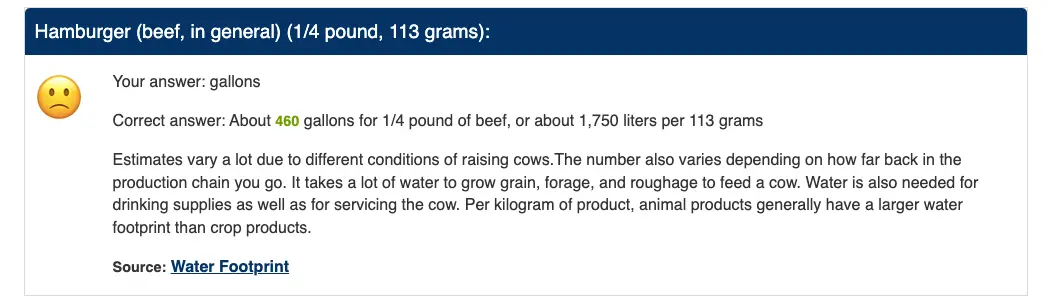
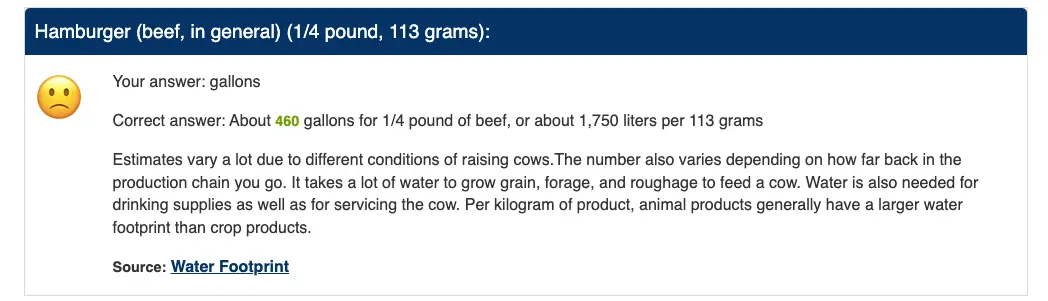
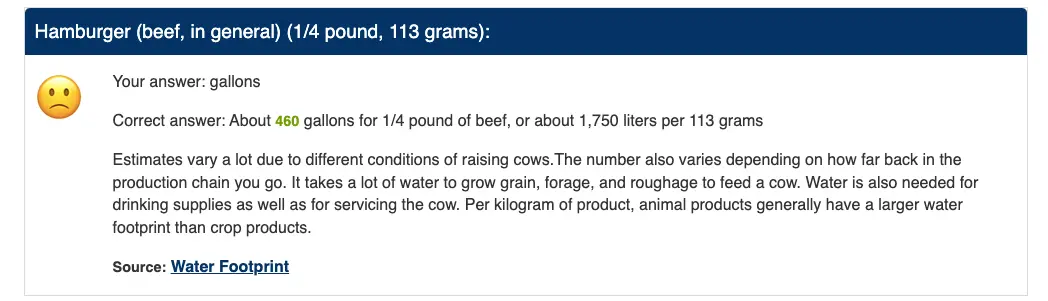
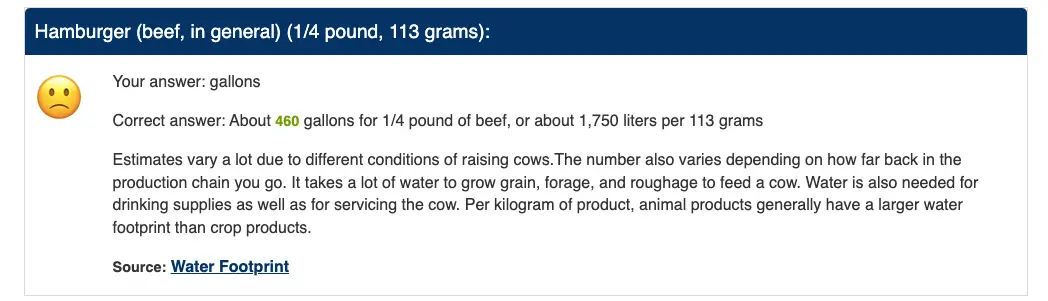
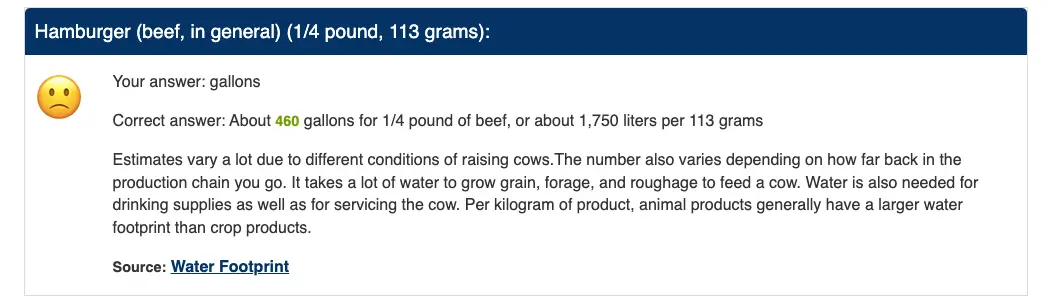
However, when this figure is juxtaposed against the USGS food impact calculator metrics, the limitations of bathroom-focused conservation become apparent. The USGS data reveals that producing a single quarter-pound of beef requires approximately 460 gallons of water. Scaled up to a full pound, the water footprint of beef skyrockets to a staggering 1,840 gallons.
+-------------------------------------------------------------------+
|                THE WATER FOOTPRINT OF BEEF PRODUCTION             |
|                                                                   |
|  1/4 Pound of Beef = 460 gallons of water                         |
|  1 Full Pound of Beef = 1,840 gallons of water                    |
+-------------------------------------------------------------------+
The implications of these metrics are eye-opening. Consuming a single pound of beef incurs a water footprint that effectively neutralizes an entire year’s worth of two-minute daily shower reductions.
Expressed differently, using a traditional 2.5-gallon-per-minute showerhead, an individual would need to endure 736 cumulative minutes of showering—equivalent to over 12 hours of continuous water flow—to equal the water expended in the production of just one pound of beef. Consumers are thus offered a choice: take a twelve-hour shower, or eat a pound of beef, and consume the exact same volume of Earth’s freshwater resources.
Official Responses
Environmental scientists, agricultural economists, and sustainability advocates have increasingly spoken out regarding the messaging disconnect in public conservation campaigns.

"We are all about saving the planet, but doing so without it ever feeling like a sacrifice," notes eco-entrepreneur and sustainability author Scott Cooney. Reflecting on his own experience with the USGS food impact calculator, Cooney admits, "I took the quiz and really didn’t do well—I grossly underestimated the water impact of some foods, in particular beef and chicken."
For years, municipal governments and water authorities have targeted residential end-users with restrictions on lawn watering, car washing, and indoor plumbing retrofits. While these policies are essential for managing municipal infrastructure and local watershed stress, water policy experts argue that public education campaigns have historically neglected the systemic impact of dietary choices.
Agricultural water use accounts for roughly 70 percent of global freshwater withdrawals. Industry analysts suggest that shifting public awareness toward the virtual water embedded in food products can achieve exponentially higher conservation yields without demanding lifestyle changes that alienate the average consumer.
Implications
The realization that dietary choices outweigh direct domestic habits carries profound implications for the future of environmental advocacy, consumer behavior, and public policy.

1. Rebranding Sustainability
If conservation is framed primarily as a series of constant personal sacrifices—shorter showers, colder water, restricted living standards—public adoption will inevitably stall. Conversely, when messaging directs consumers toward high-impact, low-friction adjustments—such as reducing meat consumption or substituting alternative proteins a few days a week—individuals can achieve massive environmental benefits while maintaining their quality of life.
2. Shifting Focus to Agricultural Transparency
Addressing the global water crisis requires structural reforms in agricultural practices, supply chain transparency, and consumer education. Rather than placing the burden entirely on residential water meters, policymakers must encourage sustainable farming techniques, improved irrigation efficiencies, and the commercial growth of lower-impact food systems.
3. Empowering the Individual
Ultimately, modern sustainability tools like the USGS water calculator empower consumers to make informed, high-leverage decisions. By understanding that a single dietary modification can accomplish more than months of daily domestic self-denial, individuals can approach environmental stewardship with greater clarity, efficiency, and long-term commitment.
About the Author
Scott Cooney is a serial eco-entrepreneur, the solo founder of Pono Home, HomeEfficiency.com, and CleanTechnica, and the author of two books on sustainable living. A former sustainability consultant for major corporations including Wal-Mart, Johnson & Johnson, Eastman Chemical, and Duke Energy, Cooney has also served as an adjunct professor teaching the first course in sustainable business within the MBA program at UH Manoa. He is an advocate for local, healthy food systems and plant-based nutrition.