By Global Science & Culture Desk
For millennia, long before the advent of digital notifications, pocket-sized smartphones, or standardized Gregorian calendars, humanity looked to the night sky to make sense of the passage of time. Across North America, Indigenous nations established sophisticated timekeeping systems that intertwined the earth’s seasonal shifts with the lunar cycle. Far from being mere poetic decorations, names assigned to the full moons served as vital ecological guides—reminders of when to harvest wild rice, when to prepare for the bitter grip of winter, and when to expect the earth to thaw.
Today, while mainstream society relies on solar calendars and automated weather apps, the traditional names of the full moons persist in popular culture, almanacs, and astronomical guides. However, behind monikers like the "Wolf Moon," the "Strawberry Moon," and the "Beaver Moon" lies a deep reservoir of Indigenous wisdom, intricate environmental observation, and a complex history of cross-cultural adaptation between Native nations and European settlers.
1. Main Facts: The Intersection of Astronomy, Ecology, and Culture
At its core, the traditional naming of full moons is an exercise in ecological literacy. Indigenous communities across North America did not view the cosmos as separate from the terrestrial world. In Anishinaabe tradition, for instance, Nookomis Dibik-Giizis (Grandmother Moon) is considered a primary teacher, governing the rhythms of water, plant growth, and animal behavior.
The most widely recognized full moon names used in contemporary Western society stem primarily from the Algonquian language family, whose historic territories stretched from New England to Lake Superior. Prominent among them are the Ojibwe (Chippewa) people, one of the largest Algonquian-speaking nations in the Great Lakes region. Their culture was—and remains—intimately tied to seasonal markers such as copper mining and trade, birchbark harvesting, and the meticulous gathering of maple syrup and wild rice.
Unlike the fixed, standardized months of the Julian or Gregorian systems, Indigenous lunar calendars were remarkably flexible. While some tribes tracked years comprising 12 moons, others incorporated 13, and some cultures measured time through four or even five distinct seasons. This fluidity allowed different communities to adapt their timekeeping directly to the realities of their specific local environments.
2. Chronology of the Lunar Year: A Seasonal Journey
To understand the rhythm of a traditional lunar calendar, one must trace the cycle from the dead of winter through the explosion of summer abundance and back to the quiet preparation of late autumn.
Winter Moons: Survival, Endurance, and Scarcity
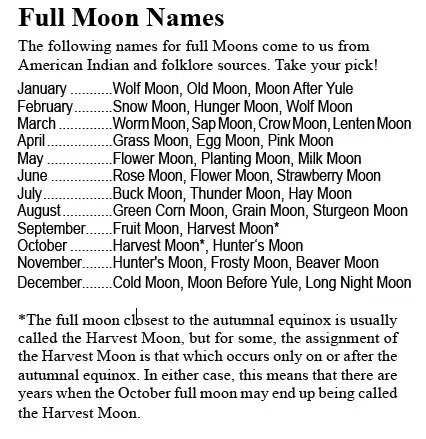
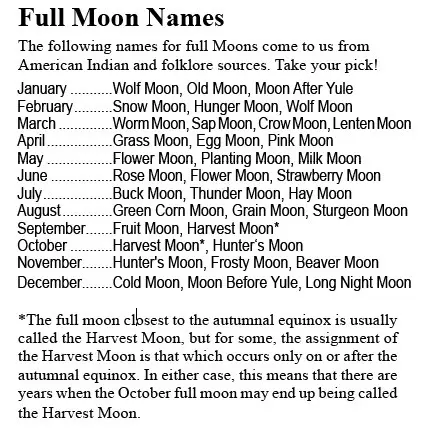
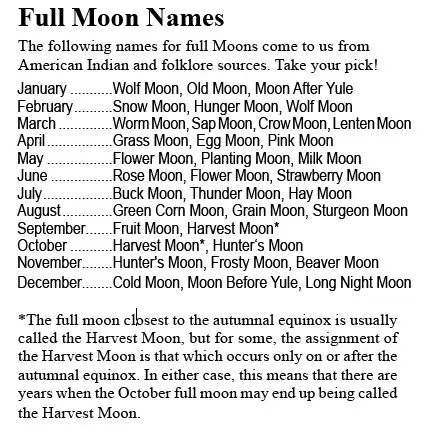
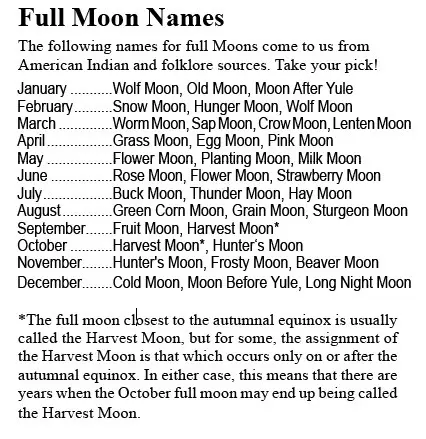
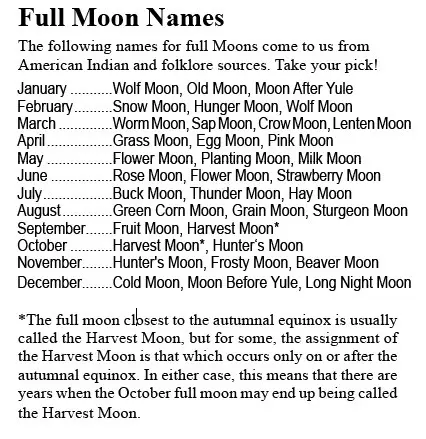
- January – Wolf Moon: Often associated with the howling of hungry packs echoing through midwinter nights, this name carries both Celtic/Old English roots brought by European settlers and Indigenous equivalents like the "Severe Moon" or "Center Moon," highlighting the stark realities of January survival.
- February – Snow Moon / Hunger Moon: Marking winter’s peak intensity, this moon reflected deep scarcity. While some tribes termed it the "Hunger Moon" due to depleted food stores, others called it the "Bear Moon" to mark the birth of bear cubs, or named it after the sucker fish—a crucial winter resource for the Ojibwe.
Spring Moons: Renewal, Thaw, and Awakening
- March – Worm Moon: As the ground softens and earthworm casts reappear, signaling the return of robins, northern tribes historically knew this as the "Crow Moon" (marked by the cawing of returning crows), the "Snow Crust Moon," or the "Sap and Sugar Moon."
- April – Pink Moon: Named for the wild ground phlox (Phlox subulata) that paints North American fields pink in early spring. The Ojibwe traditionally observed this as the maple sap boiling moon, while other nations called it the "Breaking Ice Moon" or "The Moon of the Red Grass Appearing."
Summer Moons: Abundance, Harvest, and Activity
- May – Flower Moon: Symbolizing the height of spring vitality, this moon celebrated blooming flora and signaled the ideal window for planting corn.
- June – Strawberry Moon: A widely shared marker indicating that wild strawberries were ripe for picking. Coastal tribes often called this the "Fish Moon," noting when shad began swimming upstream.
- July – Buck Moon / Thunder Moon: Named because male deer (bucks) grow their antlers at full capacity during this month. Frequent summer thunderstorms also earned it the "Thunder Moon" title.
- August – Sturgeon Moon / Rice Moon: For Great Lakes tribes, this moon marked the peak catch of sturgeon. Crucially, for the Anishinaabe, it announced Manoomini-giizis—the sacred season for harvesting wild rice.
Autumn Moons: Gathering and Preparation
- September – Harvest Moon: Closest to the autumnal equinox, this moon illuminated the fields as communities gathered staple crops like corn, beans, squash, pumpkins, and wild rice.
- October – Hunter’s Moon: With fields cleared of crops and deciduous trees dropping their leaves, game animals were easily spotted and fattened for winter, making this the prime hunting window.
- November – Beaver Moon: Signaled the time to set beaver traps before swamps froze to secure warm winter pelts, or marked the period when beavers actively reinforced their lodges.
- December – Cold Moon / Long Night Moon: Characterized by heavy snowfalls, frigid temperatures, and deep winter darkness, making hunting extraordinarily difficult.
3. Supporting Data: Tribal Diversity and Regional Variation
It is a common misconception that a single standardized set of moon names applied uniformly across North America. With more than 576 federally recognized tribes in the United States alone—along with numerous First Nations across Canada—the diversity of lunar nomenclature is vast.

Climate differences played a decisive role. For instance, a tribe in southeastern Ontario experienced spring thaws weeks earlier than a community in North Dakota. Consequently, their respective "Breaking Ice" or "Sap" moons fell at different times.
Furthermore, European settlers introduced their own historical traditions, blending them with Indigenous practices. Medieval European cultures contributed names like the "Mead Moon" (July), "Grain Moon" (August), and "Barley Moon" (September), demonstrating that agrarian societies worldwide independently developed parallel methods for tracking seasonal agricultural milestones through celestial observation.
4. Official Responses and Modern Perspectives on Cultural Preservation
As awareness of Indigenous history grows, cultural historians, environmentalists, and tribal leaders have emphasized the need to approach traditional moon names with rigorous respect and accuracy.
Organizations such as the Smithsonian National Museum of the American Indian and various tribal historic preservation offices point out that using these names without context can inadvertently strip them of their cultural depth. In recent years, public institutions and science educators have made concerted efforts to credit specific nations—such as the Ojibwe, Cree, and Cherokee—when discussing the origins of lunar terminology.
Moreover, Indigenous environmental scientists note that traditional lunar calendars are not historical artifacts; they are living systems. In an era defined by rapid climate change, many tribal communities are observing shifts in animal migrations, plant budding, and ice formation that disrupt traditional temporal markers. Just as their ancestors adapted their calendars centuries ago, modern Indigenous communities are actively studying these ecological shifts to preserve ancestral knowledge for future generations.
5. Implications: Reconnecting with the Environment in the Digital Age
The enduring popularity of terms like "Wolf Moon" or "Harvest Moon" points to a deeper human desire to remain connected to natural cycles. In a modern society dominated by artificial lighting, concrete environments, and constant digital stimulation, paying attention to the lunar cycle offers a grounding counterbalance.
How Contemporary Nature Enthusiasts Can Honor Lunar Wisdom:
- Adopt Observational Timekeeping: Step outside during a full moon to notice what is happening in your local ecosystem—are trees shedding leaves? Are local birds migrating?
- Research Local Tribal Territories: Acknowledge the specific Indigenous nations whose ancestral lands you inhabit, and seek out their distinct regional names and stories associated with the moon.
- Recognize Ecological Interconnectedness: Understand that the moon names are data points representing the delicate balance of flora, fauna, and weather patterns.
Conclusion: Honoring a Living Legacy
The full moon names we celebrate today are far more than poetic, whimsical labels. They represent a sophisticated, empirically tested system of ecological knowledge, climate tracking, and cultural wisdom cultivated by Indigenous peoples over thousands of years.
By understanding their complex origins, respecting their tribal diversity, and applying their underlying philosophy of environmental attentiveness, modern stargazers can forge a deeper, more meaningful connection with both the cosmos above and the rich heritage of the Indigenous stewards who first mapped the skies.