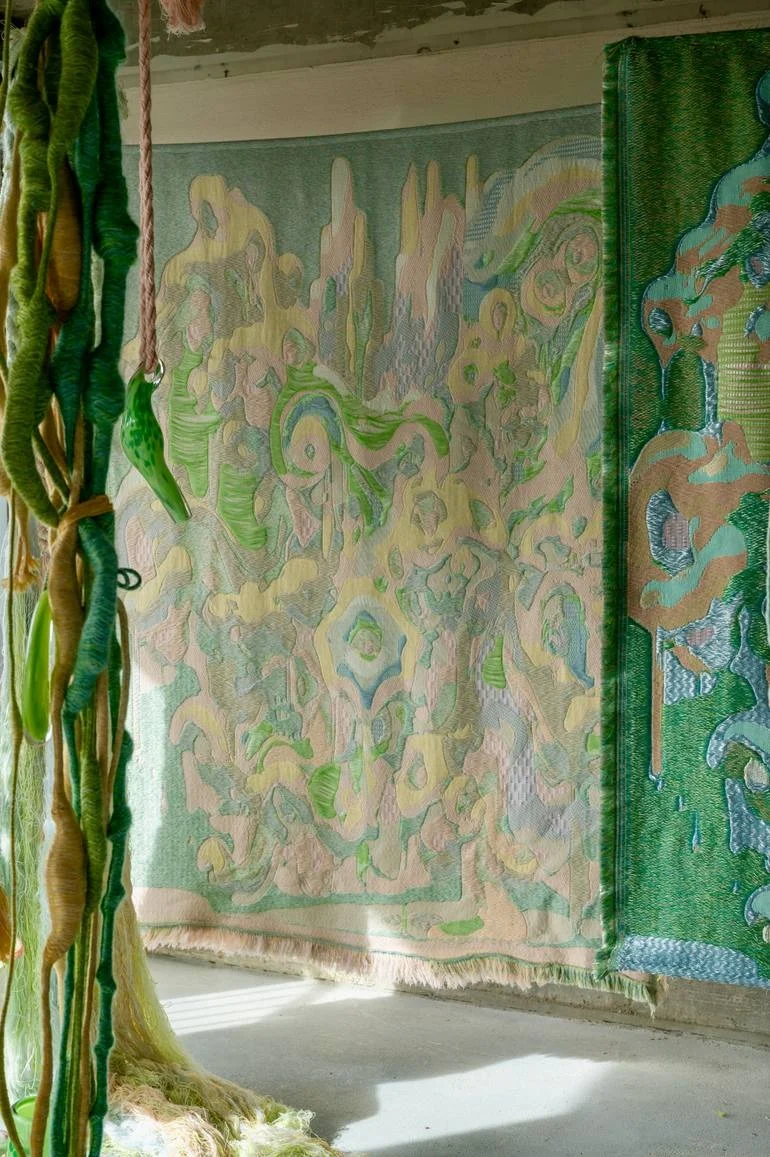
AMSTERDAM — In an era dominated by flat screens, algorithmic feeds, and a hyper-accelerated visual culture that often leaves audiences feeling emotionally detached, Dutch contemporary artist Sandra Keja Planken is carving out a profound counter-narrative. Operating at the ambiguous intersection of organism and object, Planken creates immersive installations, woven textile sculptures, and glass works that pulse with a visceral, almost biological energy. Her art does not merely demand to be looked at; it demands to be felt, inhabited, and experienced as a living ecosystem.
From her base in the Netherlands, Planken has spent years developing a singular artistic vocabulary that dissolves the boundaries between soft and hard, interior and exterior, human memory and ecological persistence. Her creations—ranging from shimmering, hyper-textured tapestries to rigid glass forms that somehow appear malleable—defy easy categorization, positioning her at the vanguard of contemporary sensory and sustainable art.
Main Facts
- Artist: Sandra Keja Planken
- Base: The Netherlands
- Primary Mediums: Recycled textiles, glass, mixed fibers, and immersive spatial installations
- Core Philosophy: Reconnecting contemporary society to tactility, emotional depth, and ecological awareness through material presence.
- Signature Project: Weaves of Saltwater Dreams, a coral-inspired art installation created in collaboration with ValorosaViva and showcased at BIG ART Amsterdam.
- Scientific & Ecological Collaboration: Partnering with the Branch Foundation and Wageningen University under the umbrella of her ongoing creative universe, Nature’s Visual Sound, to grow heat-resilient algae and corals on specialized glass and textile seabed structures.
- Philanthropic Initiative: Ten percent of the proceeds from every artwork acquisition go directly toward funding her underwater reef restoration and art projects.
Chronology: The Evolution of a Sensorial Practice
Early Sensitivities and Cultural Roots
Planken’s artistic sensibility was forged in her formative years, shaped by a unique cultural duality. Growing up navigating the emotional openness of Spanish culture alongside the structural restraint of Northern Europe, she developed an acute, lifelong awareness of spatial atmospheres. She noticed early on that certain environments vibrate with life and emotional resonance, while others feel stark, alienated, and strangely absent.
This sensitivity became the foundational question of her artistic journey: How can spaces and materials be made to feel alive?
The Textural Threshold
She initially gravitated toward textiles because of the medium’s profound tactility and innate emotional presence. Threads, knots, and woven structures carry an almost human vulnerability. Over time, Planken’s practice expanded organically—moving outward from intimate objects into monumental sculptures, and ultimately into total, immersive spatial environments that engulf the viewer.

The Introduction of Glass
As her conceptual framework matured, glass entered her practice as a counterpoint to the softness of fiber. Seeking a material that could capture fragility, spatial reflection, and the sensation of suspended light, she began experimenting with the tension between the two elements. Through rigorous trial and error, Planken learned to dissolve the traditional boundaries between softness and hardness, transforming inanimate substances into responsive, organism-like entities.
Ecological Awakening and Scientific Intersection
In recent years, the natural world—specifically fragile coral ecosystems and the mechanics of ecological transformation—has become a central pillar of her work. This evolution culminated in her ongoing initiative, Nature’s Visual Sound, where her studio practice directly intersects with marine science and ecological activism.
Supporting Data and Creative Process
Planken’s creative methodology is fundamentally intuitive, bypassing rigid preliminary blueprints in favor of a dynamic dialogue with her materials.
Observation and Materiality
Her process begins with deep, contemplative observation. Fragments of the everyday world—light dancing across water, underwater currents, blooming flora, discarded seaweed, and the subtle emotional tensions hidden within architectural spaces—serve as conceptual catalysts.
- Textiles as Emotion: Utilizing woven fibers, recycled wools, and mixed media, she invites physical closeness. The tactile nature of her tapestries disarms the viewer, encouraging a sense of vulnerability and haptic exploration.
- Glass as Light: Glass introduces an architectural dialogue regarding fragility and transparency. Planken expertly manipulates the material so that it paradoxically appears soft, bending light in ways that challenge our physical assumptions.
- Layered Accumulation: Works are constructed layer by layer through accumulation and material transformation. Light acts as the final, living collaborator, shifting the mood and atmosphere of the installations dynamically across different times of day and viewing angles.
The Anatomy of a Masterpiece: Weaves of Saltwater Dreams
Nowhere is Planken’s mastery more evident than in Weaves of Saltwater Dreams, her celebrated coral installation presented at BIG ART Amsterdam in collaboration with ValorosaViva.

The piece features a monumental woven tapestry in rich, oceanic hues of green, cream, copper, and teal. It unfurls across the gallery space like an otherworldly submarine cartography—simultaneously resembling a living coral reef and a waking dream. Thick, tactile ropes cascade alongside the main structure, elongating into organic, sea-creature silhouettes that shimmer under ambient light.
Crucially, the sustainability ethos behind the work is absolute. Every yarn utilized is either recycled or donated—sourced from discarded wardrobes and forgotten industrial stock—and systematically reborn as complex coral topography.
Official Perspectives: In the Artist’s Own Words
To understand Planken’s work is to understand her critique of modern speed, digital saturation, and artistic commodification. In a rare statement on her philosophy, the artist reflects on the invisible labor and emotional stakes of contemporary creation:
"I wish more people understood that being an artist is not only about creating objects, but about learning how to remain deeply sensitive within a world that constantly pushes towards speed, distraction, and sameness. Most artworks are built through years of experimentation, doubt, observation, and invisible labor. The final piece often carries countless emotional and material decisions that are never immediately visible on the surface."
Expanding on the societal function of art, Planken emphasizes the necessity of cultivating imagination over algorithmic homogenization:

"I also believe artists help create emotional and cultural space within society. Art can slow people down, reconnect them to wonder, and allow them to experience the world differently for a moment. In a time where so much becomes flattened into fast images and algorithms, I think sensitivity and imagination become increasingly important."
Implications: Art as an Active Ecological Agent
Planken’s practice transcends the traditional confines of gallery walls, pushing into the realm of active environmental stewardship. Through her ongoing partnership with the Branch Foundation and Wageningen University, she is actively engaged in scientific field trials. By utilizing specialized glass and textile structures designed as temporary seabed habitats, her studio is assisting in the cultivation of heat-resilient algae and coral restoration.
This pragmatic integration of art and science redefines the role of the contemporary creative. Planken avoids heavy-handed, didactic environmentalism. Instead, her work operates on a psychological level: it makes the viewer feel wonder and emotional connection first, allowing cognitive care and ecological responsibility to follow naturally.
Acquisition and Impact
For collectors and institutions engaging with her work—such as her major wool sculpture measuring 55 W x 40 H x 2 D inches, constructed from mixed fibers and variable dimensions—the transaction carries a deeper resonance. By design, 10% of every acquisition goes directly to funding her underwater reef art and restoration projects, cementing a direct, material link between the collector’s living space and the regeneration of marine ecosystems.
Ultimately, Sandra Keja Planken’s work offers a vital antidote to our hyper-digitized age. By fusing high-concept tactile sculpture with genuine marine conservation, she proves that art can be both a sanctuary for human emotion and a tangible instrument for planetary healing.