There is a distinct, fleeting moment that Los Angeles-based sculptural artist Katrien Van der Schueren chases in her sprawling, dust-dusted workspace—not when a piece is officially declared finished, but the precise second it arrives. It is the instant a creation steps into being, transforming into a version of itself. It is never meant to be the definitive, singular version, but rather the one that exists for now, holding space in the physical world.
This philosophy captures the most honest reality an artist can confess about their creative practice. It acknowledges that creation is not a static destination, but an ongoing dialogue between maker and matter. And it serves as the foundational ethos behind every heavy, poetic object that leaves her studio.
Main Facts: The Industrial Feminine
Katrien Van der Schueren works extensively in materials that have, by conventional design standards, no business feeling delicate. Her medium palette reads like an industrial inventory list: raw wood, heavy metal, structural plaster, bio-resin, and industrial concrete. Yet, through an alchemy of intuition and technical mastery, she transforms these rigid, unyielding elements into forms that are entirely, unmistakably feminine and deeply poetic.

A persistent tension anchors everything Van der Schueren creates. It lives in the friction between the immense weight of her materials and the astonishing lightness of her silhouettes, and in the clash between the industrial and the intimate. That friction is not a byproduct of her work; it is the entire point.
- Primary Mediums: Concrete, metal, wood, plaster, and bio-resin.
- Signature Aesthetics: Industrial materials subverted into delicate, fluid, and feminine forms; striking contrasts of weight and lightness.
- Notable Works: The Gold Mural Fireplace and the celebrated Envelope Sconce.
- Base of Operations: Los Angeles, California.
Chronology: The Evolution of a Practice
While Van der Schueren’s path as a sculptural artist has deep roots in her relationship with her physical environment, her practice has evolved through distinct phases of material exploration and intuitive surrender.
Phase One: The Gathering of Influences
Long before specific pieces take shape, Van der Schueren’s process begins with total immersion. Operating under the belief that nothing is ever made in a vacuum, her early creative periods are defined by observation. Everything she experiences—from the socio-cultural shifts in the wider world to the intimate surroundings she curates—finds a subtle, subconscious way into her sculptural work.

Phase Two: Entering the Studio and the State of Obsession
Once the conceptual groundwork is laid, the timeline shifts into a realm where chronological time completely dissolves. Describing her creative windows, Van der Schueren notes how standard markers of time vanish. Tuesdays and Wednesdays blur together inside an all-consuming creative bubble. It is an intense, obsessive cycle where she cannot stop thinking about a piece, living in a state of continuous, active fixation until the physical object aligns with her inner vision.
Phase Three: Commercial and Residential Integration
In recent years, Van der Schueren’s work has transitioned from purely experimental sculptural objects to highly sought-after functional art pieces. Her wall sconces, vessels, and architectural installations have found permanent homes in high-end residential and commercial interiors across Los Angeles and international design markets, specified by interior architects who recognize the rare power of her creations.
Supporting Data: Anatomy of the Envelope Sconce
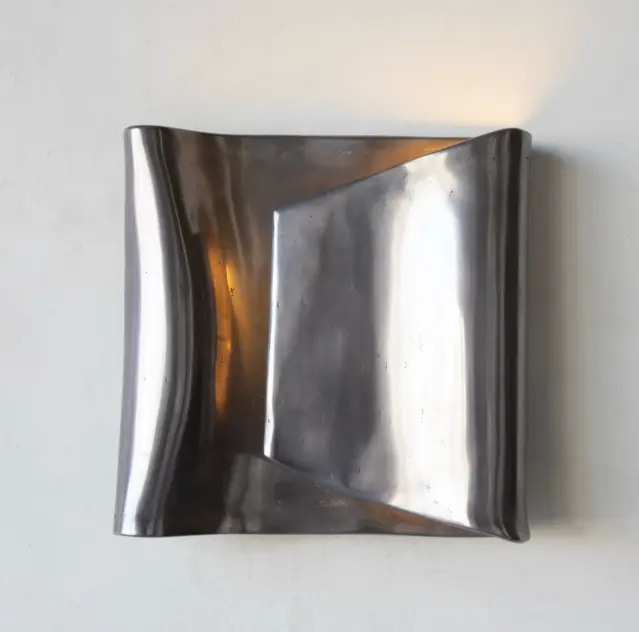
To truly understand Van der Schueren’s methodology, one need only look at her standout creation: The Envelope Sconce. Featured prominently in the ongoing Studio Visit editorial series by Roomhints, this piece encapsulates her entire design philosophy into a single object.

+-------------------------------------------------------------+
|                   THE ENVELOPE SCONCE                       |
+-------------------------------------------------------------+
| Dimensions  : 12 × 12 inches                                |
| Base Material: Industrial Concrete                          |
| Finishes    : Cold-applied liquid bronze tin & white bronze |
| Form Factor : Folded wall light mimicking soft paper        |
| Lighting    : Dynamic interaction with natural diurnal light|
+-------------------------------------------------------------+
Measuring a modest 12 by 12 inches, the Envelope Sconce is crafted from concrete—a notoriously rigid, brutalist substance—yet it appears to have been delicately folded by hand, as if a sheet of paper had been creased and pinned to the wall.
The application of a cold-applied liquid bronze tin and white bronze finish creates a dynamic surface that actively shifts throughout the day. Morning light catches the metallic undertones differently than the deep, moody shadows cast during evening hours. It is an object engineered not to blend quietly into the background, but to command a room through subtlety rather than volume.
Official Perspectives: On Surrender and Collaboration
When asked about her creative formula, Van der Schueren resists traditional categorization, offering instead a deeply psychological view of art-making.

“Sculpting, to me, is very much an intuitive process. Almost subconscious, really. I can think about a piece, and what I want to make, but it’s only once I start playing with the materials, shaping, adding, removing… that it becomes clear what the piece needs to be. And mostly, the only thing I can do is to surrender to that process.”
This perspective diverges sharply from industrial manufacturing or mass-production mentalities. It is an act of listening rather than imposing. Rather than forcing concrete to mimic something it is not, Van der Schueren coaxes out its inherent character, allowing the material to look as though it were always meant to assume that exact geometry.
She describes her relationship with her work in intensely personal terms:

“It’s an amazing, wonderful love affair. And it’s also very much… an obsession. You’re in this bubble. Time dissolves. There is no Tuesday, Wednesday. You’re just obsessed. You can’t stop thinking about the piece.”
This uncompromising standard has earned her the respect of top-tier interior designers. In the elite tiers of spatial design, Van der Schueren’s work occupies a scarce category: pieces that elevate everything in their immediate vicinity without competing for dominance. They do not shout; they hold the room.
Implications: The Future of Functional Art in Interior Design
The growing demand for Katrien Van der Schueren’s sculptures and lighting objects signals a broader shift in contemporary interior architecture. As modern spaces increasingly lean toward minimalist palettes, sterile finishes, and mass-market uniformity, there is a fierce counter-movement valuing raw, tactile authenticity.

1. The Rejection of the "Assembled" Room
Designers are moving away from spaces curated simply by checking items off a generic shopping list. Instead, homes and commercial venues are being built around emotional resonance—spaces that require deep, obsessive thought. Van der Schueren’s pieces, which change character as the natural light shifts throughout the day, anchor these intentional rooms, giving them a living pulse.
2. The Elevation of Industrial Subversion
By forcing industrial materials like concrete and structural steel to behave with organic, feminine grace, Van der Schueren challenges traditional boundaries between fine art and functional design. This blurs the line for collectors and investors, who increasingly view high-end architectural lighting and wall sconces not merely as utilities, but as investment-grade sculptures.
3. Direct Studio Engagement
Reflecting the exclusivity of her practice, Van der Schueren’s work remains intentionally removed from mass retail channels. Collectors and interior designers must engage directly with her Los Angeles studio or follow her active documentation via Instagram (@katrienscult) to commission pieces. This direct-to-artisan model preserves the integrity of the work, ensuring that every piece retains the intimate, obsessive energy born inside her studio’s working walls.