Main Facts: The Intersection of Design, Emotion, and Woodcraft
In the contemporary landscape of high-end interior design, mass production often dominates the commercial market, prioritizing speed and scalability over narrative and soul. Yet, a counter-movement is quietly taking root in the rugged terrain of the American Rocky Mountains. Studio Becker, founded by furniture maker and designer Coulton Becker, represents a deliberate rejection of disposable culture. Based in Breckenridge, Colorado, the independent furniture studio specializes in bespoke, handcrafted pieces fashioned exclusively from premium hardwoods such as walnut, white oak, and maple.
At the core of Studio Becker’s operational ethos is a philosophy that blurs the line between the tangible and the intangible. Becker does not merely construct functional objects for daily use; rather, he builds physical vessels meant to encapsulate memories, emotions, and personal narratives. Characterized by clean lines, natural materials, and meticulous hand-woven Danish cord detailing, the studio’s collection speaks a quiet, confident design language. Each piece is individually handcrafted, ensuring that no two items are identical, and functions as both a utilitarian object and an anchor that fundamentally transforms the spatial dynamics of a room.
Chronology: From Personal Loss to Mountain Craft
To understand the foundational philosophy of Studio Becker, one must trace the personal and professional timeline of its creator. The journey of Coulton Becker did not begin in a traditional woodworking shop, but rather in the crucible of profound personal transformation.
Formative Years and the Turning Point (1999–2019)
During his sophomore year at the University of Missouri, where he was studying architecture and interior design, twenty-year-old Becker faced a life-altering tragedy: the unexpected death of his father. Grappling with a grief that defied standard articulation, Becker turned to the methodologies of his discipline. Designers solve problems by creating; Becker decided to build.

He designed and constructed a large-scale memorial titled Fluss Ewig—German for "constantly changing." Having never worked on a project of that magnitude previously, the construction process served as a visceral, therapeutic outlet. Upon stepping back to view the completed memorial, a profound clarity emerged. As Becker reflects, "The moment I took a step back from the completed memorial, I realized my passion for design and woodcraft." That single act of creation laid the conceptual cornerstone for everything that followed.
Professional Beginnings and the Pandemic Pivot (2019–2020)
Following his graduation in 2019, Becker secured a position designing luxury mountain homes in Frisco, Colorado. On paper, it was a prestigious start—a stable career path aligning perfectly with his formal education in interior architecture. However, the onset of the global COVID-19 pandemic in early 2020 triggered a dramatic shift in perspective.
The unprecedented disruption of daily life collapsed the distance between the work Becker was performing to build a resume and the work he felt compelled to execute. He turned to wood not as a casual pastime, but as a rigorous daily practice. In the middle of global uncertainty, Studio Becker was officially founded in 2020—an appropriately honest context for a brand centered on the idea that physical objects can and should carry deep emotional resonance.
Evolution and Relocation (2020–Present)
To properly hone his technical skills and develop his unique craft, Becker relocated to Kansas City, immersing himself in traditional woodworking techniques. After refining his practice, he returned to Colorado, eventually settling his permanent workshop in Breckenridge in 2025. Over these years, the work evolved: it became quieter, more specific, and deeply aligned with his signature aesthetic—marrying architectural precision with tactile warmth.

Supporting Data: The Anatomy of Studio Becker and the Una Bench
Studio Becker operates on a bespoke model, focusing on uncompromising material selection and meticulous hand-assembly. The studio’s technical and commercial profile highlights a commitment to slow, intentional craftsmanship:
- Founding Year: 2020
- Current Headquarters: Breckenridge, Colorado
- Primary Materials: Premium North American hardwoods (Walnut, White Oak, Maple) paired with hand-woven Danish cord.
- Production Model: 100% handmade, non-mass-produced, individual builds with bespoke customization available upon direct client or designer commission.
The Spotlight Piece: The Una Bench
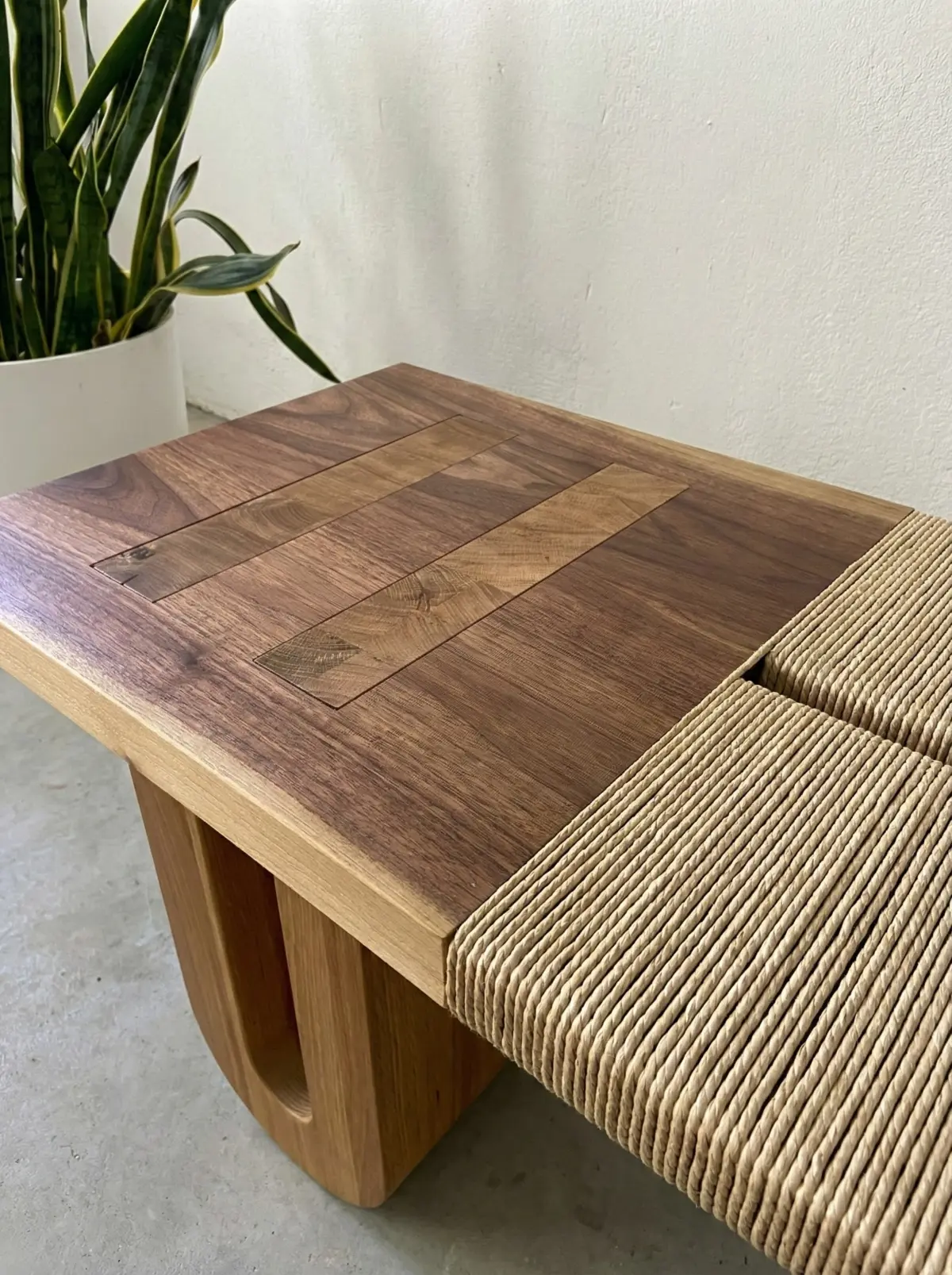
Within Studio Becker’s curated catalog, one piece stands out as a definitive expression of the brand’s identity: the Una Bench. Featured prominently in editorial reviews and interior design roundups, the bench exemplifies the studio’s mastery of proportion and texture.
- Price Point: $4,600
- Dimensions: 60 inches (Length) x 16 inches (Width) x 18 inches (Height)
- Materials: Premium Hardwood frame with hand-wrapped Danish cord seating surface.
The Una Bench is engineered to occupy spaces with subtle authority. At sixty inches long and standing eighteen inches off the ground, its silhouette is minimal enough to seamlessly integrate into various environments—whether functioning as an anchor at the foot of a king-sized bed, softening a long hallway, or grounding an expansive living room layout. The intricate weaving of the Danish cord provides both ergonomic resilience and a rich, textural contrast to the smooth, finished grain of the underlying hardwood frame.
Official Responses and Design Philosophy
The philosophical underpinnings of Studio Becker are articulated clearly through the creator’s own design principles. Rather than chasing fleeting interior design trends, Becker focuses on the psychological relationship between human beings and their living spaces.

In statements regarding his creative process, Becker emphasizes the intrinsic emotional value embedded within material culture:
"Physical objects often have a meaning and emotion associated with them, and that’s what I aim to instill in every piece I work on."
This perspective has garnered attention from architectural publications and editorial curators alike. Industry observers note that Becker’s background in architecture heavily influences his furniture design. Every stool, bench, and table is conceived not as a standalone item, but as an integral structural and emotional component of a larger spatial narrative. By collaborating directly with interior designers and private clients on custom commissions, Studio Becker ensures that each piece is tailored to the specific lived experiences of the end user.
Implications: The Shift Toward Slow Design and Emotional Longevity
The rise of independent, hyper-local makers like Coulton Becker signals broader cultural and economic implications for the global furniture and interior design industries.

1. The Counter-Movement Against Fast Furniture
For decades, the consumer market has been saturated with flat-pack, mass-produced furniture designed for short life cycles and rapid disposal. Studios like Becker’s represent a decisive pushback—a "slow design" movement that prioritizes generational durability. By utilizing premium hardwoods that develop a natural patina over decades of use, Studio Becker aligns with sustainability goals not through buzzwords, but through physical longevity. When an object is built to last fifty years and carries deep sentimental value, the incentive for premature replacement vanishes.
2. The Revitalization of Regional Craftsmanship
The geographic trajectory of Studio Becker—moving from Missouri to Kansas City, and ultimately establishing roots in the high-altitude environment of Breckenridge, Colorado—illustrates a decentralization of the design world. High-end custom furniture is no longer confined exclusively to coastal metropolises like New York or Los Angeles. Mountain communities and regional hubs are increasingly becoming incubators for innovative, tactile craftsmanship, driven by designers seeking connection to nature and space.
3. The Psychology of Residential Spaces
As remote work and urban density shift how people view their domestic environments, the demand for emotionally resonant interiors has spiked. Consumers are no longer satisfied with filling rooms with generic catalog items; they seek items that tell a story. Studio Becker’s focus on embedding intangible narratives into tangible wooden forms directly addresses this psychological need. In an increasingly digital world, the physical weight, smell, and warmth of a hand-crafted walnut bench wrapped in Danish cord offer a grounding counter-weight.
Through meticulous attention to detail, a refusal to compromise on materials, and a deeply personal design origin story, Coulton and Studio Becker have established a compelling blueprint for the future of modern woodworking—one where every joint, grain, and weave serves as a permanent record of human thought and emotion.