







DÜSSELDORF — In the contemporary landscape of industrial design, objects are frequently treated as canvases. Trends dictate silhouettes, finishes mimic natural patinas, and materials are selected primarily for how they look under the flattering glare of a showroom light or a digital rendering.
Düsseldorf-based Case Studios rejects this superficial paradigm entirely.
At the center of the interdisciplinary studio’s operations is not a distinct aesthetic signature, but a rigorous discipline: a commitment to the intrinsic logic of raw materials. Founded by a collective of creators bridging visual arts and traditional craftsmanship, Case Studios operates across product design, interior architecture, and large-scale artistic installations. Yet, what binds their diverse portfolio is a singular, uncompromising philosophy: design is not about imposing form onto matter, but engaging in a profound dialogue with it.
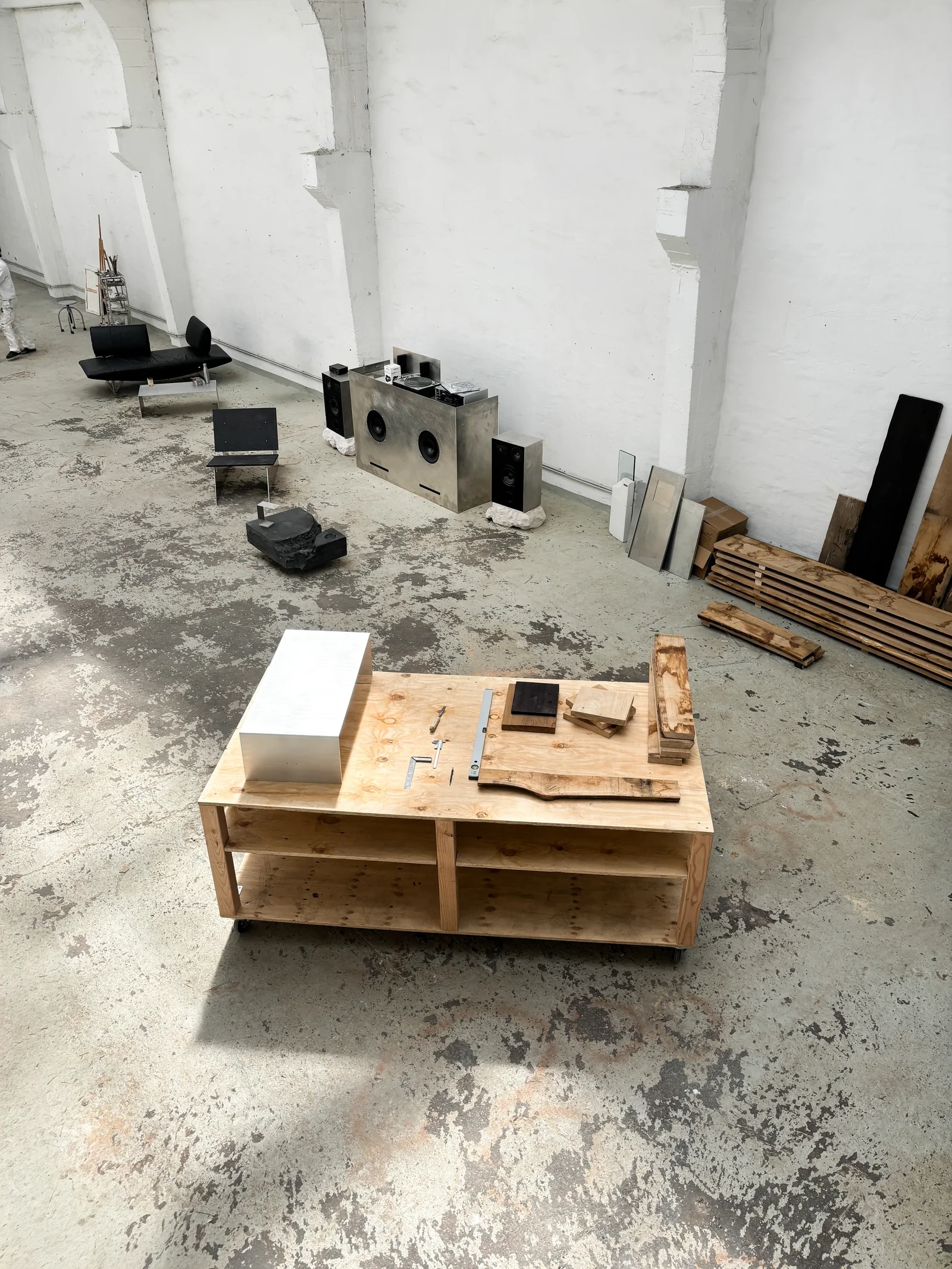
Whether working with raw concrete, hand-polished aluminum, or centuries-old charring techniques, Case Studios selects elements exclusively for what they do, rather than merely how they appear. In an era dominated by mass-produced uniformity, the German studio offers a masterclass in how honoring the structural reality of a medium can yield objects of enduring power.
Main Facts: The Philosophy and Practice of Case Studios
To understand Case Studios, one must invert the traditional design process. Most commercial production begins with an abstract concept—a silhouette or a function—followed by a search for materials that can fulfill that vision. Case Studios reverses the sequence entirely.
The material comes first. Its chemical properties, structural limitations, historical context, and tactile behavior form the baseline of the creative endeavor. The final form emerges organically from that conversation.

- Founding Collective: An interdisciplinary team rooted in visual arts and tactile craftsmanship.
- Base of Operations: Düsseldorf, Germany.
- Core Disciplines: Product design, interior architecture, and spatial artistic installations.
- Signature Palette: Raw concrete, Yakisugi burnt wood, and hand-sanded aluminum.
- Design Tenet: "The deliberate use, selection, and refinement of unique and durable materials create objects that both reshape and highlight the original properties of each material."
The resulting furniture possesses an uncanny sense of inevitability. Looking at a piece by Case Studios, one feels it could not have been manufactured any other way, nor fashioned from any other substance. There is a total absence of excess. Ornamentation is entirely absent because the structure itself provides the decoration. Every visible surface simultaneously serves a structural purpose.
This ethos creates a sharp dividing line between Case Studios and manufacturers who employ compelling materials merely as surface finishes. For the Düsseldorf team, the material is the idea; everything that follows is simply execution.
Chronology: From Ancient Craft to Modern Industrialism
The trajectory of Case Studios is defined by its synthesis of ancient, time-tested methodologies and contemporary industrial techniques.
Roots in Craft and Visual Practice
The studio was established by a coalition of artisans and visual designers seeking an antidote to the ephemeral nature of modern fast-furniture. Rather than succumbing to cyclical design trends, the founders looked backward and forward simultaneously—studying the immutable laws of physics and materials while harnessing modern fabrication precision.
The Integration of Industrial Metals
As the studio expanded its scope from interior architecture to bespoke product design, it began experimenting with cold, rigid industrial mediums. Hand-sanded aluminum became a primary vehicle for exploring reflection, weight, and touch. Unlike machine-brushed metals, hand-sanded surfaces retain micro-variations that record the human labor involved in their creation.
The Convergence of Fire and Metal
The pivotal evolution in the studio’s portfolio occurred when they introduced ancient pyrotechnic wood treatments into dialogue with cold-rolled industrial alloys. By pairing the charred remnants of organic timber with precision-tooled aluminum, Case Studios crystallized its signature aesthetic: a tension between the primal elements of earth and fire, balanced by human intervention.

Supporting Data: Anatomy of the Yakisugi Coffee Table
The studio’s material-first philosophy finds its most compelling physical expression in the Yakisugi Burnt Wood Coffee Table, a flagship piece from the Case Studios Exclusive Line.
+--------------------------------------------------------------------------+
|                  CASE STUDIOS EXCLUSIVE LINE SPECIFICATIONS              |
+--------------------------------------------------------------------------+
| Product Name         | Yakisugi Burnt Wood Coffee Table                  |
+--------------------------------------------------------------------------+
| Dimensions           | 115 cm (Length) x 60 cm (Width) x 30 cm (Height)  |
+--------------------------------------------------------------------------+
| Primary Materials    | Burnt, sealed hardwood & hand-sanded aluminum     |
+--------------------------------------------------------------------------+
| Origin               | Handcrafted in Germany                            |
+--------------------------------------------------------------------------+
| Variability          | Unique; no two pieces are identical               |
+--------------------------------------------------------------------------+
The Science of Yakisugi
At the heart of the table’s design is Yakisugi (焼杉), a traditional Japanese method of preserving wood by charring the surface with fire. Originally developed to increase durability against weather, insects, and decay without chemical treatments, the process physically alters the timber.
Fire burns away the softer cellulose fibers of the wood, leaving behind a dense, highly resilient carbon layer. The resulting surface turns a deep, matte black, developing a rich topography of fine cracks and textures that no artificial paint, stain, or veneer can authentically replicate.
The Dialectic of Contrasts
Case Studios takes this ancient pyro-craft and places it in direct conversation with hand-sanded aluminum. This pairing creates a powerful structural and visual contrast:
- Cold Meets Char: The thermal history of the burnt wood counters the chill of industrial aluminum.
- Organic Meets Precision: The unpredictable, carbonized grain of the timber meets the razor-sharp, hand-finished geometry of metal.
The dimensions of the table—115 by 60 centimeters at a low 30-centimeter height—are deliberately calculated. It is intentionally low and wide, possessing the physical proportions required to anchor a room rather than merely fill space. Because the charring process reacts uniquely to every single board of hardwood, no two tables are identical. The fire acts as an unpredictable co-designer.
Official Perspectives and Studio Philosophy
While Case Studios maintains a deliberately understated public profile, letting the physical objects speak on behalf of the collective, their published manifestos and curatorial notes offer deep insight into their worldview.

In communications accompanying their limited-edition drops, the founders frequently emphasize the psychological weight of physical objects in modern spaces. "When an object hides what it is made of, it creates a subtle disconnection," notes a studio brief from their Düsseldorf atelier. "When an object exposes its logic—showing you why the aluminum is thick, why the wood is charred, why the joint is engineered a certain way—it builds an immediate trust between the user and the space."
Design curators and architectural critics have increasingly taken notice. By refusing to chase consumerist cycles, Case Studios has positioned itself within a broader European movement toward radical materiality—a design philosophy that values longevity, repairability, and raw authenticity over seasonal styling.
Implications: The Future of Material-Driven Design
The approach pioneered by Case Studios carries significant implications for the future trajectories of product design and interior architecture.
1. A Shift Away from Surface Illusionism
For decades, the mainstream furniture industry has relied on synthetic laminates, faux-wood printing, and chemical veneers to simulate durability and luxury. Case Studios demonstrates that modern consumers—particularly in high-end residential and architectural markets—are increasingly drawn to radical transparency. When a material is authentic, its aging process becomes an asset rather than a defect; a scratch on hand-sanded aluminum or a scuff on charred hardwood only adds to the object’s narrative.
2. The Revival of Cross-Disciplinary Craftsmanship
By merging traditional techniques like Yakisugi with contemporary computer-numerical-control (CNC) milling and hand-finishing, the studio highlights a viable economic and artistic model for small-batch ateliers. This hybrid approach ensures that ancient craft traditions do not vanish into museums, but remain active, evolving components of modern functional design.
3. Sustainability Through Longevity
In an era grappling with the environmental toll of fast-furniture, Case Studios’ commitment to indestructible, heavy-duty materials offers a structural solution to sustainability. Objects built from solid concrete, heavy-gauge aluminum, and fire-hardened timber are, by definition, multi-generational. They are designed not for disposal, but for permanence.

Where to Experience Case Studios
For those looking to integrate this uncompromising material philosophy into their own spaces, the studio’s catalog can be explored directly through their primary portal at case-studios.com. Curated highlights and spatial integration concepts are also featured across international design platforms, including a dedicated showcase on Roomhints.
As design culture continues to search for meaning amidst a sea of digital noise, studios like Case Studios prove that the most radical thing a designer can do is simply listen to the material, honor its limitations, and step out of the way.