







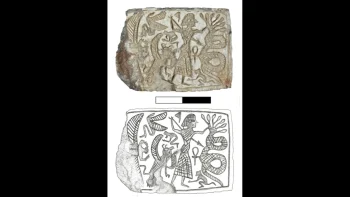
JERUSALEM — Deep within the dusty archives of archaeological history, a microscopic artifact has emerged to challenge our understanding of how ancient mythologies traveled, evolved, and interconnected across the ancient Near East. Measuring barely the size of a modern postage stamp, a 2,800-year-old stone seal recently analyzed by researchers in Israel depicts a scene straight out of modern fantasy: a valiant champion locked in mortal combat with a terrifying, seven-headed serpent.
Far from being a mere decorative trinket, this Iron Age object is prompting a radical reassessment among historians and biblical scholars. Experts suggest it may represent the crucial missing link connecting the chaotic dragon-slaying motifs found in Canaanite lore, the Hebrew Bible, and classical Greek mythology—including the legendary labors of Heracles against the Lernaean Hydra.
Main Facts: The Discovery and Its Iconography
The artifact in question is an Iron Age stamp seal, meticulously carved from soft stone during a period when the Levant was a volatile cultural and geopolitical crossroads between empires. Discovered during excavations in Israel and subjected to advanced imaging techniques by archaeological specialists, the seal reveals a deeply detailed narrative scene.
At the center of the carving stands a human figure—interpreted by archaeologists as a hero, deity, or royal champion—engaged in a fierce struggle. Surrounding or confronting this figure is a monstrous entity boasting not one, but seven distinct serpentine heads. The composition radiates a sense of cosmic dread and ultimate triumph, a visual trope designed to convey the stabilization of order over chaos.
- Age: Approximately 2,800 years old (dating back to the Iron Age II period, roughly the 8th to 7th centuries BCE).
- Medium: A small conical or scaraboid stamp seal, typical of administrative and ritual practices in the ancient Southern Levant.
- Central Imagery: A human warrior/hero confronting a multi-headed serpentine monster.
- Significance: Serves as rare material evidence of a pervasive mythological motif previously known primarily through textual sources rather than visual art from this specific region and era.
The motif of the multi-headed serpent is not isolated; rather, it is a heavyweight champion in the pantheon of ancient Near Eastern comparative mythology. For generations, scholars have traced the literary lineage of storm gods and heroes defeating primordial sea dragons. This seal provides tangible, physical art that bridges the gap between abstract textual references and the shared iconography of the ancient Mediterranean and Mesopotamian worlds.
Chronology: The Evolution of the Serpent-Slayer Trope
To understand why this tiny seal has sent ripples through the academic community, one must trace the deep timeline of the "chaoskampf"—the mythological battle between a creator or hero and a chaotic sea monster or dragon.
1. The Bronze Age Roots (Third to Second Millennia BCE)
Long before the creation of the Israeli seal, the trope was already well-established in the Fertile Crescent.
- Mesopotamia: The Sumerian and Akkadian myths of Tiamat, a primordial chaos dragon defeated by the storm god Marduk, established the paradigm of cosmic order wrested from the jaws of watery anarchy.
- Ugarit (Canaanite Lore): Texts discovered in the ancient city of Ugarit (modern-day Syria) dating to the Late Bronze Age introduce Lotan (or Lôtān), a fugitive, twisting, seven-headed serpent defeated by the storm and fertility Baal. Scholars immediately recognize Lotan as the direct linguistic and conceptual ancestor of the biblical Leviathan.
2. The Iron Age Materialization (circa 8th Century BCE)
This is where the newly highlighted Israeli seal takes center stage. During a period marked by the dominance and expansion of the Neo-Assyrian Empire, cultural exchange across the Levant was at an all-time high. Artisans synthesized motifs from Egypt, Mesopotamia, and local Canaanite traditions.
- The seal captures this syncretism, translating ancient oral and textual traditions about seven-headed dragons into a compact, portable medium used for sealing documents or commodities, thereby embedding the cosmic myth into daily administrative life.
3. Classical Antiquity and the Greek Synthesis (First Millennium BCE)
As trade routes expanded westward, Eastern mythologies deeply influenced the nascent cultures of the Aegean.
- The Greek myth of the Lernaean Hydra—a serpentine water monster with multiple heads that grew back twofold when severed, slain by Heracles—bears striking structural and thematic similarities to the Canaanite Lotan and the Mesopotamian dragon narratives.
- While Greeks adapted the story to fit their own heroic framework, the conceptual DNA of the multi-headed chaos serpent remained fundamentally intact.
4. Biblical and Post-Biblical Echoes
Within the Hebrew Bible, the imagery of the multi-headed serpent persists as a potent symbol of cosmic rebellion against divine order. Passages in the Book of Psalms (e.g., Psalm 74:14, which speaks of crushing "the heads of Leviathan") and the Prophet Isaiah directly mirror the ancient Ugaritic descriptions of Lotan. The new seal demonstrates that ordinary inhabitants or elites of the Iron Age Southern Levant were steeped in this visual and mythological vocabulary.
Supporting Data: Archaeological Context and Comparative Analysis
In evaluating the importance of the seal, epigraphers and iconographers have relied on comparative material culture from across the Ancient Near East. Multi-headed serpents are exceedingly rare in Levantine glyptic art (the study of engraved gems and seals), making this find an statistical outlier of immense value.
| Region / Culture | Mythological Serpent | Primary Textual Source | Direct Visual Art Evidence |
|---|---|---|---|
| Ugaritic / Canaanite | Lotan (Ltn) | The Baal Cycle (clay tablets) | Extremely rare / Fragmentary |
| Mesopotamian | Tiamat / Mušḫuššu | Enûma Eliš | Common for dragon-figures, rare for multi-headed variants |
| Biblical / Hebrew | Leviathan (Livyatan) | Psalms, Isaiah, Job | Absent (aniconic religious tradition) |
| Greek / Classical | Lernaean Hydra | Hesiod, Apollodorus | Common in later Greek pottery and sculpture |
| Southern Levant | Unnamed Iron Age Motif | The 2,800-Year-Old Seal | Newly recovered physical artifact |
The rarity of visual depictions in the Levant stems largely from the cultural shifts of the Iron Age, where religious practices frequently leaned away from anthropomorphic or zoomorphic idols, particularly in regions influenced by Yahwistic traditions. Consequently, finding a seal that breaks this mold with such a complex mythological scene provides researchers with a rare window into the popular imagination and elite iconography of the period.
Official Responses and Academic Perspectives
The publication of findings related to the seal has drawn commentary from leading authorities in Near Eastern archaeology, biblical studies, and ancient history.
Dr. Alon Ben-David, a senior Near Eastern art historian, noted the profound implications of the artifact’s composition:
"What we see on this stone is not merely a localized fairy tale. It is the visual crystallization of a shared regional anxiety and theological worldview. The multi-headed serpent represents unbridled chaos—political, natural, and spiritual. By depicting a hero subduing it, the owner of this seal was tapping into a deeply rooted cosmic narrative that stretched from the marshes of Mesopotamia to the hills of Judea and Samaria."
Meanwhile, biblical archaeologist Dr. Sarah Jenkins emphasizes the bridge this creates between Canaanite literature and later texts:
"For decades, skeptics and scholars debated whether Israelites and their neighbors were genuinely familiar with the mythological tropes found in Ugaritic texts like the Baal Cycle. This seal acts as tangible proof that these stories weren’t locked away in dusty scribal schools; they were part of the living, breathing cultural landscape of the Iron Age Levant. The imagery of defeating a multi-headed monster was immediately recognizable to the people who walked these lands centuries before the Common Era."
Museum curators and conservation specialists have also highlighted the technical mastery required to carve such intricate details—including the distinct heads of the serpent and the posture of the combatant—onto a stone surface using rudimentary tools of the eighth century BCE.
Implications: Rethinking Cultural Diffusion in the Ancient World
The rediscovery and analysis of this 2,800-year-old artifact ripple far beyond the specialized field of glyptic studies, offering broader lessons for historians studying how ideas spread in antiquity.
1. Dismantling Isolationist Models of Ancient Culture
For a long time, early historical frameworks tended to view ancient cultures as isolated linguistic and religious silos. The Hebrew Bible was often read strictly in opposition to surrounding pagan cultures, or Canaanite myths were treated as entirely distinct from Aegean traditions. Artifacts like this seal shatter those rigid boundaries. They prove that the ancient Mediterranean and Near East operated as a deeply interconnected network where motifs, fears, and hero archetypes flowed freely across borders.
2. The Persistence of Archetypes in Human Psychology
From a psychological perspective, why does the multi-headed serpent endure across millennia? As analytical psychologists like Carl Jung noted, the dragon represents the primordial unknown, and multiple heads signify a threat that multiplies the moment you think you have solved it. The ancient hero slicing away at a hydra or a leviathan speaks to the timeless human struggle against overwhelming, compounding crises—whether pestilence, war, or political instability.
3. Future Directions in Digital Archaeology
The success of this research underscores the transformative power of modern imaging technologies. Many museum drawers around the world hold artifacts that were miscataloged or deemed too worn to yield information a century ago. By applying polynomial texture mapping, 3D laser scanning, and high-resolution multispectral analysis, modern researchers are continually unlocking hidden chapters of human history from objects once thought to be thoroughly understood.
Conclusion
As this tiny 2,800-year-old seal takes its rightful place in the discussions of ancient world history, it serves as a humbling reminder of how much of our cultural heritage remains buried or overlooked.
The next time popular culture presents a hero battling a multi-headed monster—whether in a modern fantasy novel, a blockbuster film, or classical Greek art—we can look back to this small stone carved in the ancient Levant. It stands as a silent witness to humanity’s oldest storytelling traditions, proving that long before the invention of the printing press or digital media, our ancestors were already telling epic stories of courage, chaos, and the eternal fight to bring order to a terrifying world.